
Banshee Cake
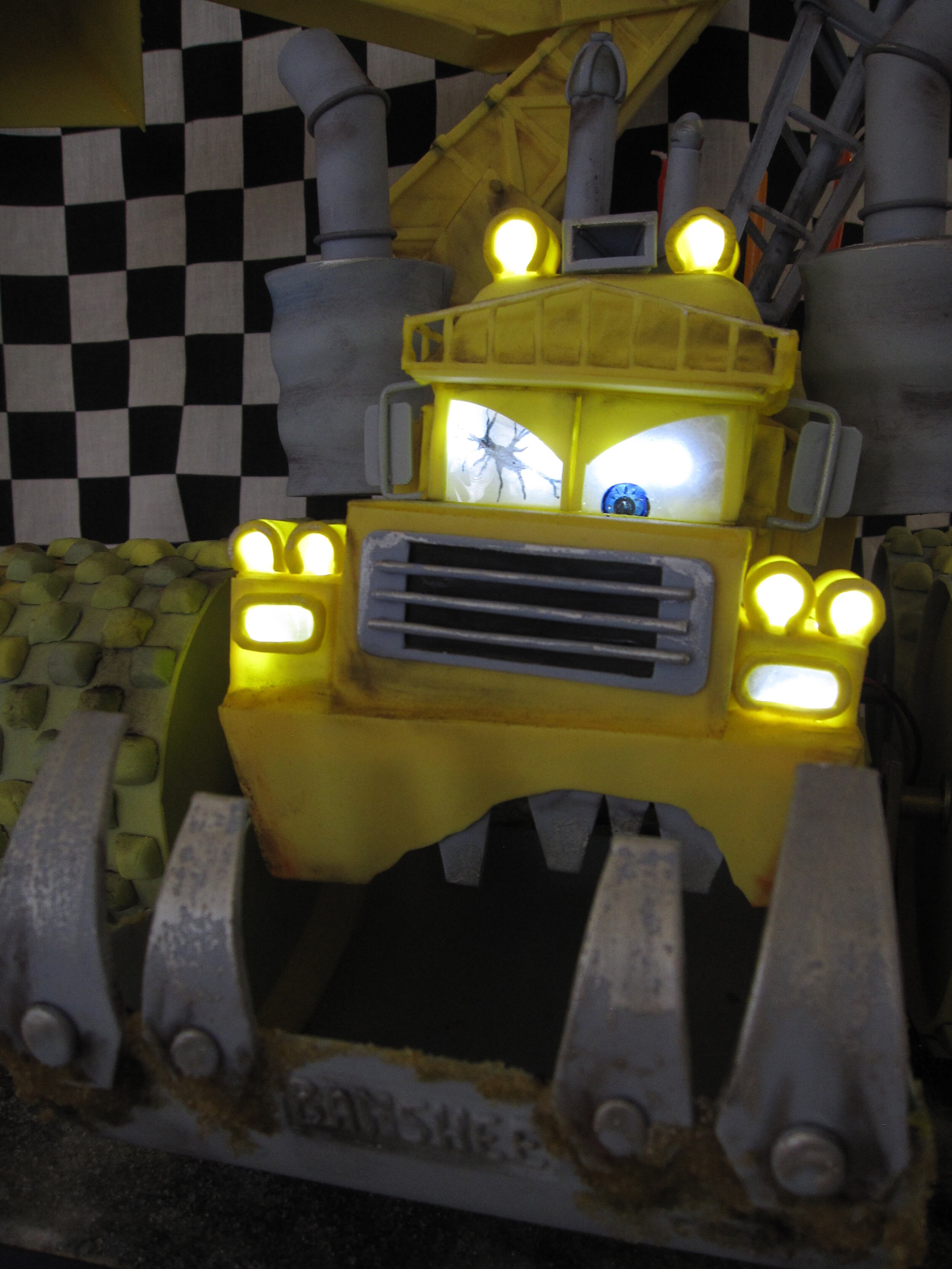
My niece Alex’s specifications for her fifth birthday cake: “I want a Banshee cake. And one switch will make the lights turn on and one switch will make the wheels turn and one switch will make the mouth open and close.”
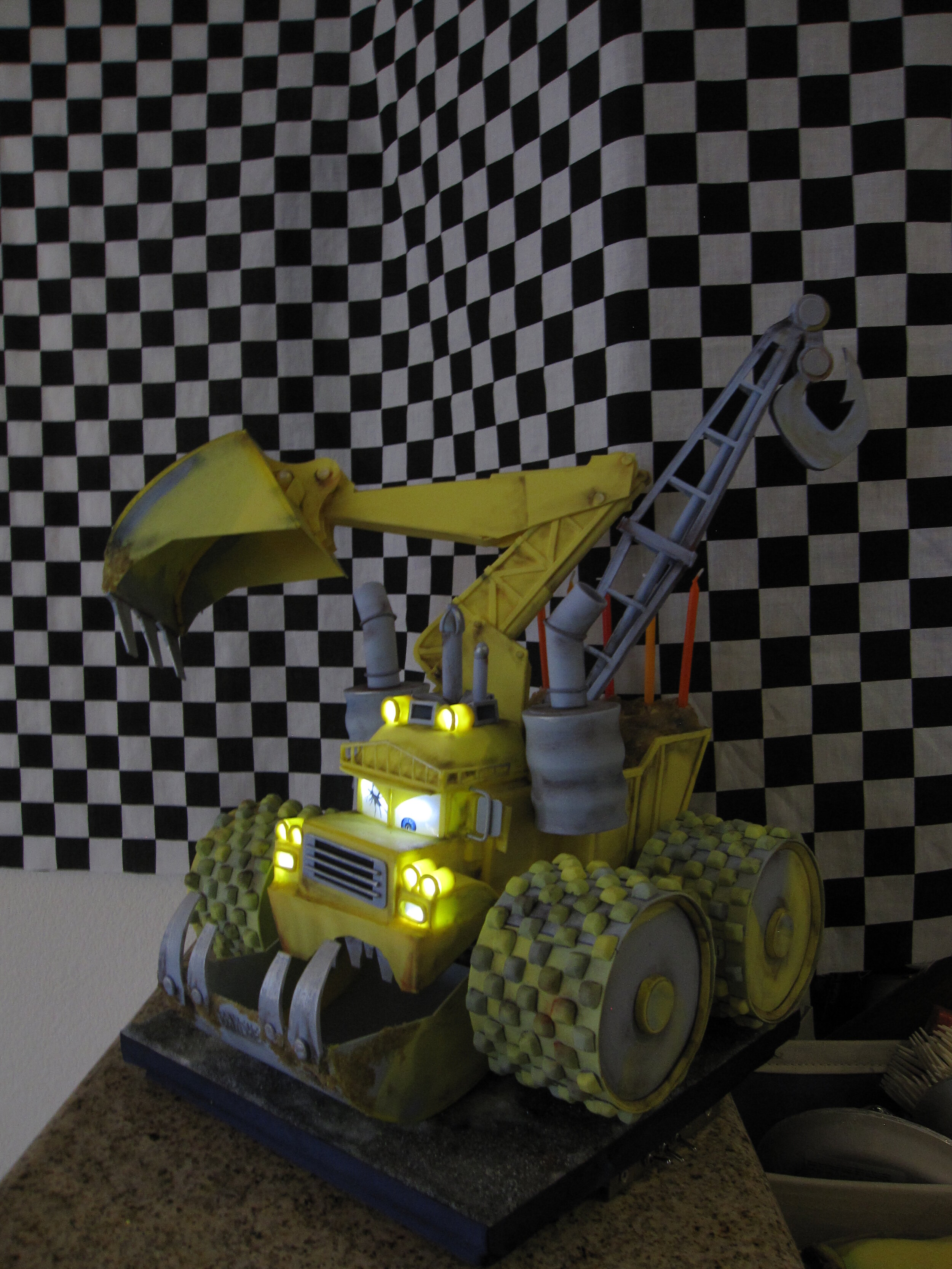
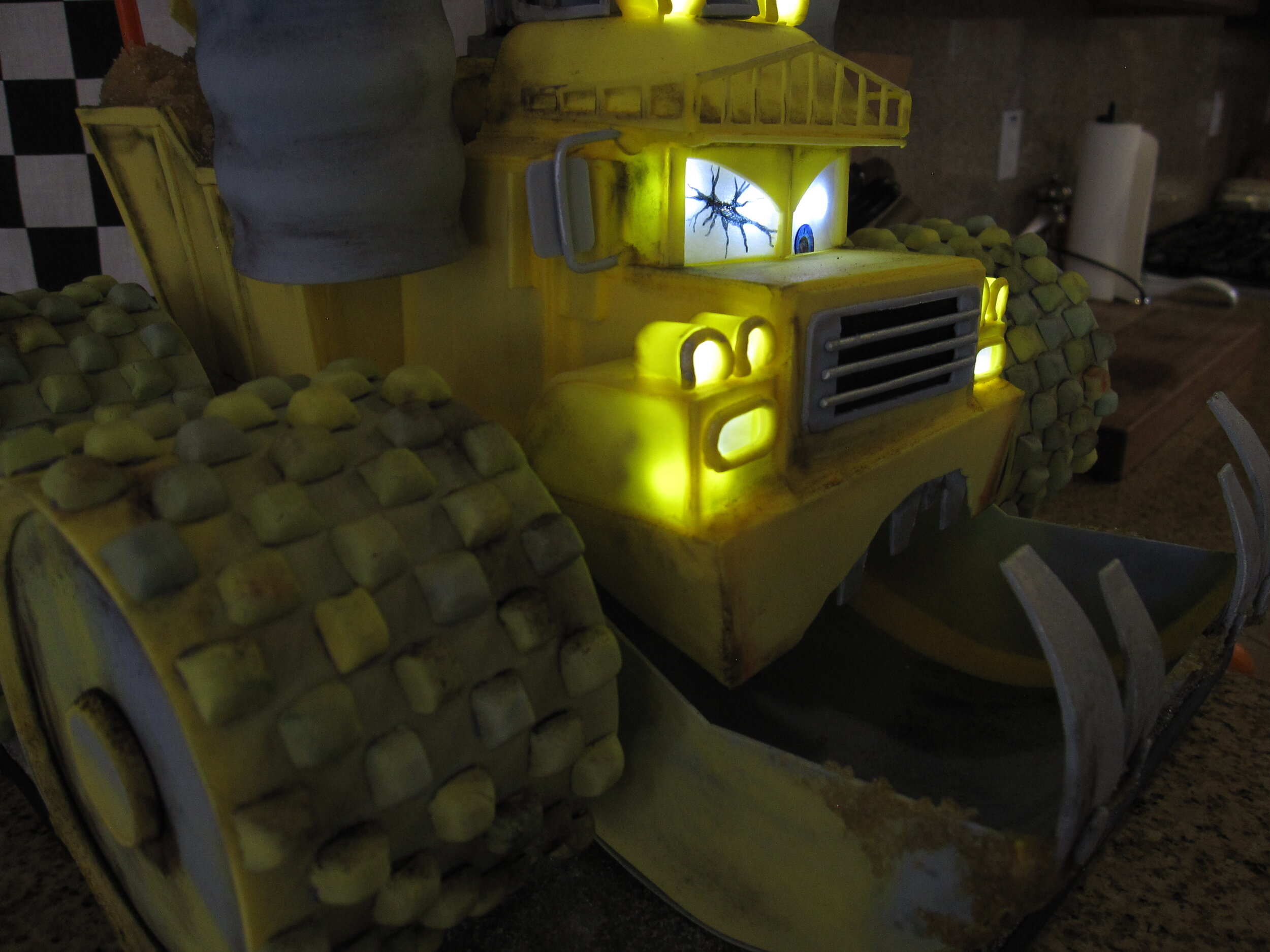
My niece Alex’s specifications for her fifth birthday cake:
“I want a Banshee cake. And one switch will make the lights turn on and one switch will make the wheels turn and one switch will make the mouth open and close.”
Given her previous four birthday cakes, this is a reasonable request, though as you’ll read later in this account, I only managed to deliver on one of the switch operations. Of course, when I made her other birthday cakes, I was living in the same house with Alex. But now, while Alex still lives in California, I am in grad school in Madison, Wisconsin. Fortunately, my spring break aligns fairly well with Alex’s birthday, so I was able to be there for her party, but this meant that I had to make the cake in Wisconsin and then bring it with me to California on the airplane. One thing this forced me to do was to scale the cake such that it would fit in the overhead bin of an airplane, so Banshee was the smallest cake I’ve made in quite a while.

Banshee, of course, is a big work machine that appears at the end of Mater and the Ghostlight, which is an extra short on the DVD for the movie Cars. In fact, Banshee is not even in the short itself; he pops onto the screen only after the closing credits. He appears for all of twenty seconds and you only see him from one angle, which means that I had no idea, from watching the short, what the back half of Banshee looks like. Fortunately there is also a toy version of Banshee, so I bought one, planning to use it as a model for the cake and then give it to Alex for her birthday. However, since I failed to inform my sister and her husband that I had this toy for Alex, they bought her one as well. I gave mine to my little friend Isaac (age 4), who is also a huge Cars fan, so it actually worked out well for everyone.
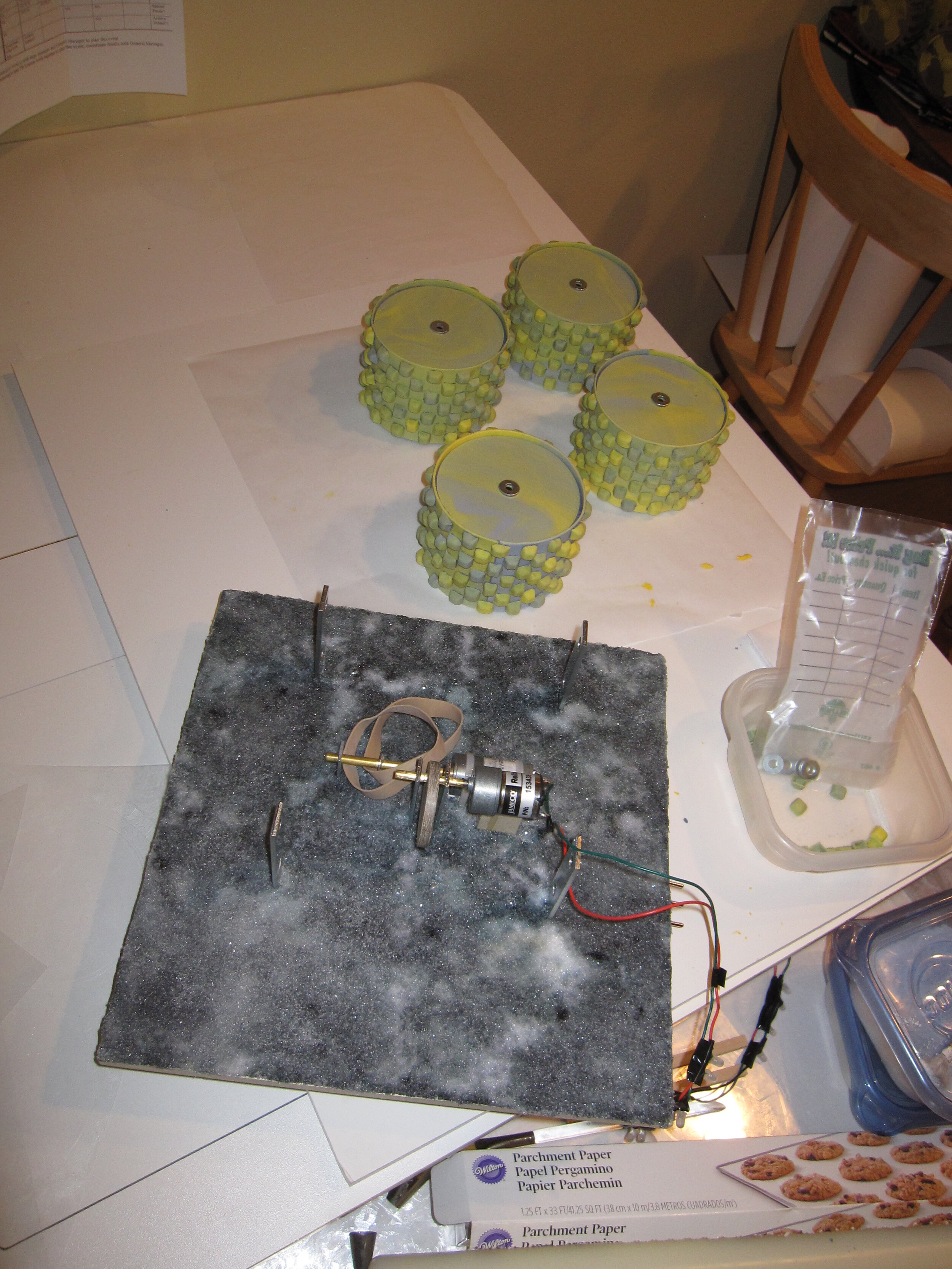
My first step was to create the electronics. By this point, I’m pretty adept at putting LEDs in my cakes, so the lights were easy. I reused the LEDs that I originally bought for the Tardis Cake. To make the wheels spin, I used a motor that I last used to power Big Rig on Alex’s fourth birthday cake, transferring power to the axles via rubber band drives. I still think it would have worked if my rubber bands had been slightly shorter. Rather than just make the mouth open and close I decided that the whole cake should rise and fall as well, so that Banshee looked like he was breathing, as he does in the movie. So I made an eccentric cam, hooked up to a motor that I had from powering Melvin the cement mixer’s drum, also on Alex’s fourth birthday cake. So as the cam rotated, it was meant to raise and lower the front end of Banshee’s body, which was anchored at the axle for his rear wheels, while simultaneously pushing his jaw up and down. If my motor had been strong enough to actually do this with the weight of the cake on it, it would have been really cool.
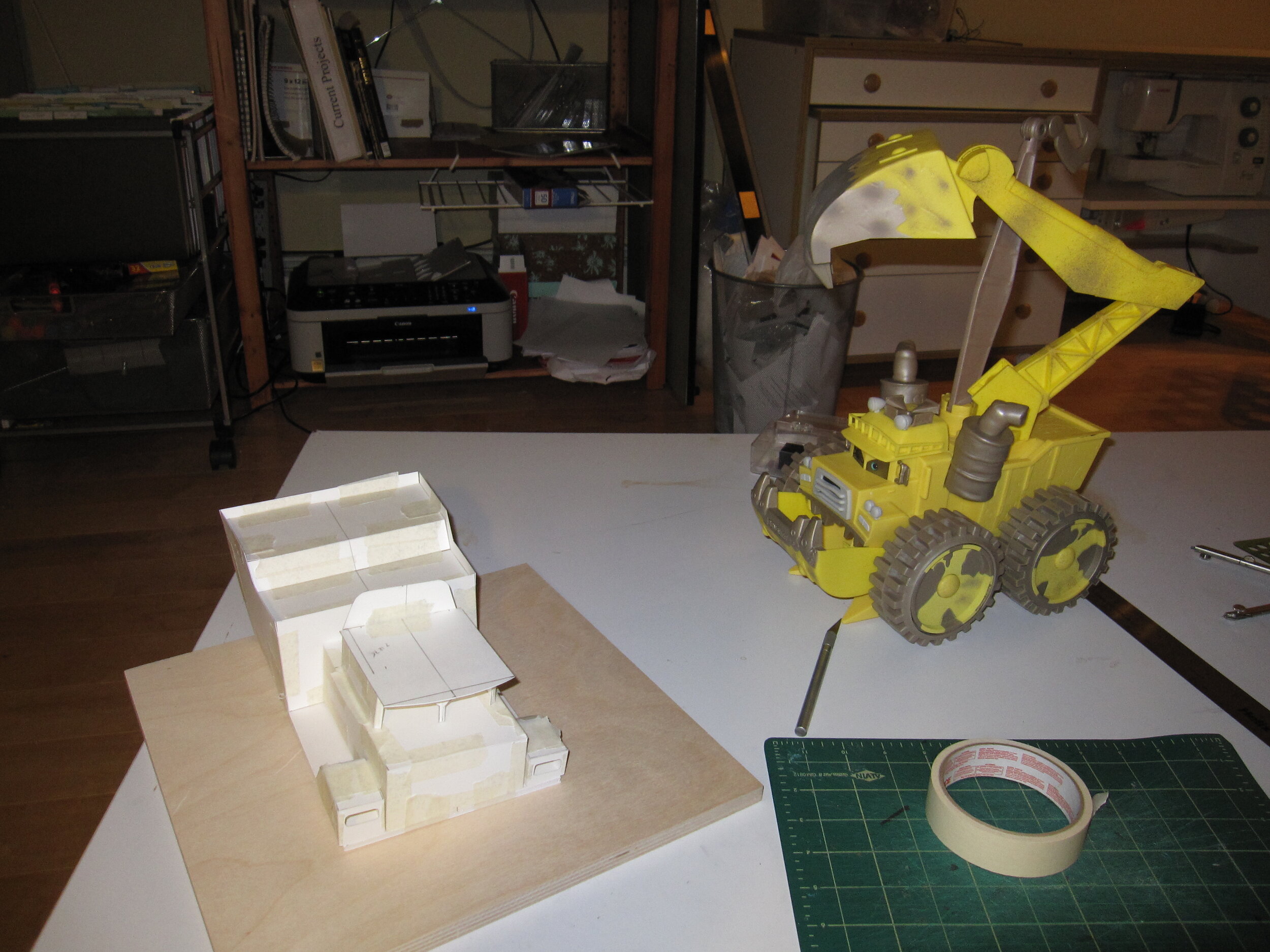
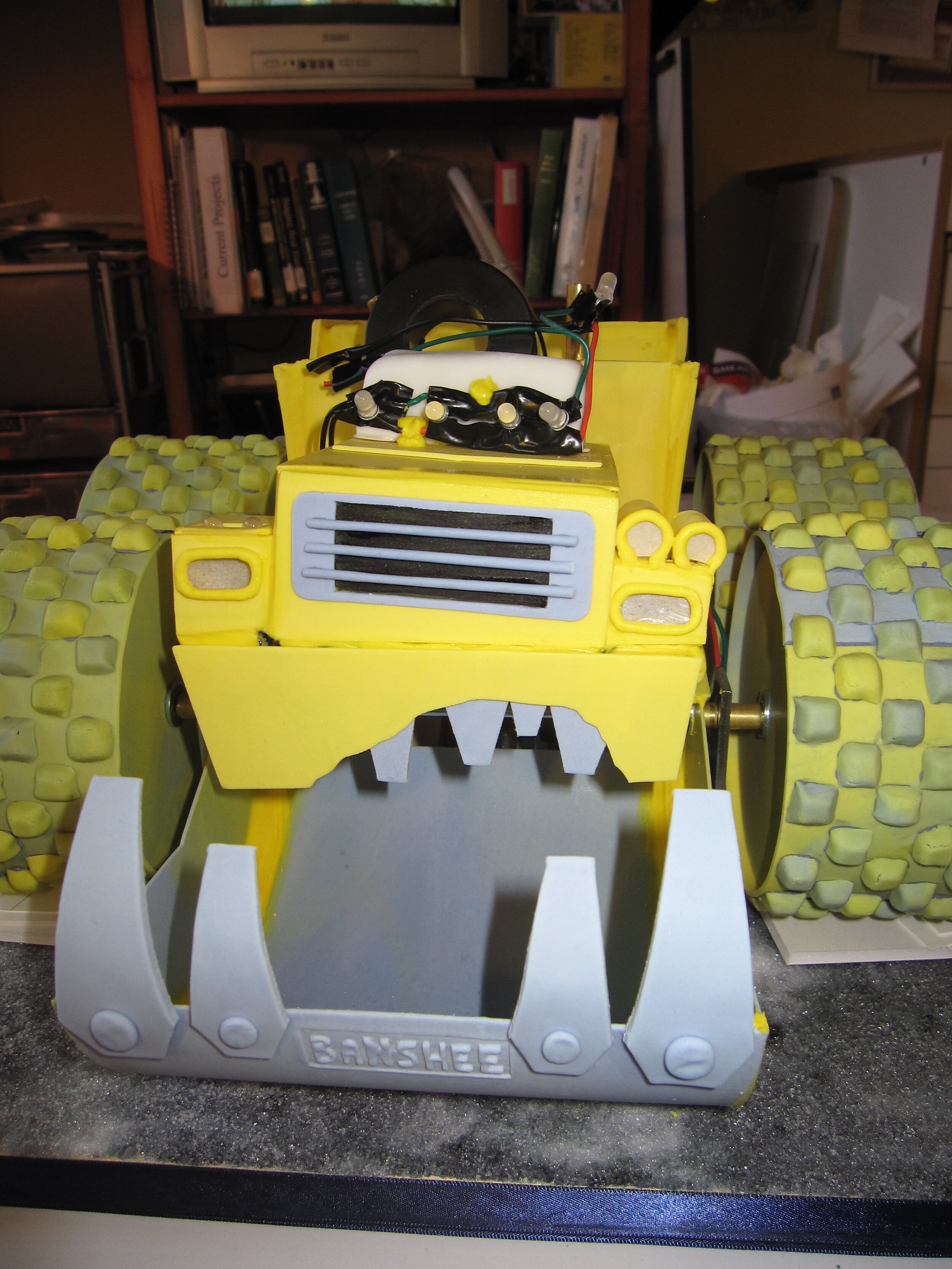
Before I made anything in edible materials, I made a full scale mockup of the entire cake in Bristol board. Then I cut it apart to use as a pattern to make the entire exterior of the cake out of gum paste. One nice thing about Banshee is that he only requires two colors of gum paste – construction vehicle yellow and old, dirty metal grey. This helped the gum paste cutting stage to go by fairly quickly. The most tedious part was making the approximately four hundred and twenty little truncated pyramids for the treads of the tires.

Once all the gum paste was dry, I assembled substructures as much as possible with royal icing. Because I was going to be transporting this cake across the country, I used more non-edible supports than I might have normally.
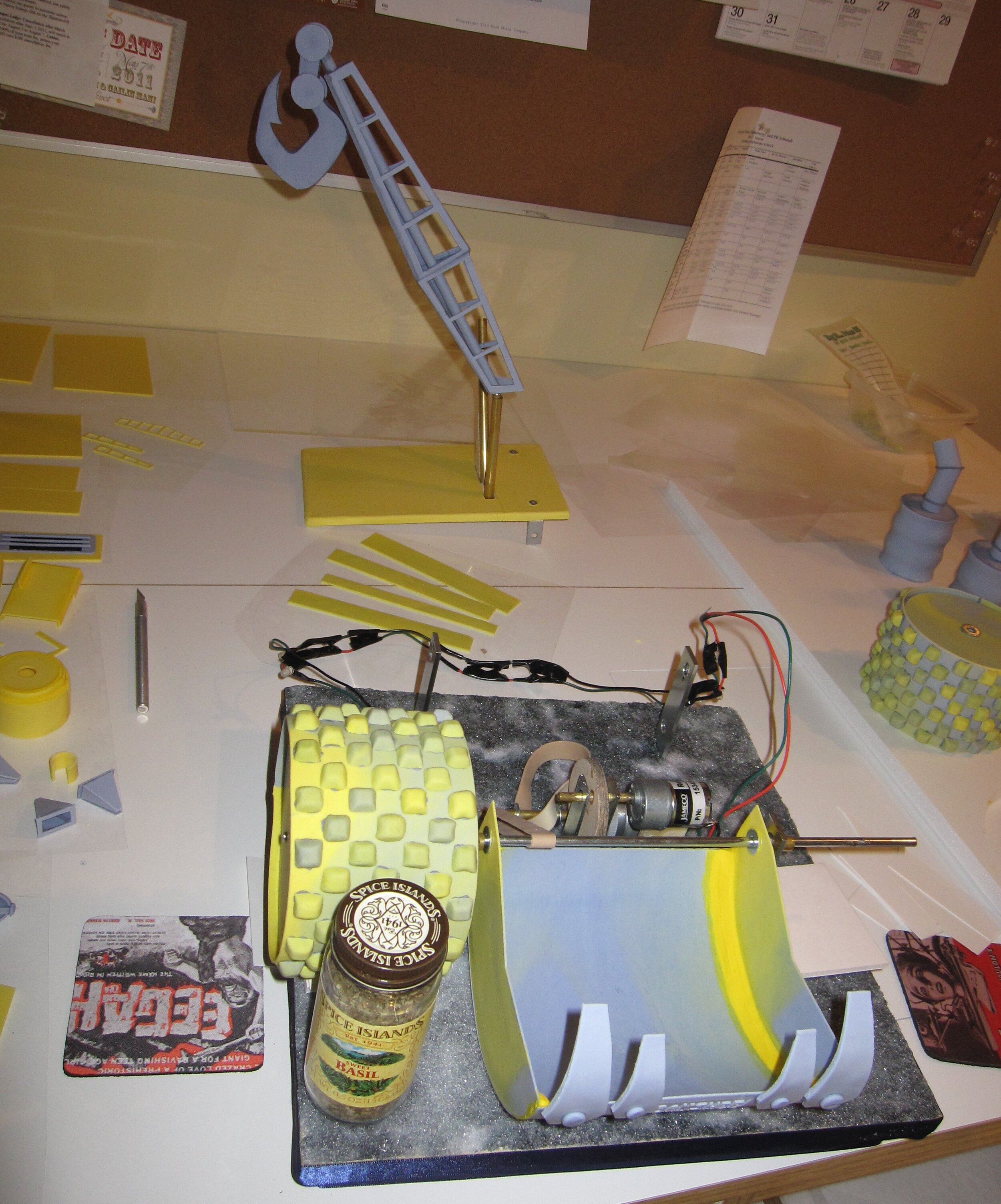
The tow hook and the scoop, for instance, were assembled around brass rods. Incidentally, although I’m breezing over all this in a paragraph, in reality I spent about a month on this stage of the project.

Two days before my flight to California I baked the actual cake. Because I wanted to be sure of a very stable cake for transport I used a chocolate ganache filling, rather than a buttercream. I made three separate little cakes – one for the bottom of the cab, one for the top of the cab, and one for the dumper bed in back. I covered them in fondant because you don’t want gum paste directly in contact with the cake because icing softens the gum paste.
Cake assembly went well. Only a few gum paste pieces were inexplicably the wrong size, but I was able to shave them down to size with a minimum of trouble.
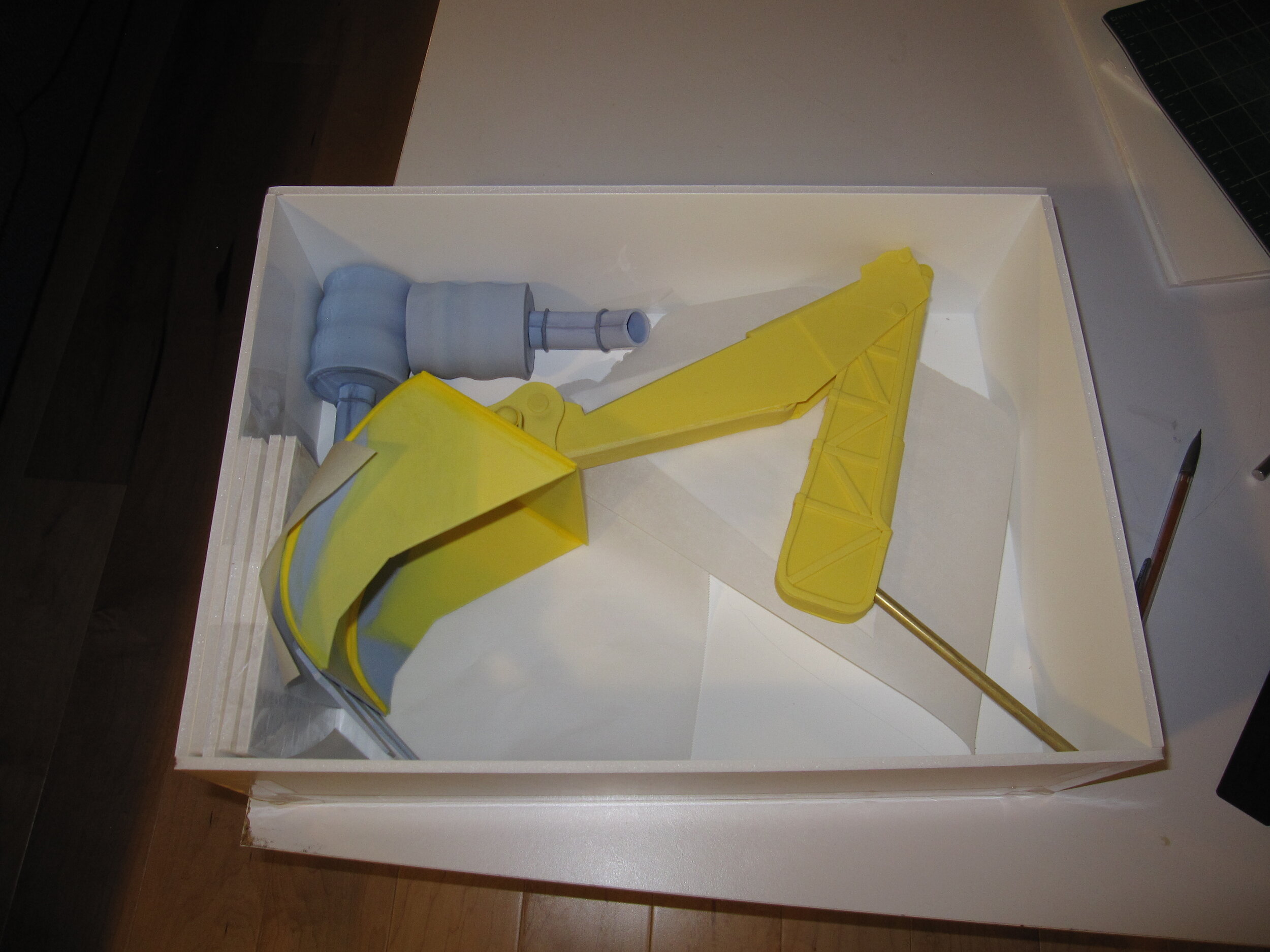
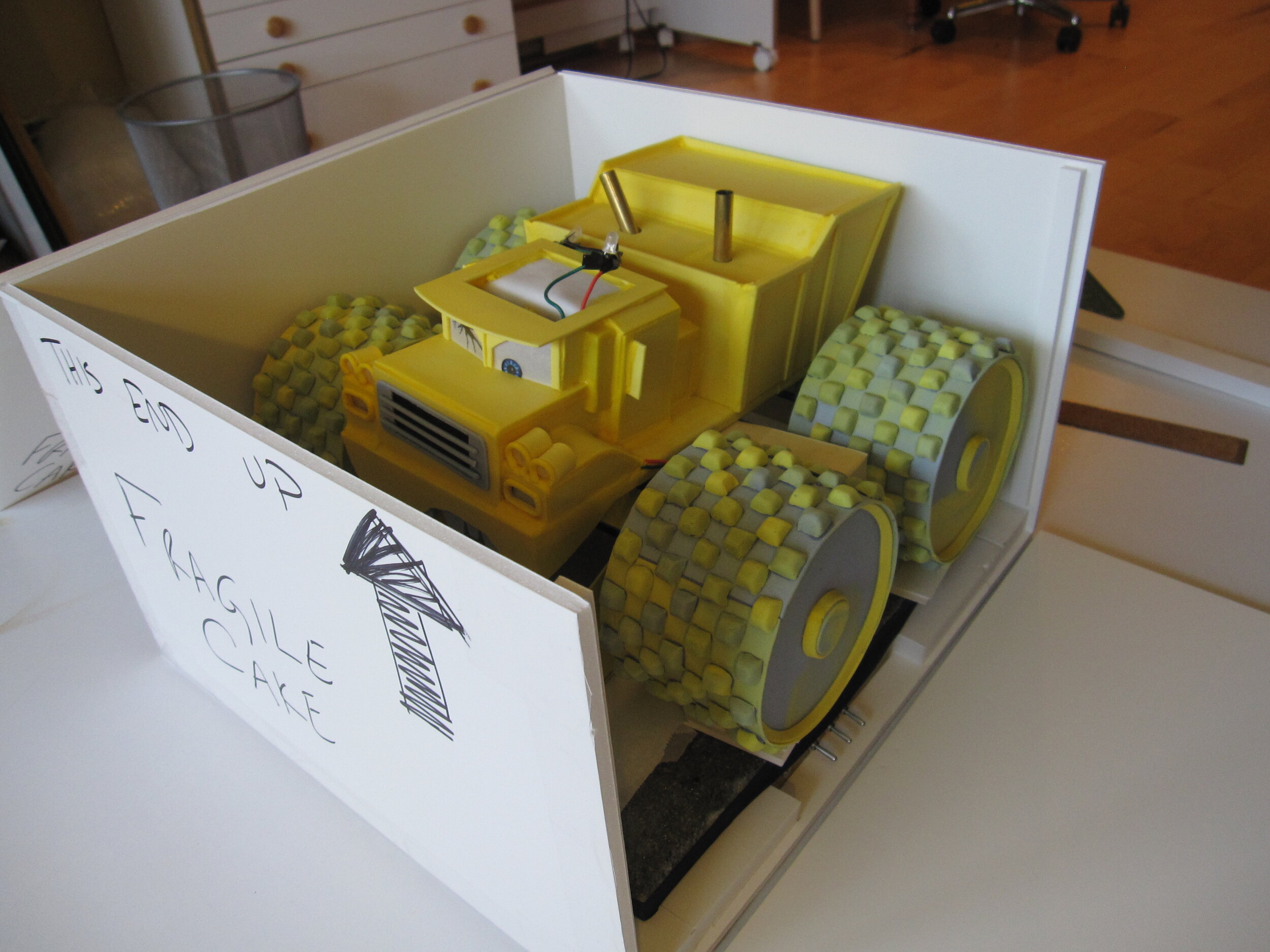
Much more problematic than assembling the cake was packing the cake for travel. This was the first time I had ever tried to move a cake except by car so I was nervous. I had to use basically every inch of my two carry on allotment. For my main carry on I made a foam core box that was about 9”x14”x15” to carry the cake. I also needed to use my extra briefcase carry on allotment to bring Banshee’s scoop arm and tow hook, as well as all the components that made him more than 8 ½” tall. Terrified that my pieces would break en route and I wouldn’t have a cake to give to Alex, I spent at least six hours making boxes, carefully packing components, padding, etc. It was time well spent.
The trip was probably the most stressful flight I have ever endured, with the possible exception of the first solo plane trip I ever took when I was sixteen and flew from Michigan to California to visit my sister in her first year at Stanford. Initially, I had imagined that I would relax once I successfully got the boxed cake through security. This turned out not to be the case.
Security screening went pretty well, although I was so nervous that my hands were shaking. If I hadn’t been allowed to take the cake on the plane, it would have been game over. Fortunately, I was flying out of the Madison, Wisconsin airport, which is by far the most laid back airport I’ve even been to. The only other airport I’ve been to that even comes close is in Paro, Bhutan, an airport so remote and exclusive that only two airplanes are allowed to land there. I got to the airport about three hours early to be sure to have plenty of time to get through security. Obviously, they needed me to open the boxes, but the security personnel were very respectful of the cake’s fragility and complimentary of its appearance. After they swabbed my hands, the cake boxes, and the switches I was cleared through security and safely on my way.
At this point I realized that I couldn’t relax because I was traveling by myself and didn’t want to take my cake into the bathroom with me to pee. Fortunately, I ran into a friend in the airport bar whose flight to Albuquerque had been delayed, so she was able to watch my cake while I ran to the ladies’ room.
Getting onto the plane was also terrifying because the first leg of my itinerary was Madison to Chicago, which is a short commuter flight on a very small plane. When the gate attendant in charge of gate checking carry ons came around the gate area, he told me that I would probably not to able to fit both of my carry ons onto the plane, which to me would have been a complete disaster. However, after a half hour of sitting in the gate area in terror, I was able to stow the cake under the seat in front of me and my other item in the overhead bin. I cannot tell you how relieved I was that this worked out.
In Chicago, I had to carry the cake from one end of the airport to the other to get to my next gate, but at least it fit more easily onto this plane than the last one. A flight attendant even saw it in the overhead bin and offered to put an ice pack on the box to keep the cake cool.
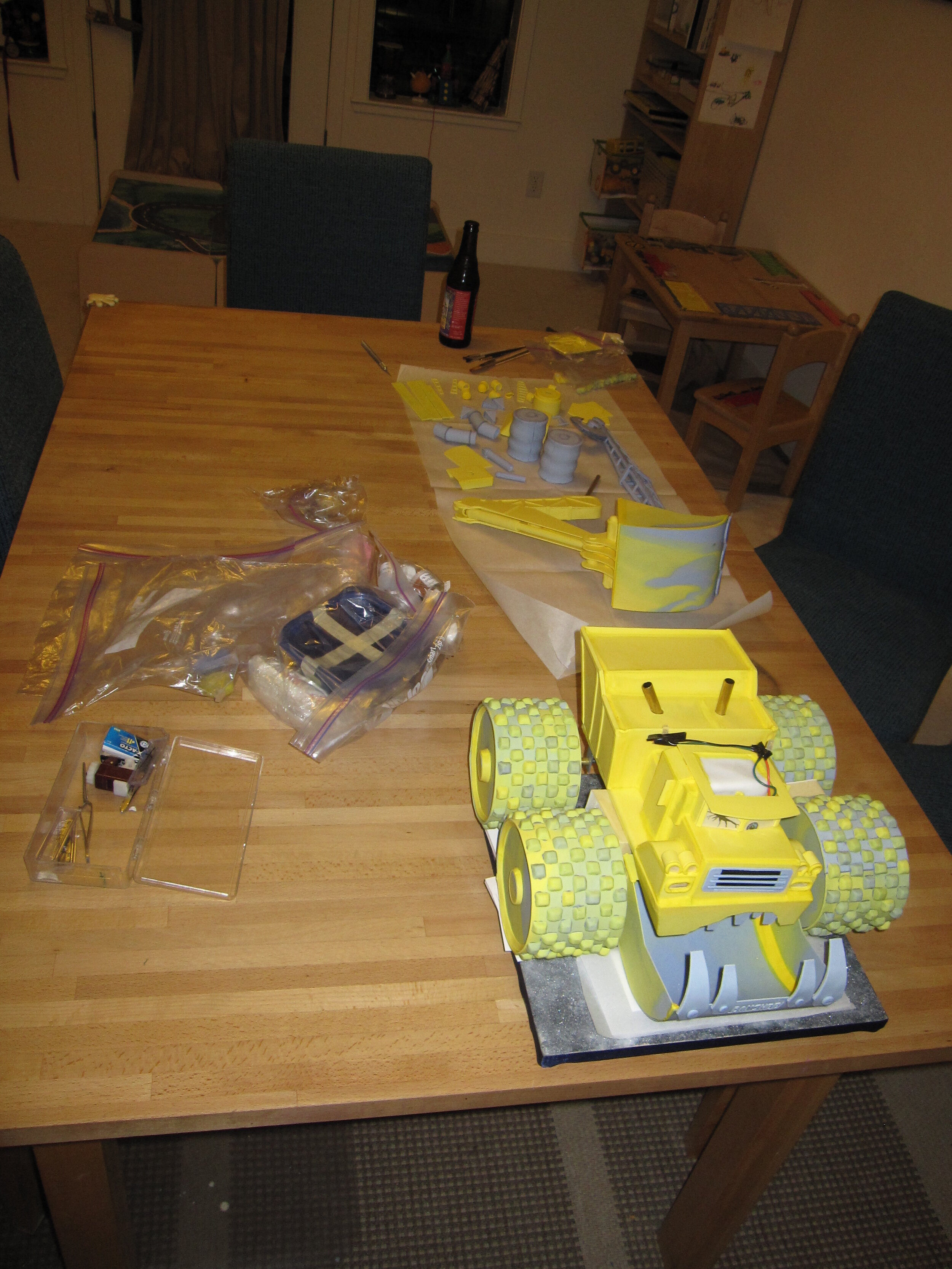
I arrived in California late Friday night and the party was scheduled for Sunday afternoon. On Friday, all I could do was open the box to verify that the cake hadn’t completely collapsed before I fell asleep. I spent Saturday playing with the kids, so I didn’t get to unpack the cake completely until Saturday evening after the kids went to bed.
Amazingly, the cake came through the journey completely unscathed. Literally only one piece broke, and it was a piece that I had extras of, so it didn’t even matter. Even in my best case scenario, I had expected to have to effect at least minor repairs. I was completely flabbergasted by how well the cake traveled.
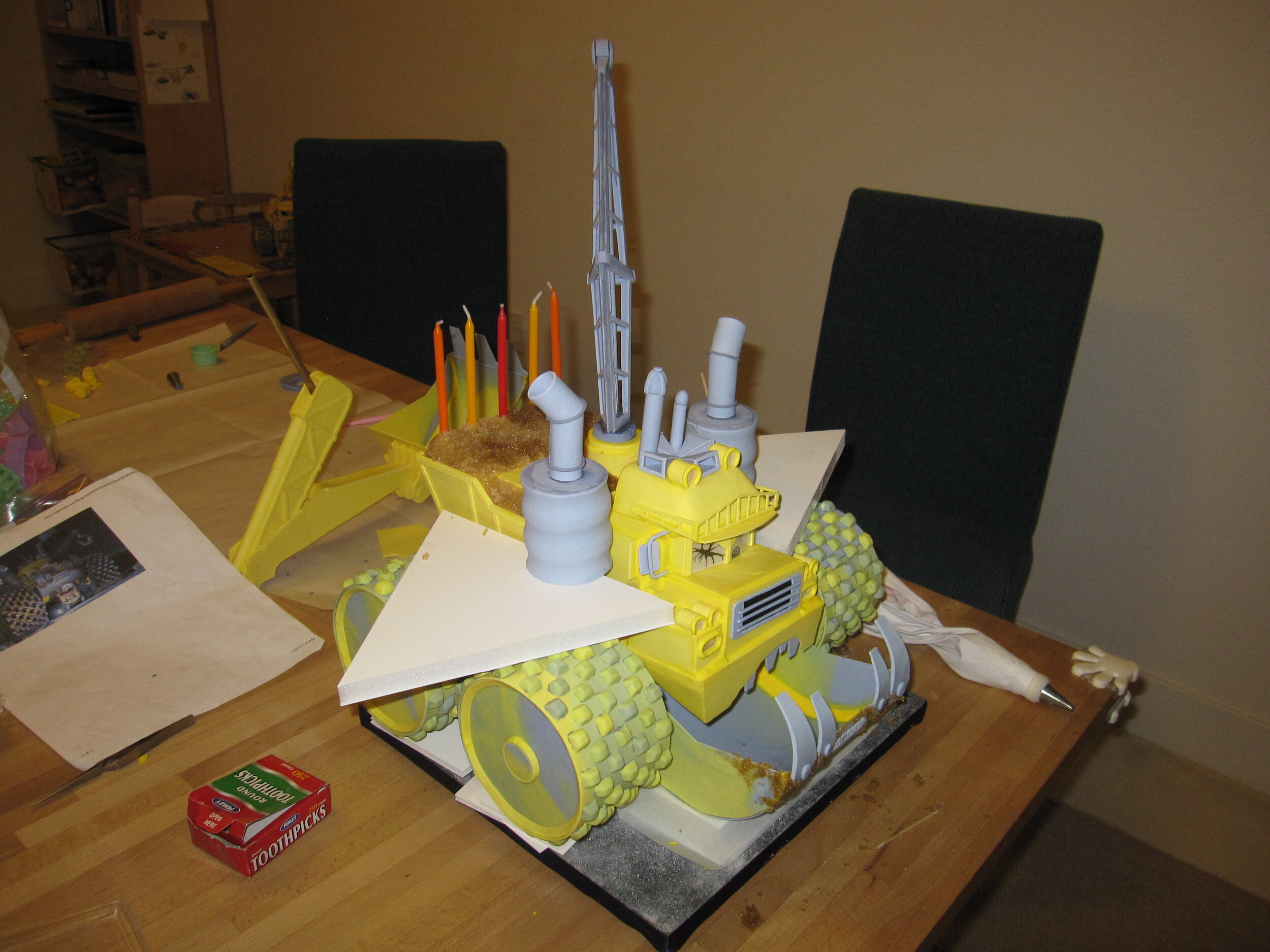
I spent Saturday night completing the assembly of the cake, installing the hook and the scoop, and adding finishing touches to the paint job. I also used some pressed sugar colored with brown food coloring for dirt on the teeth and in the dumper bed, where I also installed the five candles.

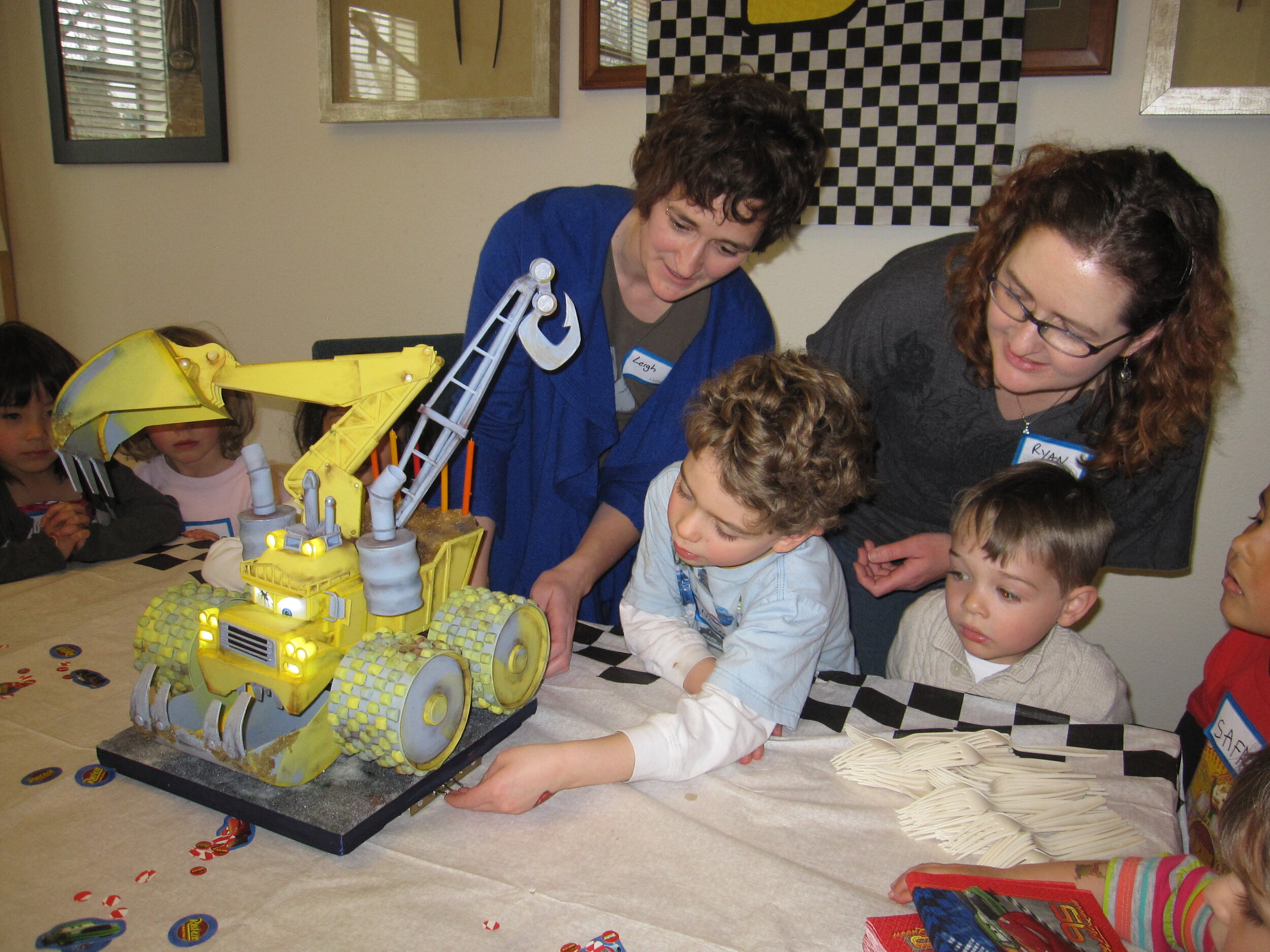
The party was fantastic. Our friend Sara brought awesome Cars decorations and balloons. My sister had invited Alex’s entire preschool class plus several other friends, so there were about 20 children. I’m not sure how they even all fit in the house.
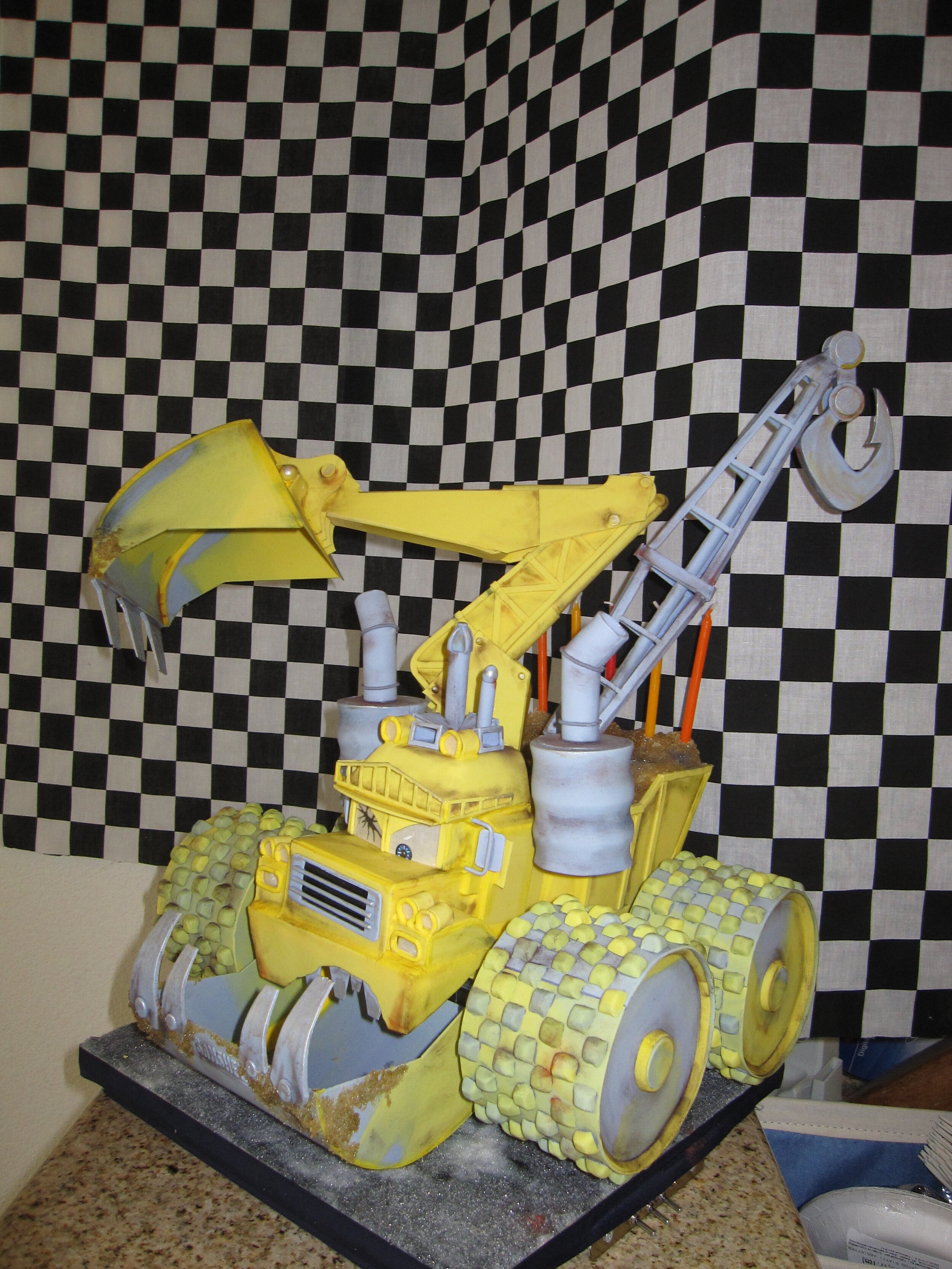
Sadly, Banshee’s wheels didn’t spin (I think the rubber bands weren’t tight enough) and he didn’t go up and down (I think the cake was too heavy for the motor), but otherwise he was very well received. The most important thing is that Alex was happy. Happy and full of sugar.
Peep and the Big Wide World Cake
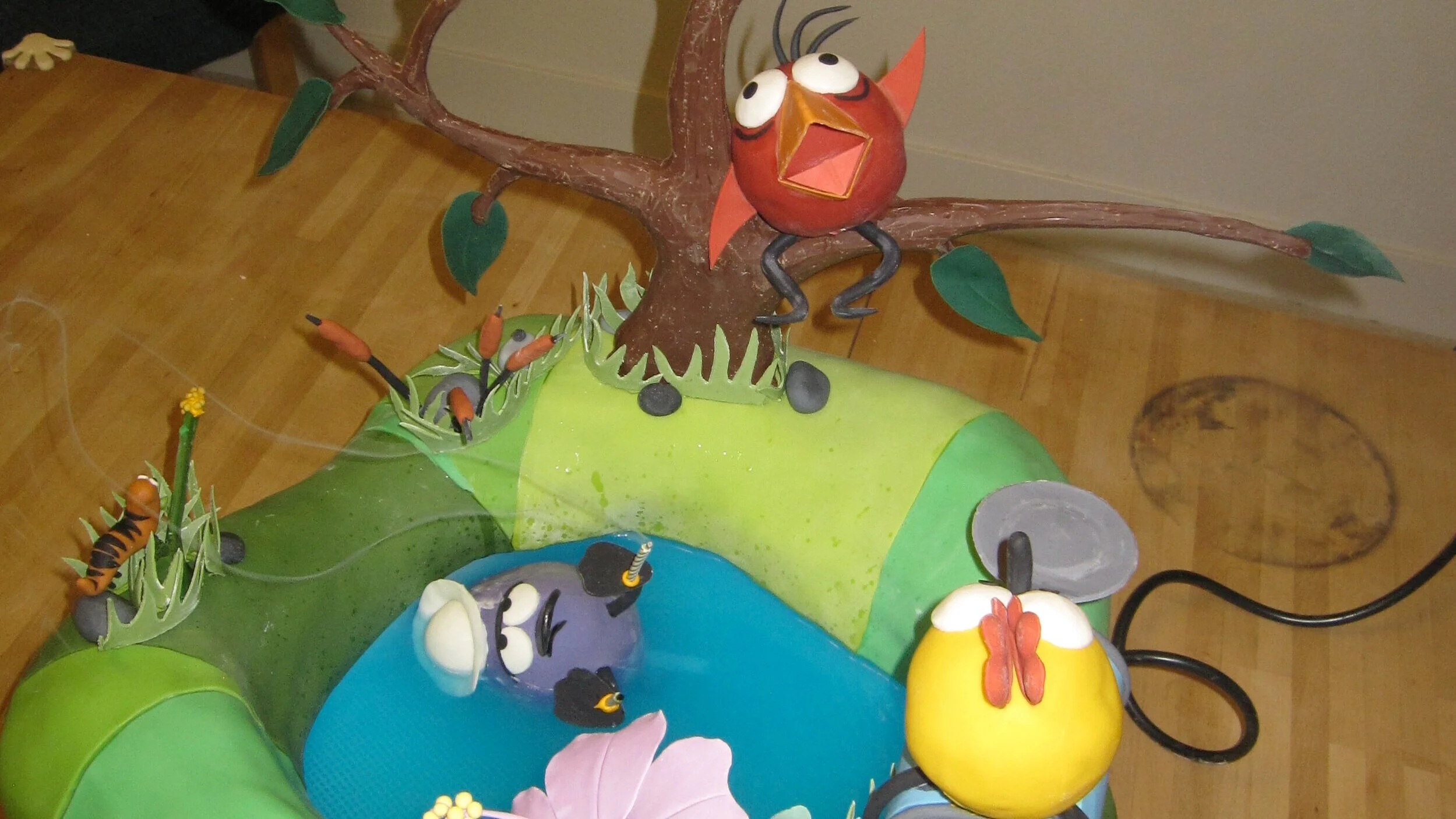
When it came time to design my nephew Sam’s second birthday cake, I turned to Sam’s older sister, Alex, to help me conceptualize the cake. Alex came up with the idea that Sam might like a duck cake, which I thought was a very good idea. Sam loves animals of all kinds. After further discussion, I suggested that we should make a cake based on the TV show Peep and the Big Wide World, which could include not only Quack (a duck), but also Peep (a chick) and Chirp (a baby bird).
When it came time to design my nephew Sam’s second birthday cake, I turned to Sam’s older sister, Alex, to help me conceptualize the cake. Sam, while remarkably verbal for a two-year-old, still cannot be relied up to respond to specific questions in a direct manner.
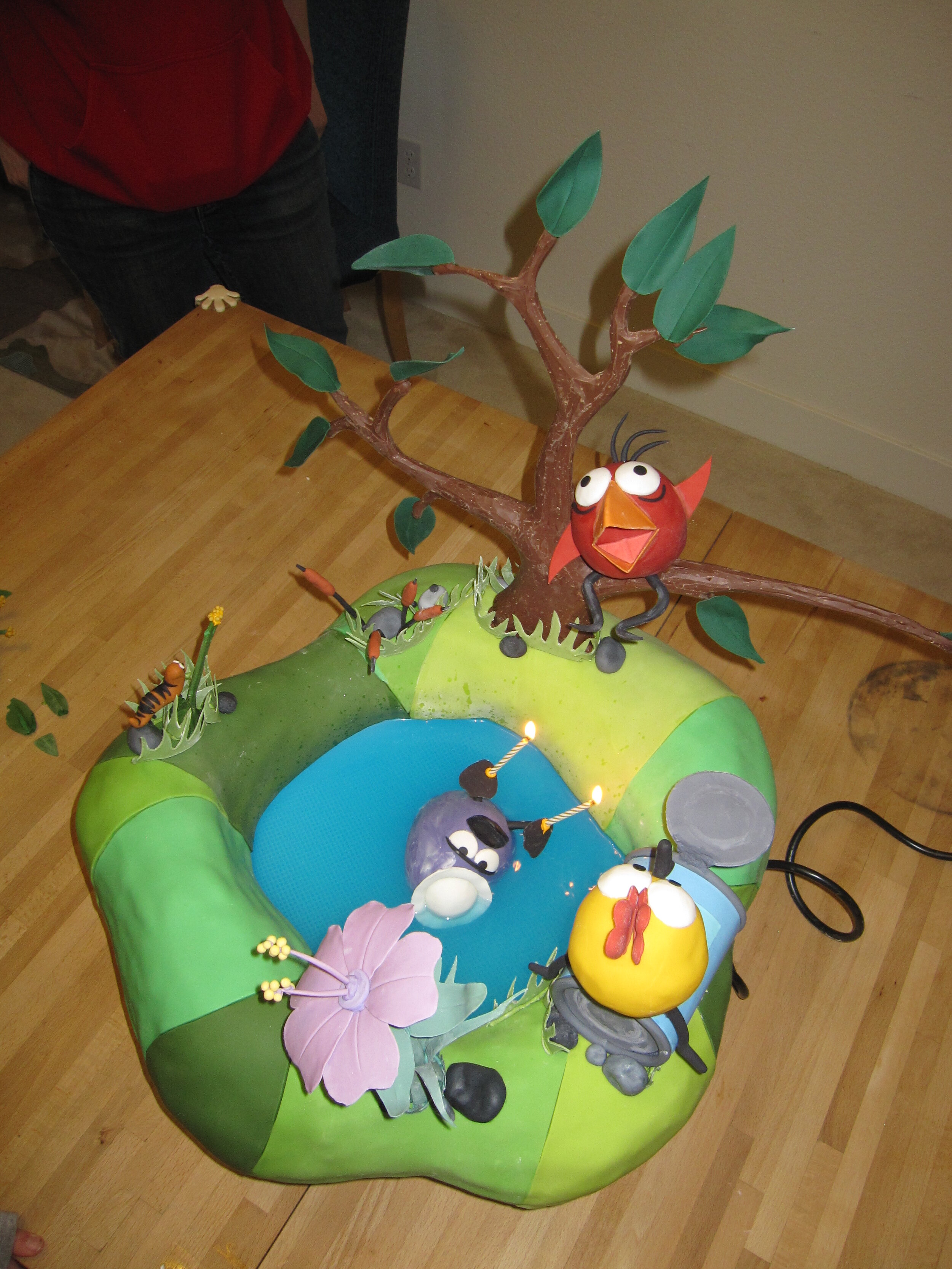
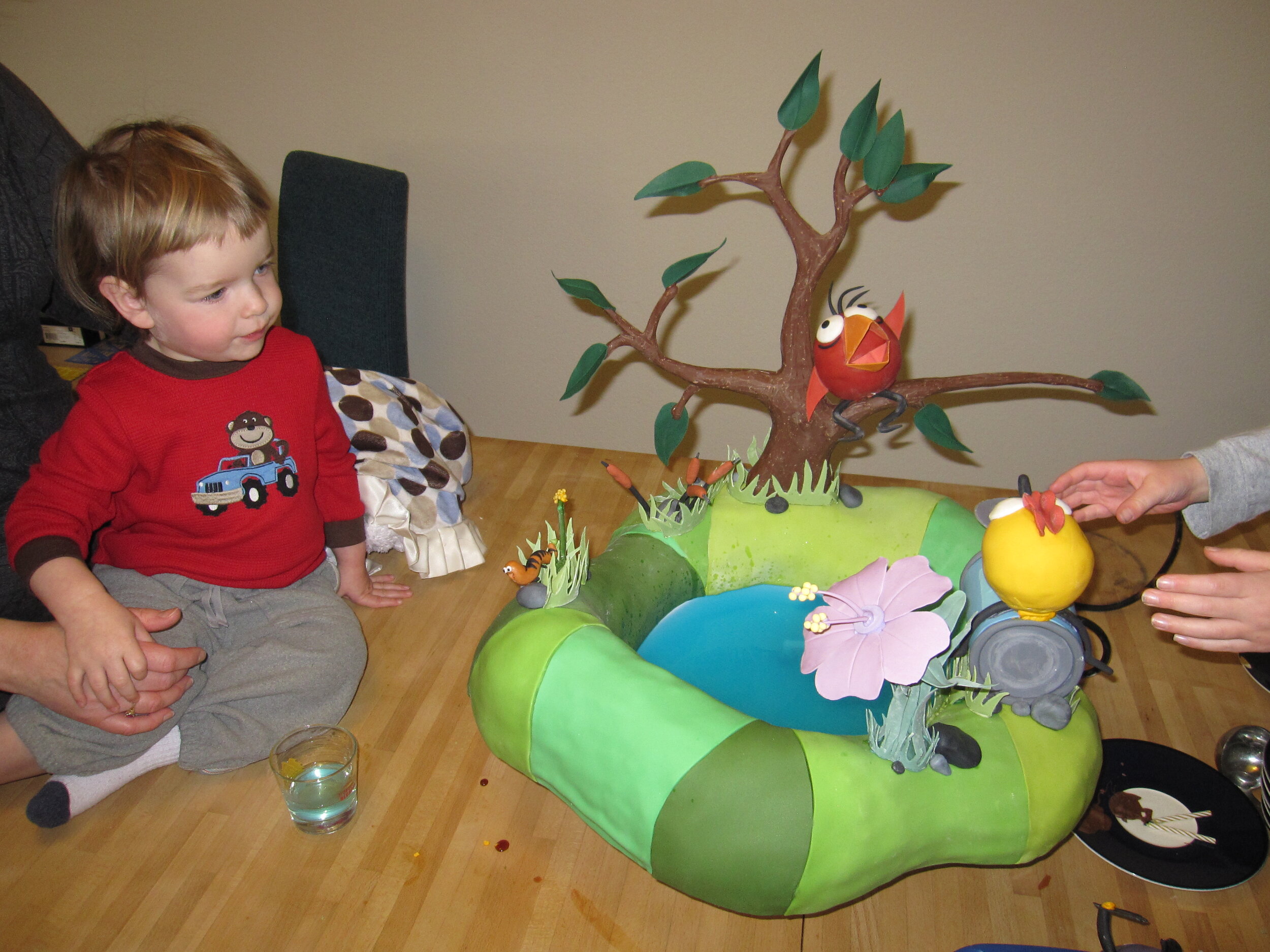
At first, Alex suggested various vehicle-based concepts because Alex loves vehicles. Eventually, I was able to convince Alex that we should base the cake design primarily on things that Sam likes, which may not correlate directly to things that Alex likes. At this point, Alex came up with the idea that Sam might like a duck cake, which I thought was a very good idea. Sam loves animals of all kinds. After further discussion, I suggested that we should make a cake based on the TV show Peep and the Big Wide World, which could include not only Quack (a duck), but also Peep (a chick) and Chirp (a baby bird). Since Quack is very much attached to his pond, I decided that it would be fun to make Quack float in a lake of blue Kool-Aid. As it turns out, blue Kool-Aid is difficult to find, but Gatorade makes an absolutely disgusting flavor that was the perfect color for Quack’s pond, so I used that instead.
This is almost the first cake I’ve made that was primarily landscape-based, rather than primarily object- or character-based. Each major character in Peep and the Big Wide World has a special landscape feature with which he or she is associated. Quack has his pond; Chirp perches in her big tree; Peep lives in an old tin can. I also decided to include “the most beautiful flower,” because I really like that episode, and a caterpillar. The caterpillar is a minor character in the show, but Sam had recently said “caterpillar,” which he pronounced something like “patta-putter,” when I was reading to him. I thought this was absolutely adorable and I hoped that, if I put a caterpillar on his cake, he might say it again.
All of this required a great deal of advance work in gum paste and in chocolate. Most of the gum paste work was fairly conventional – cutting leaves and flower petals out of gum paste and draping them over various things to get graceful curves. The can was easily accomplished by wrapping gum paste around an actual tin can.

I was quite proud of Chirp’s tree. Rather than making the tree out of gum paste or fondant, I decided to make it out of chocolate. While I have taken classes in chocolate-work and I frequently make truffles and such, this was my first attempt at making anything this big out of chocolate, at least since the white chocolate rib cage of the Thorax Cake. The first step in casting the tree was to cut the basic shape out of foam core. Then I made a soft bed of cocoa powder by sifting it into a baking tray. I pushed the foam core positive into the cocoa powder to make the negative mold, then piped tempered milk chocolate into the depression in the cocoa powder. Then I flipped the piece of foam core over and did the same thing again to make the other side of the tree. Once those pieces had set, I glued them together with more milk chocolate. After carving off the excess cocoa powder and smoothing out the rough edges with a knife, I was really pleased with the result. And, as it turns out, properly tempered chocolate is much more rigid than my usual building materials of gum paste and fondant. I’m going to have to start incorporating chocolate into my cakes more often.
To create the pond, I bought a big bowl. Then I cut a piece of ½” foam core with a hole in the middle to sit on top of the bowl to support the cake for the land. I also bought a little pump and put it into the pond. The idea was that, if the water was moving, Quack would float around the pond, rather than remaining stationary.
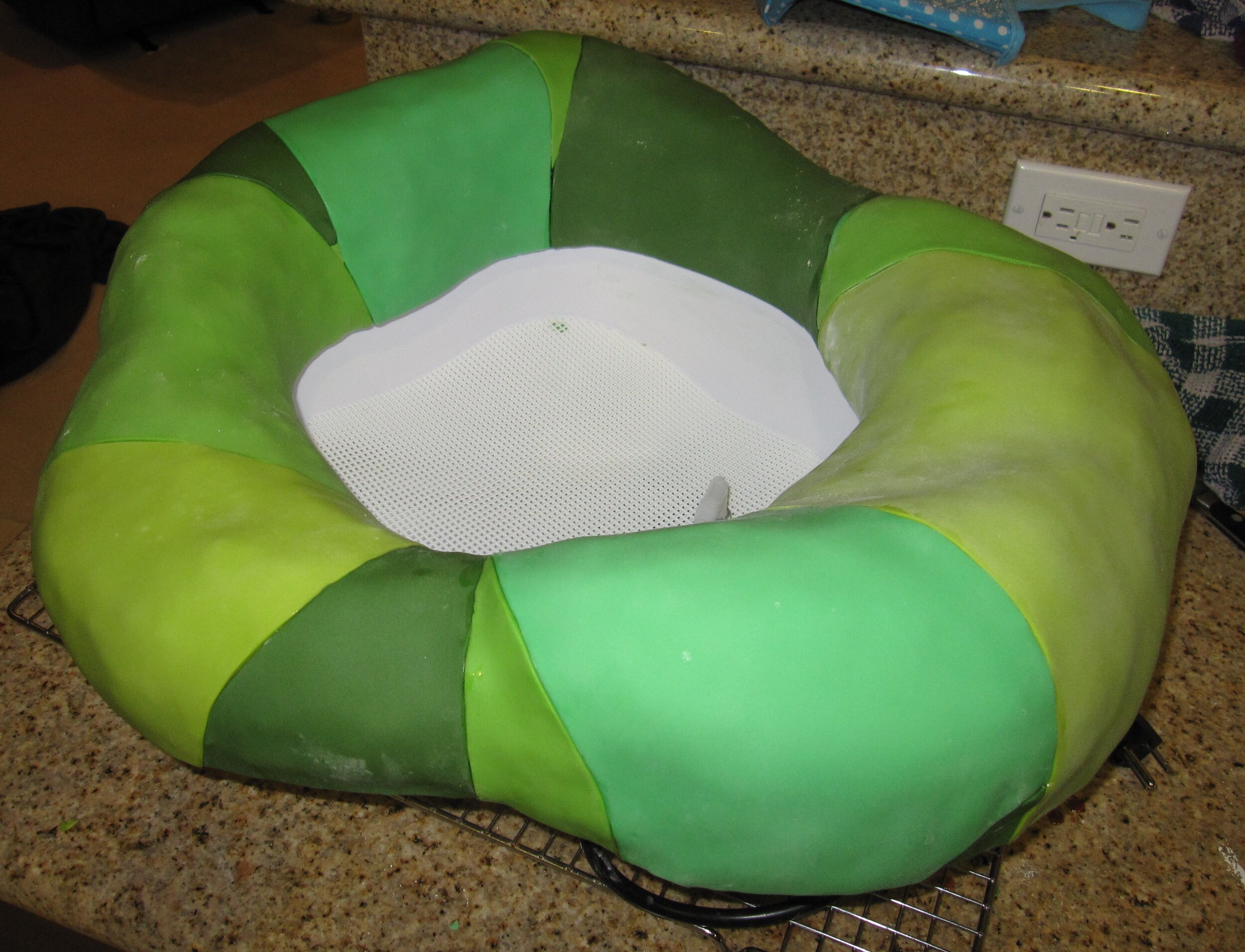
Sculpting the cake into a scenic hilly landscape was easy. Rather than attempting to cover the entire thing in a single piece of fondant, I decided to cover it in a patchwork of various shades of green. This didn’t perfectly mimic the landscape of the show, but I felt that it still captured the cartoony effect.

Installing the tree went remarkably well. I cut a big hole in the cake, poured tempered chocolate into it, and then stuck in the tree. A little more chocolate easily adhered the leaves. It worked perfectly. Have I mentioned that I need to use chocolate more often?
At this point in the project, two days before the birthday party was scheduled, Sam came down with a truly unfortunate case of croup. Sam and his parents spent the day before what was supposed to be his party at the hospital and I spent the day that I had planned to spend finishing Sam’s cake watching Alex and reassuring him that Mommy and Sam would be home soon. Obviously, we cancelled the party. But it was too late not to finish the cake, and the point of the cake was largely to amuse Sam and Alex, rather than our guests, so I decided to finish the cake anyway, even though there was no longer a party at which to serve it.
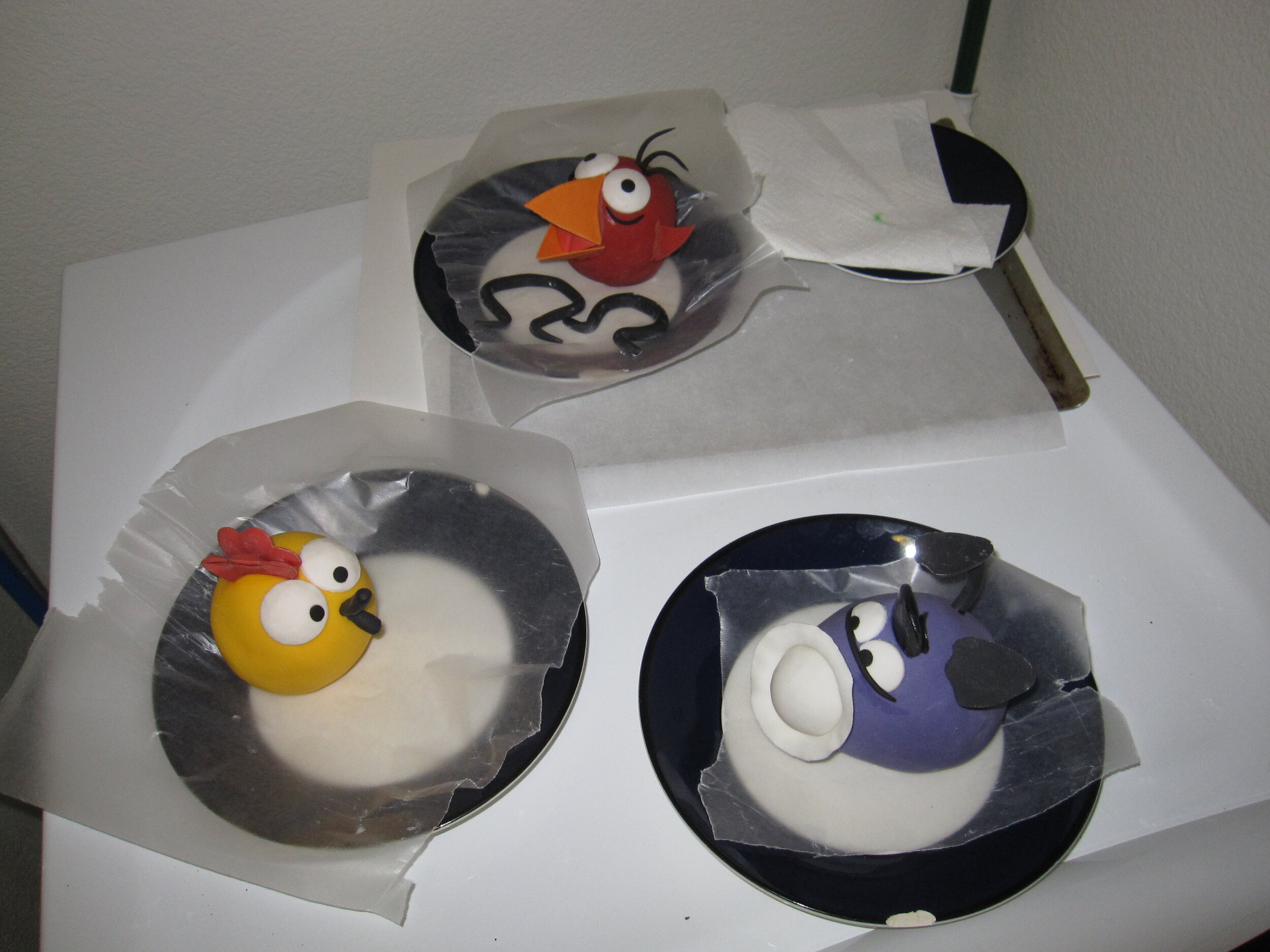
I had hoped to make Chirp and Peep entirely out of cake, but I discovered that it is basically impossible to make a sphere out of nothing but cake. So I cut some Styrofoam balls in half, covered them in tin foil, and used those for the bottom half of Peep and Chirp, with only the top half made of cake. I was quite pleased with how well I did in covering 3” diameter spheres in a smooth layer of fondant. I also think I did a pretty good job of capturing Chirp’s characteristic expression of frustration and exhaustion after she has failed in an attempt to fly.
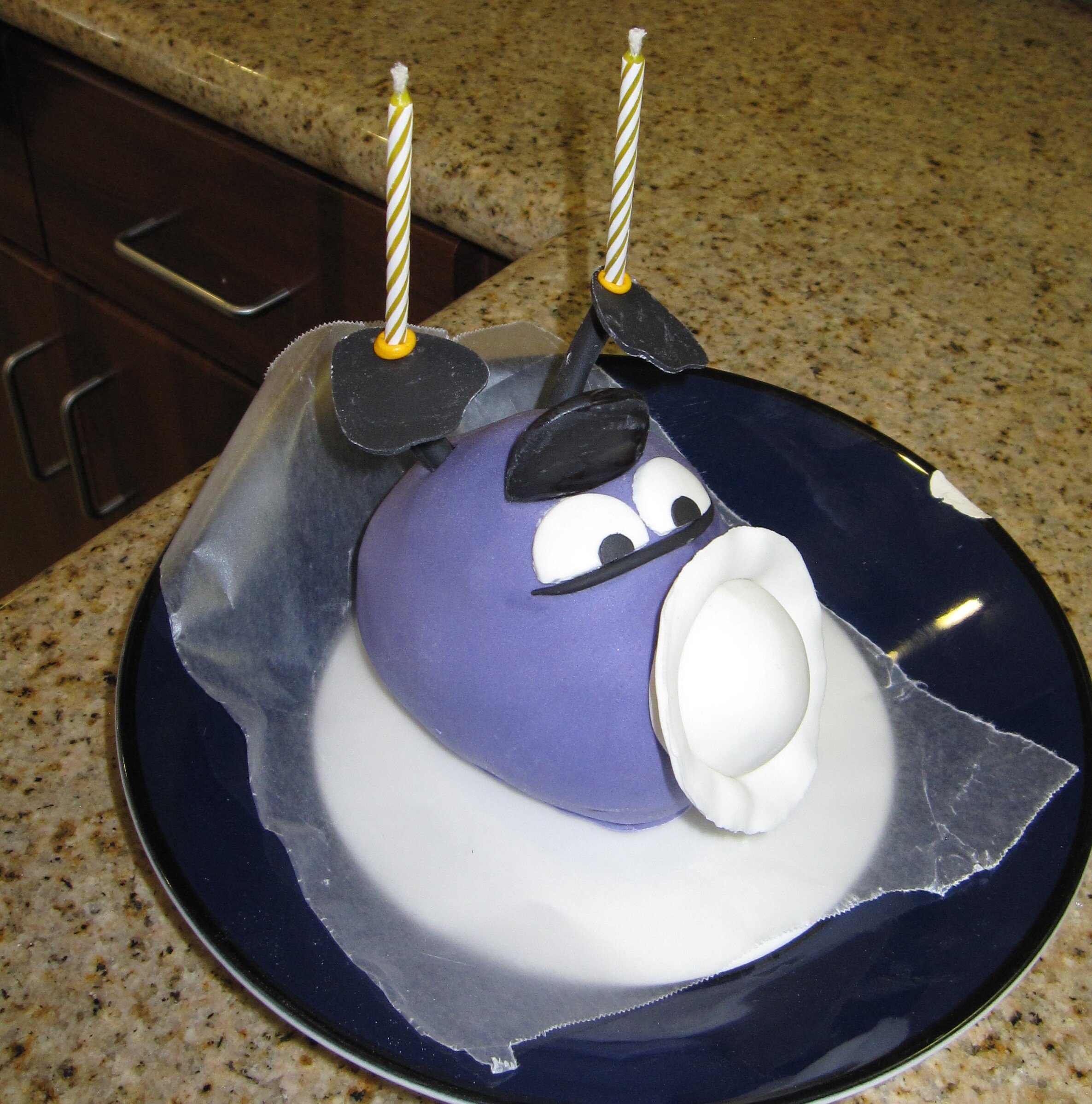
For Quack, the major problem was, of course, how to make him float. My plan was to make the bottom half of Quack out of buoyant foam and the top half out of cake. The first thing I discovered was that, if you make something egg-shaped (ie. Quack) half out of lightweight foam and half out of heavyweight cake and then place it in water, it will immediately flip over so that the heavy cake part is underwater. No good. I addressed this problem by gluing a lot of heavy steel nuts to the bottom of the foam, so that the bottom of Quack outweighed the top. This worked, up to a point, but it also necessitated a higher proportion of foam to cake to make up for the increased weight. Quack ended up only about one quarter cake and three quarters foam.
I also conducted some experiments on the solubility of fondant in water and I discovered that if I coated the fondant covering Quack in Crisco I could reasonably expect him not to dissolve for at least a quarter of an hour.
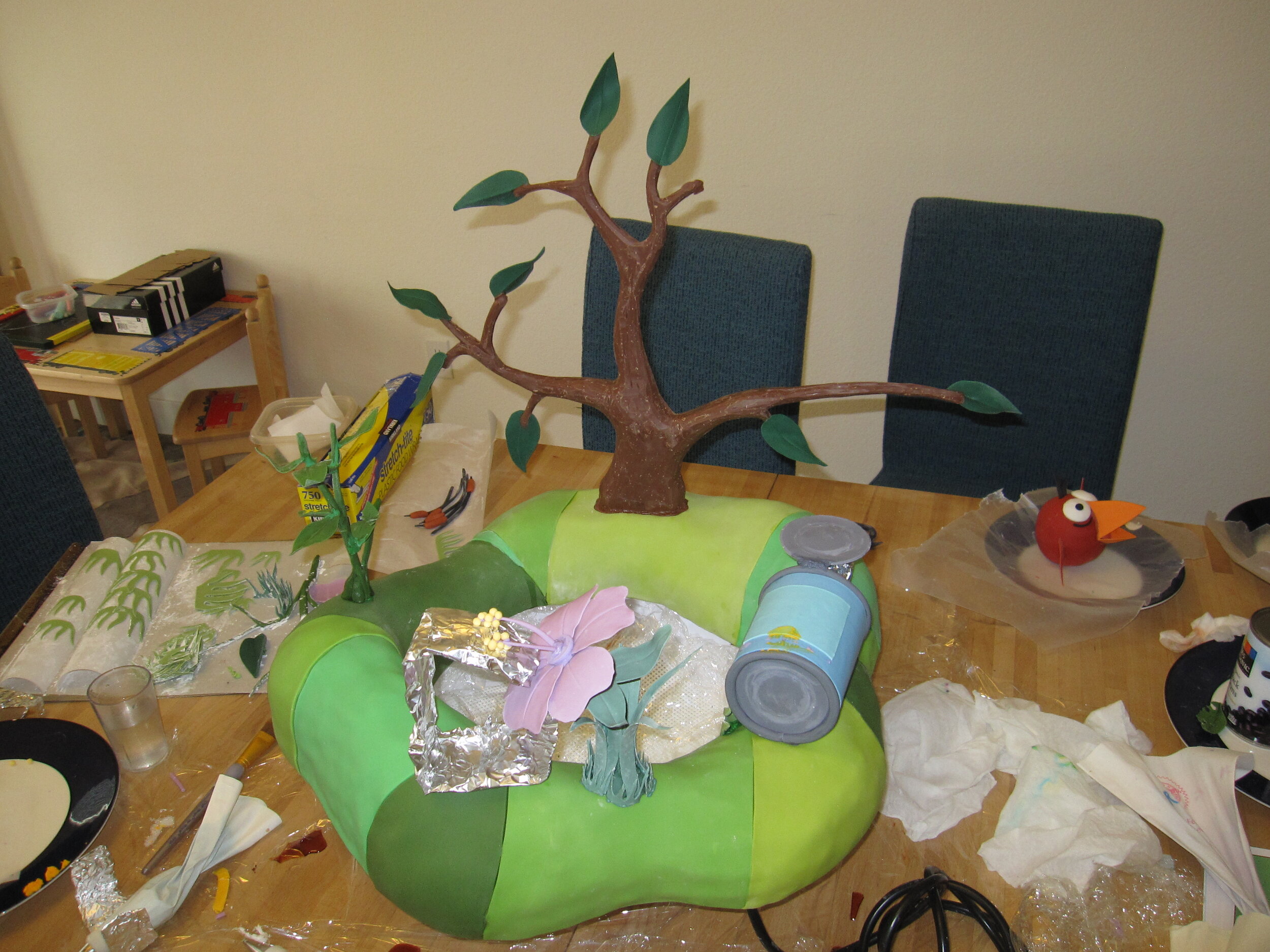
Assembling all the cake elements proved more problematic than I had anticipated for two reasons. First, my plan to stick the gum paste flower and the gum paste milkweed plant for the caterpillar directly into the cake utterly failed to account for the fact that moist cake rapidly erodes the structural integrity of gum paste. In the end I did manage to get the flower standing, but the caterpillar’s plant was ultimately a lost cause and he wound up just perched on a clump of grass.

Second, I had planned to assemble the cake while Sam napped and my sister took Alex out to the museum. As Alex proved to be utterly uninterested in the museum that day, though, they came home early. At first, this was delightful, as she immediately ran up to the not-yet-completed cake and yelled, “I love it!!!”
Unfortunately, this was also the moment at which several pieces of the cake started to fall apart. Peep fell off her can. The flower and the milkweed plant began to collapse. I began to freak out. So we spent the next hour or so forbidding Alex from approaching the cake. “It’s very, very fragile!” “Please be careful!” “Oh, stay behind the train table, please!” The poor little kid just wanted to look at it. Alex, I’m sorry. I should have been more concerned with you than I was with the cake.
Sam woke up at about the moment that I finally managed to get the cake assembled and properly accessorized with gum paste rocks and gum paste tufts of grass. Because I was convinced that several components were about to collapse, we rushed to serve the cake, making this an extremely short-lived object, even by cake standards.
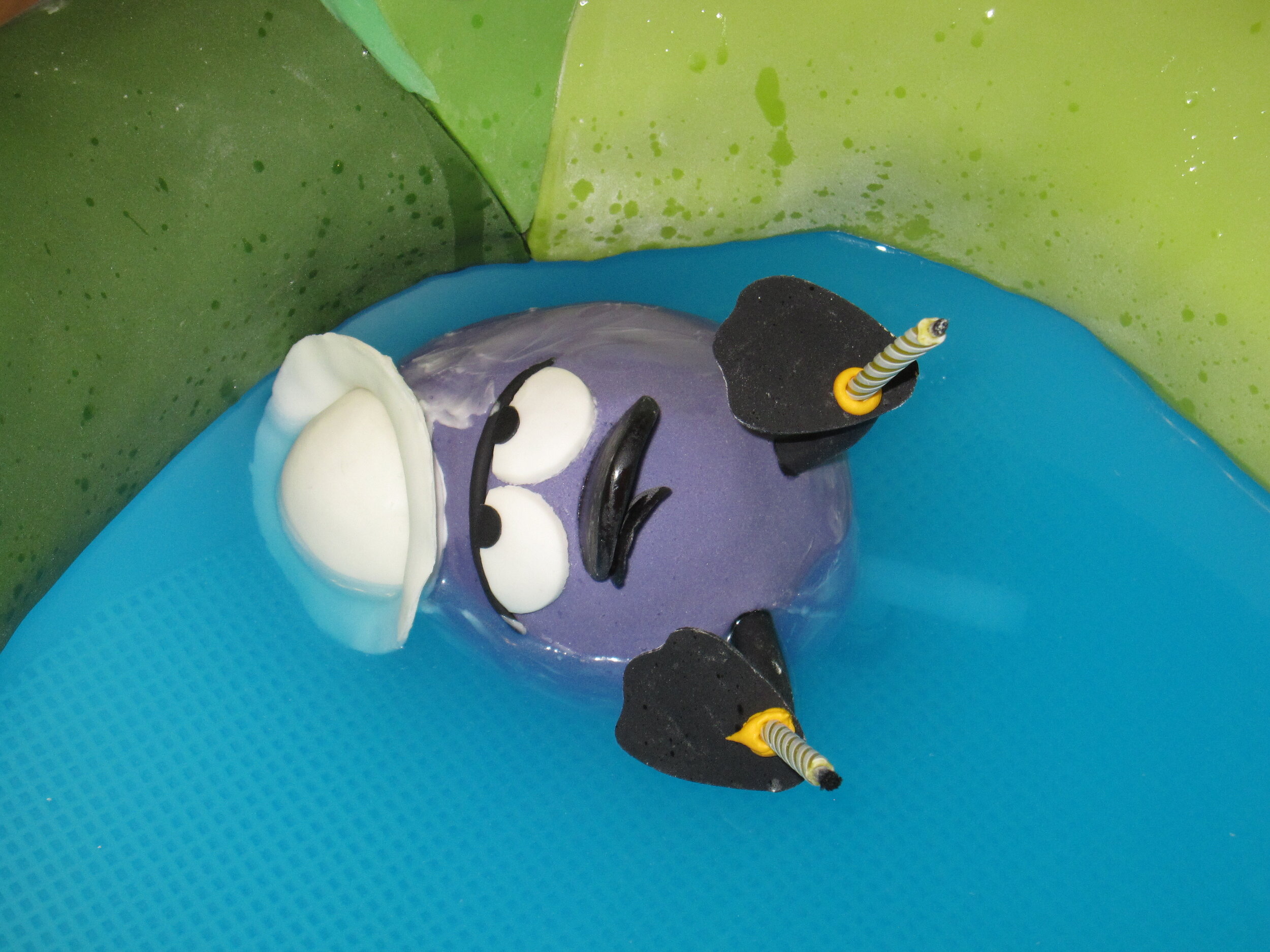
I slightly overfilled Quack’s pond with Gatorade, so that when I actually put Quack in the pond and turned on the pump to agitate the water, it overflowed a bit onto the floor. Other than that, Quack’s floating worked remarkably well. He was a little askew, but he definitely floated, and we were even able to light the two candles that I had adhered to his feet. Remarkably, the bit of cake inside of Quack even remained undamaged and edible.
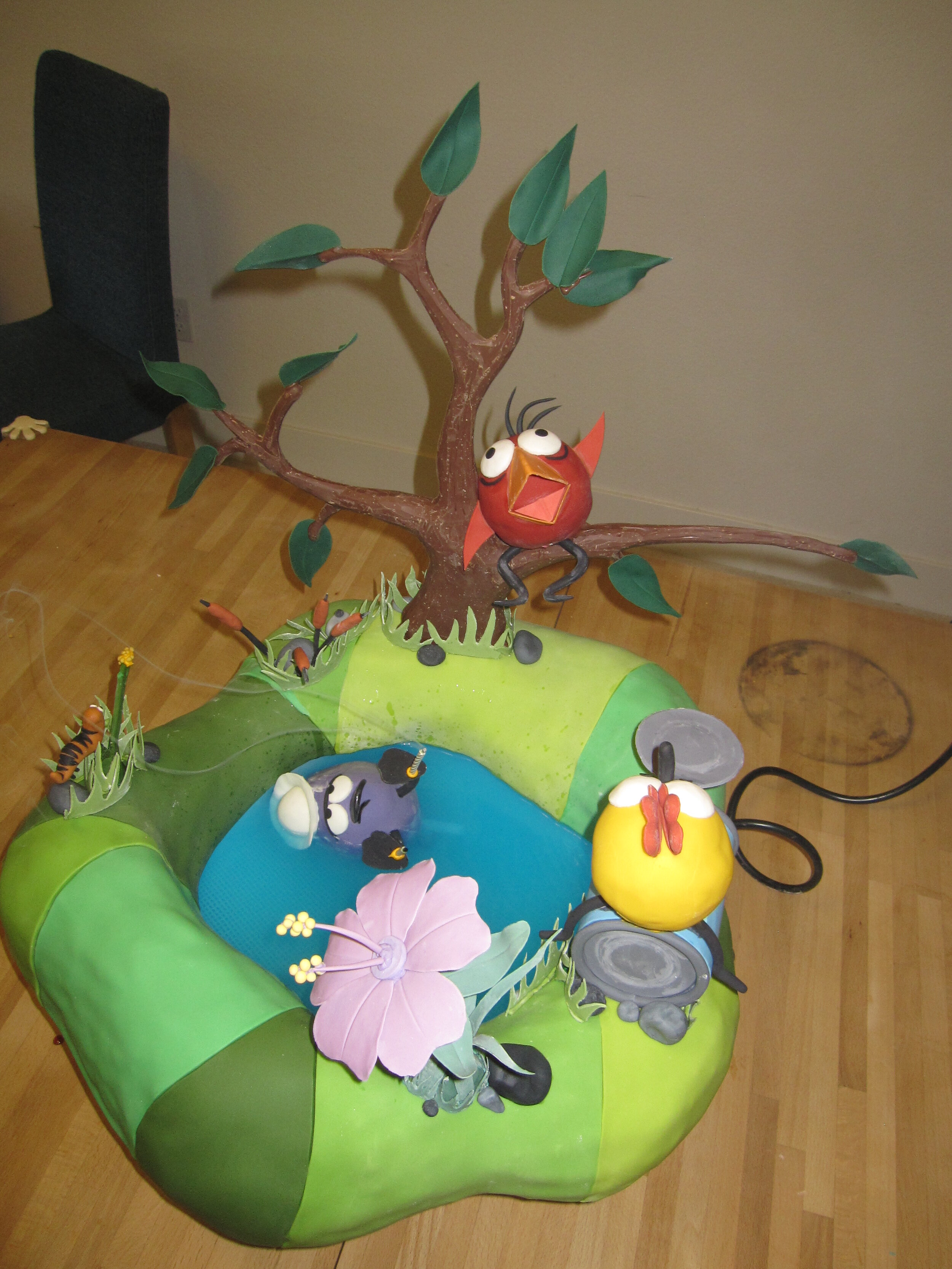
Poor Sam was probably still recovering from his croup and had just woken up, so he didn’t seem terribly impressed. I’m not sure he understood that it was cake until I dissected Chirp and actually put the cake in front of him. Then he was happy. Sam loves cake. After he finished eating Chirp, he even asked, very sweetly, for “more cake, please?” Happy birthday, Sam!
Banshee Pumpkin
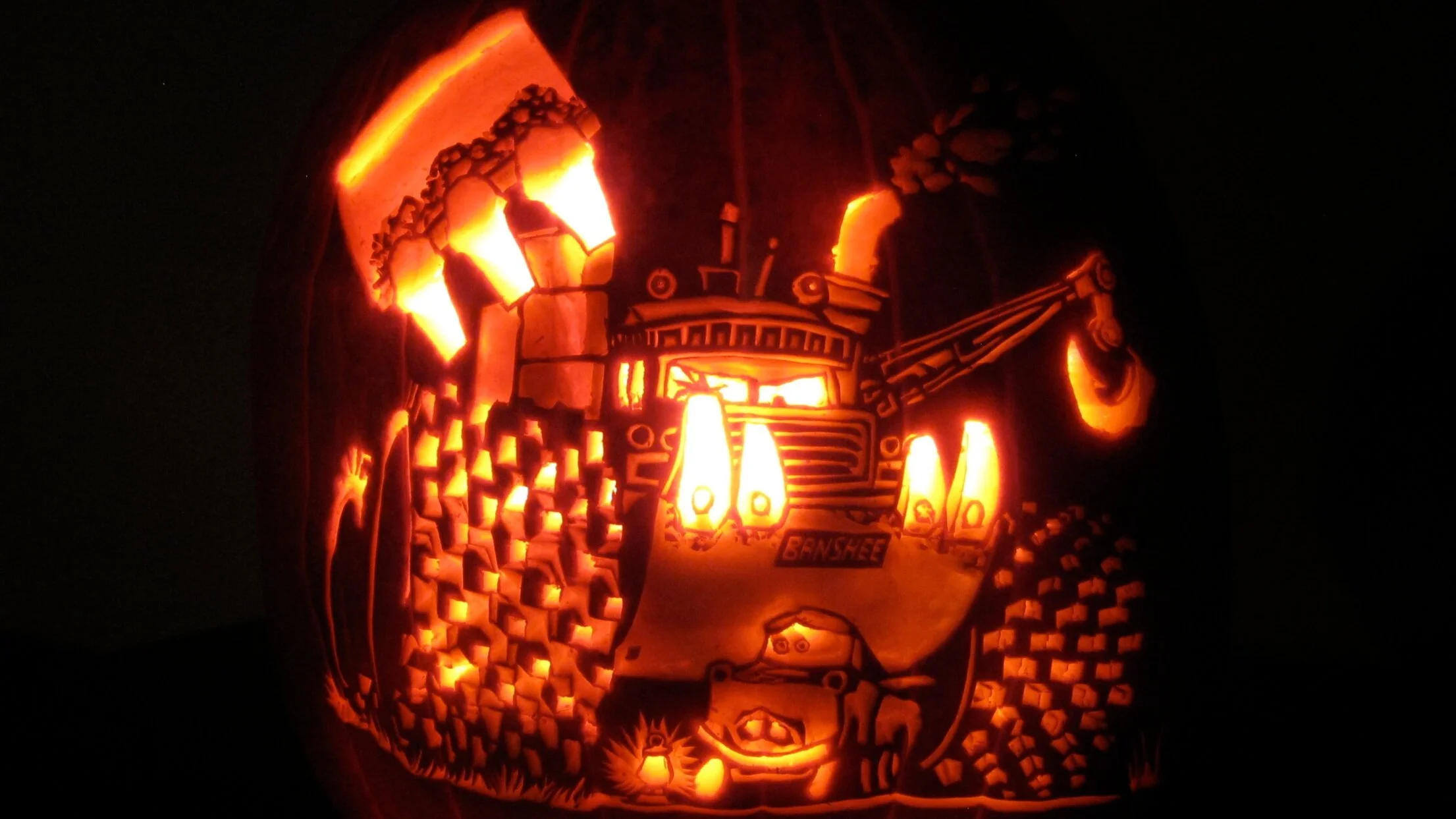
To match the Banshee Cake, here’s my Banshee Pumpkin.
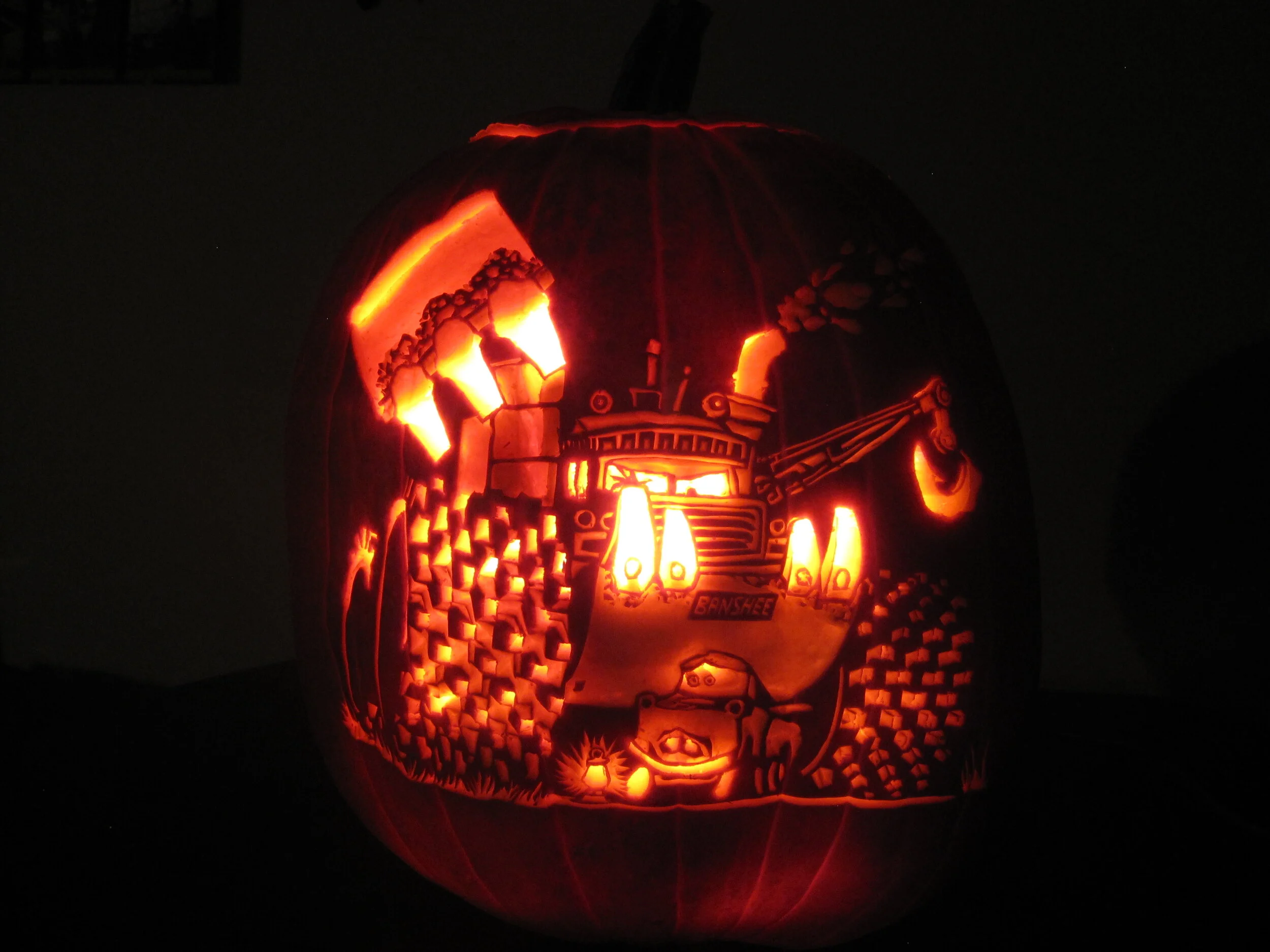
To match the Banshee Cake, here’s my Banshee Pumpkin.
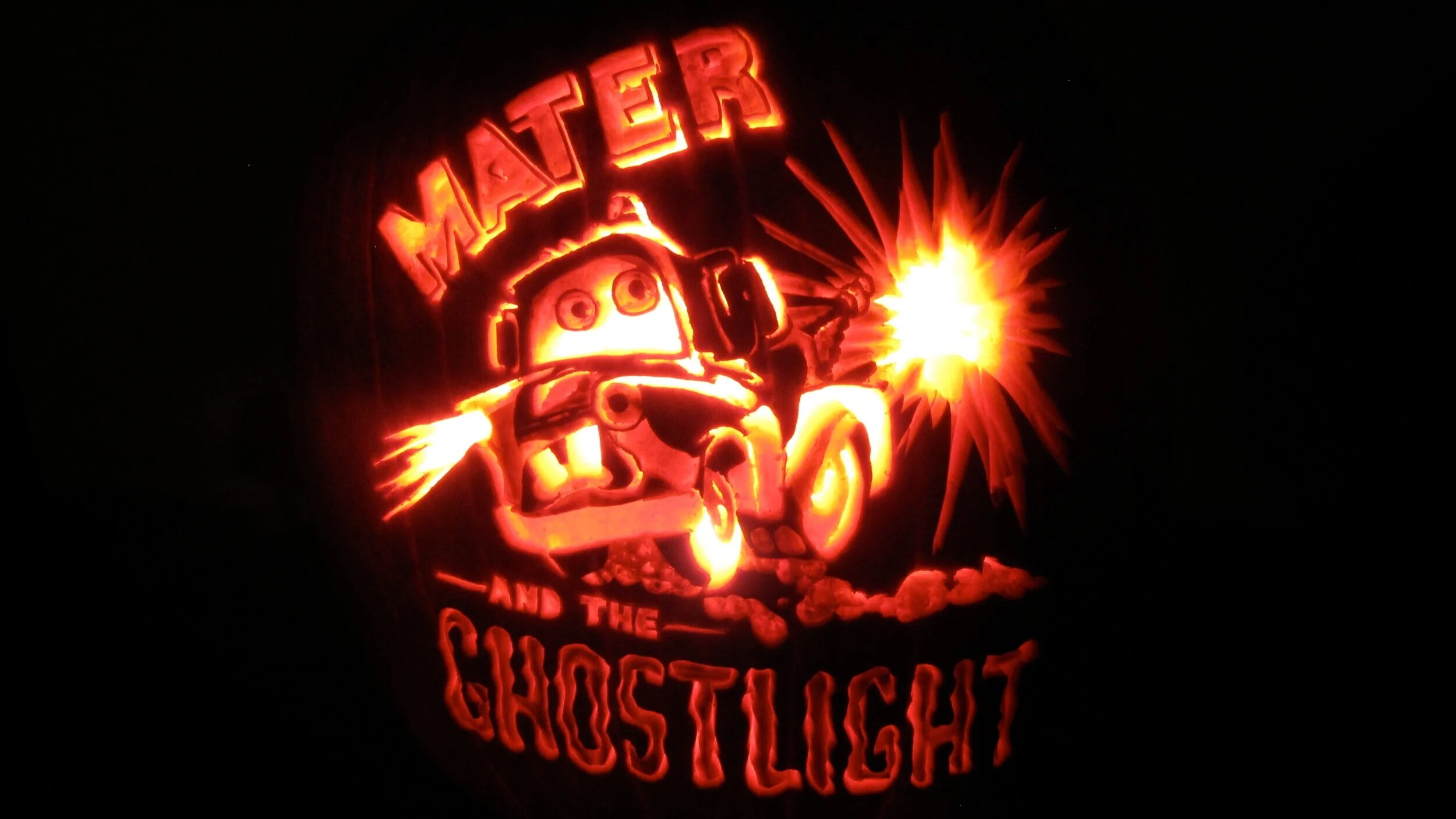
Mater and the Ghostlight Pumpkin
I was looking for things to carve into a pumpkin that my niece would appreciate. So naturally I turned to Mater’s Tall Tales for inspiration.
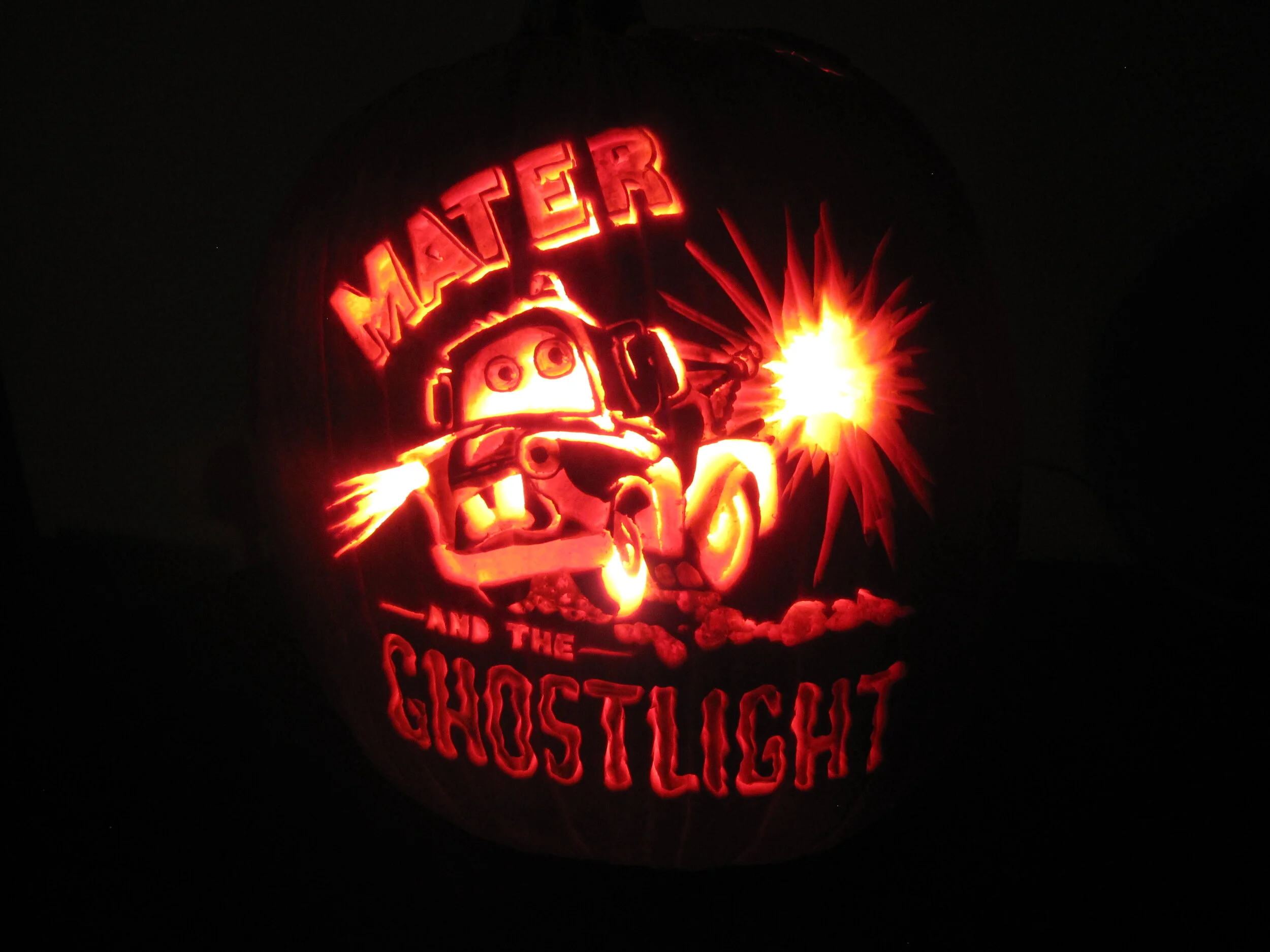
I was looking for things to carve into a pumpkin that my niece would appreciate. So naturally I turned to Mater’s Tall Tales for inspiration.

Zoom! Boom! Bully Cake
For my niece’s fourth birthday, I made a cake based on Zoom! Boom! Bully from John Scieszka’s Trucktown.

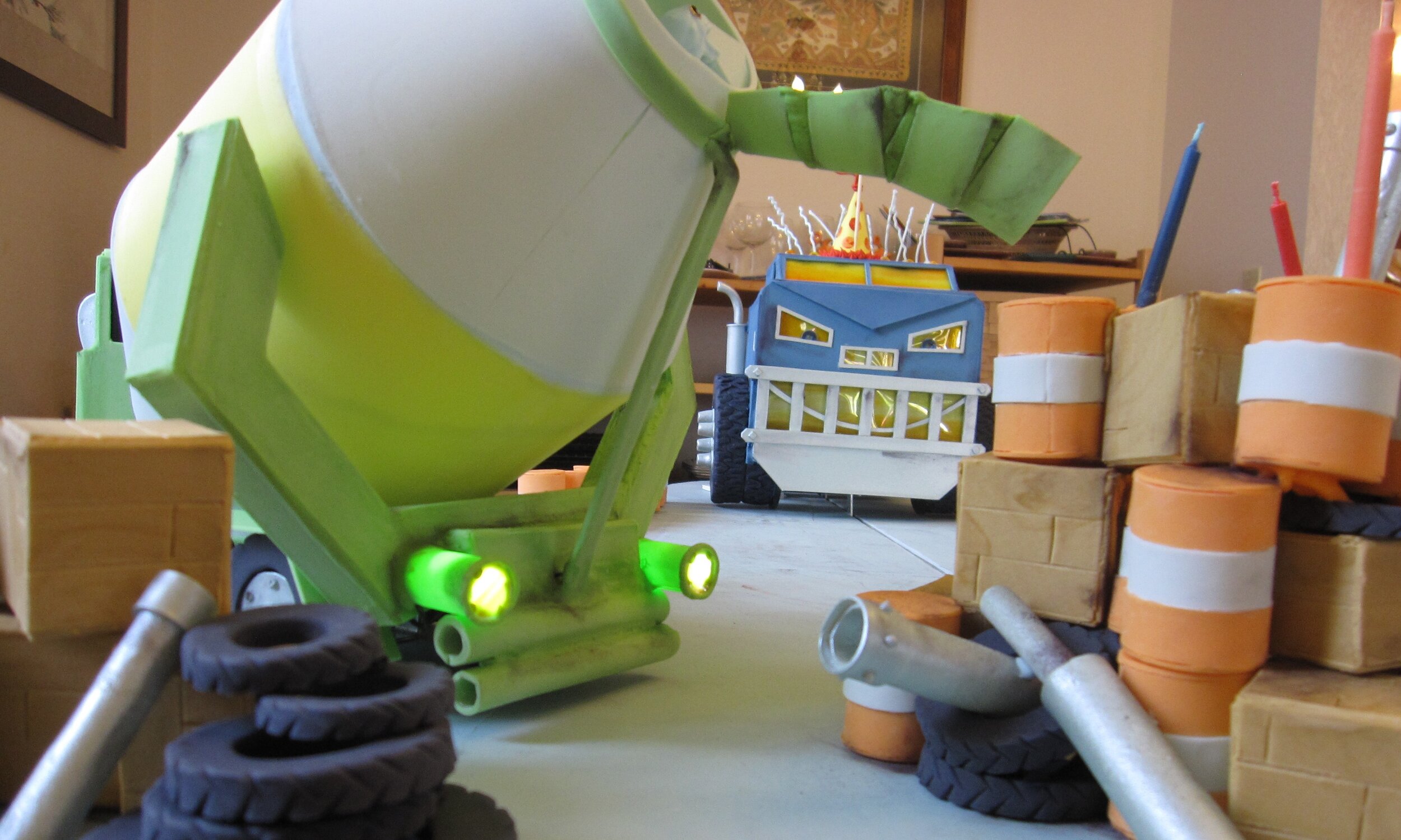
Those of you who don’t happen to be immersed in the magical world of three- to five-year-old children are probably not familiar with John Scieszka’s Trucktown. So I recommend that you follow the link so you know what the heck I’m talking about.
My personal favorite book in the Trucktown series is actually Smash! Crash!, but since the occasion for this cake was my niece Alex’s fourth birthday, Zoom! Boom! Bully was a more appropriate reference. The basic plot is that various denizens of Trucktown stack up crate, barrels, and tires in the middle of the street, but are periodically disrupted by the aptly named Big Rig smashing into them (Zoom! Boom!). The other trucks then exclaim about what a bully Big Rig is. The big surprise in the end is that it’s Big Rig’s birthday and the other trucks are making him a birthday cake out of the crates, barrels, and tires, which Melvin the cement mixer then pours cement “icing” on. Big Rig, very touched by the other trucks’ thoughtful gesture, picks up the “cake”, takes it back to his garage, and proceeds to gleefully smash it while wearing a festive yellow party hat.
I decided to recreate the penultimate moment of the book in cake form, consisting of three components:

1) The “cake” made of tires, crate, and barrels.

2) Melvin the cement mixer, with a rotating drum in the process of dumping cement onto the “cake”.

3) Big Rig, who would smash face first into the “cake”.
When I explained this concept to Alex she was very enthusiastic, if a bit disappointed that Jack Truck and Dump Truck Dan wouldn’t be on the cake.
The first thing I had to do was figure out how the heck I was going to make any of this happen. The easiest way to describe the process is probably to take each piece separately, though of course these projects were running concurrently.
Melvin the Cement Mixer
I learned a lot about cement mixer drums. The first thing I learned was that it’s very difficult to find detailed schematics of them on the internet. Eventually I resorted to studying Alex’s toy cement mixer. As far as I’ve been able to determine from these authoritative sources, cement mixer drum interiors consist of a series of semicircles, angled and staggered such that when the drum turns one way the cement is propelled towards the bottom of the drum and when it turns the other way the cement is pushed up and out the chute.
I made a whole series of Bristol board mockups with various sizes and densities of semicircles, trying them out using little pieces of paper as a cement substitute. None of them even came close to working. So I branched out and tried some other variations on the internal structure. Finally I settled on a helical arrangement of triangular wedges spiraling up towards the top of the drum. This seemed to at least sort of work.
With the basic structure settled, it was time to remake the drum in gum paste. The exterior of the drum was made in three pieces around Bristol board forms. Once these and the myriad little triangular wedges were dry, I assembled them with royal icing around a brass tube for the center support. Assembly was a lengthy process, as I had to wait for the icing on each wedge to dry before attaching the next one.

With the drum assembled around the central tube, I superglued the tube to the shaft of a reversible gear head motor (once I had figured out how to wire up the motor to make it reversible.) Mounting the drum and motor assembly to the base was a real challenge. I had made a pretty simple base for Melvin out of a cut-up aluminum baking sheet, covered with gum paste, and elevated off the wooden base for the entire cake with L-brackets, so the body of the truck would ultimately appear to be resting on its tires. In Zoom! Boom! Bully, Melvin’s drum appears to be supported from beneath in the middle by two angled beams, but there doesn’t seem to be a support for the back of the drum. This, of course, also raises the question of what Melvin’s rear chute is attached to.
My plan was to build the side support beams out of gum paste around pieces of brass, bolted to the aluminum base. Because, unlike the people illustrating the book, I physically needed something on the back to support both the drum and the chute, I decided on a brass ring mounted on a strip of brass and wrapped in gum paste, also bolted to the aluminum base.

The first time that I put this all together with the motor and the gum paste drum, I set it up so that the lowest point on the drum was resting on the aluminum base, on which I had put some UHMW tape to keep friction to a minimum. I thought that this would help to support the weight of the drum and keep stress off the motor. This turned out to be a very bad plan, as I had failed to account for the fact that, in spite of my best efforts, I had failed to center the drum perfectly on the central brass tube. This meant that when I turned the motor on, as soon as the part of the drum that was slightly further from the axis of rotation got around to the bottom, it jammed against the base. I turned the motor off as soon as I realized what has happened, but not soon enough. As the central brass tube was still trying to rotate while the drum itself was jammed against the base, the royal icing connected the gum paste drum pieces to the brass tube cracked. D’oh!
A few tense hours and one major royal icing repair later, the drum was reattached to the tube. In order to prevent this from happening again, I made a new, slightly higher brass ring to support the back of the drum and raised the motor, and therefore the front of the drum, about a half an inch as well. That way, the drum never touched the actual aluminum base and was supported only by the motor on one end and the brass ring on the other end. It worked!
Once the drum turning mechanism was in place, finishing the back of the truck was relatively simple. I covered the motor in green gum paste and assembled the gum paste pieces of the side support beams. Having previously made tires out of black fondant and hubcaps out of gum paste, sprayed silver, it was easy to attach these, as well as the gum paste wheel wells.
I had also wired up some white LEDs to use for Melvin’s taillights and headlights, so I put the LEDs for the taillights in place and then ran the wires underneath the aluminum base so they’d be in place for the headlights once I got his head assembled. The taillights themselves I made out of gum paste cylinders, capped with rice paper (to diffuse the light) and yellow gelatin (to give the light the correct hue.) In the past, when I’ve needed sheet gelatin (see the Tardis Cake and the Flying Saucer Cake) I’ve used the pre-made kind, but since that has a strange diamond pattern on it, this time I tried making my own flat sheet gelatin, using these instructions that I found on the internet. After a few abortive efforts, it worked pretty well.
Assembling the chute took a little time, because it was made of six separate pieces, which had to be attached one at a time, with sufficient time for the connective royal icing to dry before attaching the next one.

With the back of Melvin thus complete, I had to make his head, the only part of Melvin that contained actual cake. This went very smoothly. Having made all the exterior gum paste pieces in advance, it was simply a matter of carving the cake into the appropriate shape, covering it with fondant, and then setting it in place on the aluminum base. Then I could assemble the gum paste exterior with royal icing, including more tires and wheel wells, the ears / side view mirrors, and eyeglasses / headlights (which were assembled around the rest of the strand of LEDs.) To fill gaps and hide seams, I used royal icing, smoothed with a damp paintbrush.
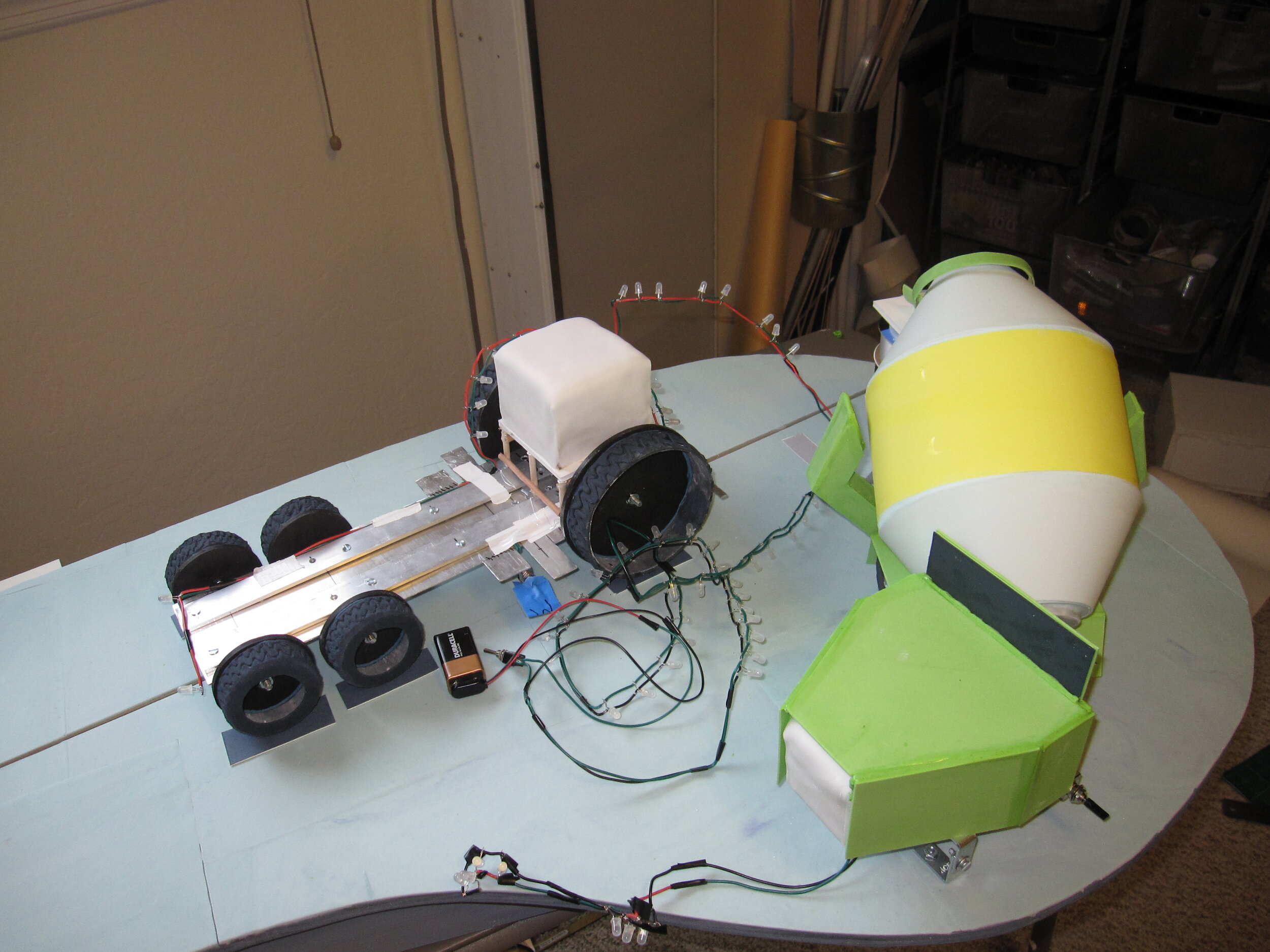
For cement, I made some white chocolate ganache, tinted grey with black powdered food coloring. Mind you, at this point I still didn’t know whether the drum was properly configured to actually push the cement out and down the tube, and I wouldn’t find out until the party.
Big Rig
My biggest challenge of this cake was figuring out how to make Big Rig roll. It was also pretty high pressure because, let’s face it, if Big Rig didn’t smash into the “cake” the whole project would pretty much be a blatant failure. With almost all of my cakes, I accept that there is a fairly high probability that it might not work as I intend. My philosophy is that if you always know that what you’re doing will work, you’re not trying hard enough. Which is fine when the only people who are going to be disappointed with a failure are me, or my adult friends, or the guests at my friends’ wedding. But I really didn’t want to disappoint Alex. So in this particular case, I really couldn’t let failure be an option.
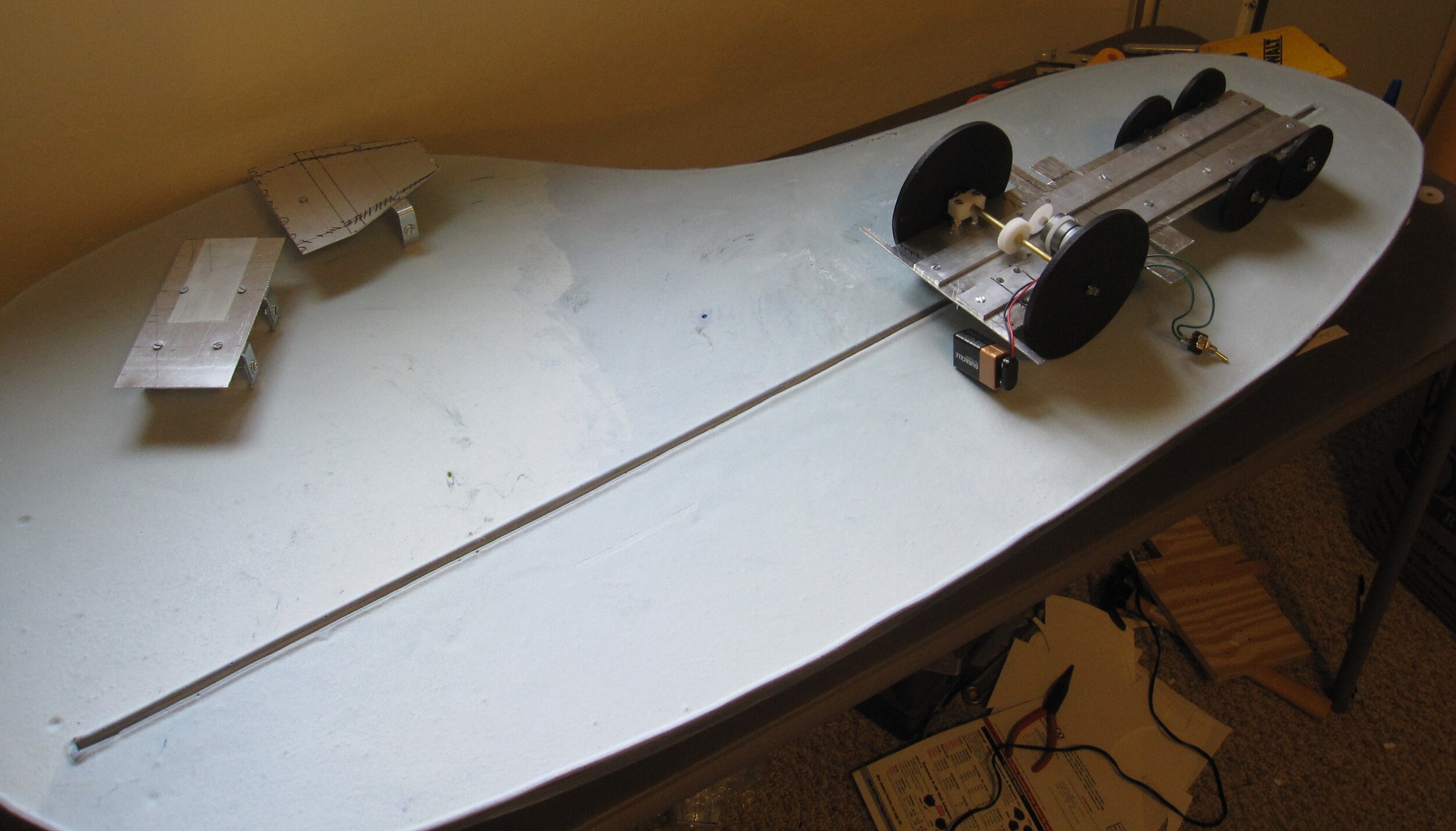
Keeping Big Rig on the right trajectory was the easy part. I attached two L-brackets to the bottom of Big Rig’s aluminum base, a material which I had selected to keep his weight as low as possible. Then I cut a track in the plywood base for the entire cake, running from the far end where Big Rig would start, leading to the end of the base where the “cake” would sit. That way, the L-brackets, slotted into the plywood track, which I had lined with UHMW tape to reduce friction, would keep Big Rig on target to the “cake.” All I had to do was get him to move.
My first attempt at a drive mechanism was to connect a hobby motor directly to the shaft of one of the front wheels (made out of plywood, to be covered later with gum paste tires), so it would basically be a one-wheel drive car. This failed for at least two reasons. First, because the two front wheels weren’t connected to each other via a complete axle, both had a tendency to bind up in their bushings, so that moving even the light aluminum base without any cake on it took all the motor’s power. Second, because only one wheel was driving the truck, it had a tendency to try to pull the truck off course so that the L-bracket bound up in the track.
So I scrapped that and tried something else. This time, I connected the two front wheels with a brass and threaded rod axle. My plan was to transfer the power from the motor to the axle with a heavy-duty rubber band under tension. This plan failed even before I connected it to the wheels, as the minute that I started experimenting with putting tension on a rubber band around the shaft of any of the hobby motors I had in hand it became clear that none of my motors had nearly enough torque to get the job done.
I went online and located a promising-looking high-torque motor. While I was waiting for that to arrive, I started playing around with the possibility of a motor-less drive mechanism. My first thought was a tension spring. Unfortunately, a few major problems with this idea soon became clear. First, the length difference between the relaxed spring and the spring under tension wasn’t nearly enough. I couldn’t pull the truck all the way back to the end of the track, and even with the spring fully relaxed I was afraid that the truck wouldn’t even reach the “cake” to smash it. Second, I was very scared that, if I had to keep Big Rig under that kind of tension for any length of time there was a significant risk of premature smashing, which would be a real tragedy. Third, I really wanted Big Rig’s tires to spin on their own, so I could start the wheels spinning, and then release the truck for the final smash. There’s a great illustration in Zoom! Boom! Bully where Big Rig’s tires are spinning into a whirl of smoke just as Jack shouts, “Stop!” and the other trucks reveal that the “cake” is for Big Rig’s birthday. I really wanted to recreate this moment in cake before the smash, and that required motor power directly to Big Rig’s wheels.
I managed to solve the first of these problems by substituting a jumbo-sized rubber band for the spring. The rubber band had a much higher stretch-to-length ratio than the spring, and the flexibility of the rubber band meant that even after its tension was exhausted, it at least wouldn’t arrest the momentum of the truck. The rubber band also seemed to have sufficient power to move the truck fairly quickly, even with the projected added weight of the cake and gum paste. But the rubber band still left my other two concerns unaddressed. It still required the truck to be under tension for a longer period of time than I was comfortable with, unless I could come up with a release mechanism that I could set after the cake was completed and moved into place. And in order to achieve the effect I wanted with the tires spinning prior to release, I really needed tires that were legitimately motor-powered.
Fortunately, when my high-torque motor arrived, early signs were encouraging. Unlike the motors I was trying before, it was clearly powerful enough to withstand the tension on the rubber band. So I mounted the motor to the cake base and ran the rubber band to connect the motor shaft to the axle. Initially, I was delighted with the result. With no weight on the aluminum base, the truck drove great. However, as soon as I put some weight on it, to mimic the weight of the cake and gum paste I was planning to put onto Big Rig, it stopped working altogether, as the added weight was sufficient to counteract the tension on the rubber band and cause it just to slip uselessly around the axle. I tried to mitigate this problem by putting something sticky on the axle, but this just made the rubber band stick to itself and get wound up around the axle.
Next, I tried using gears to transfer the power from the motor to the axle, which required a complete redo of the front bushings to leave space between the axle and the aluminum base for the gear. Like the rubber band drive, this worked great until I put any weight on the base. Unlike with the rubber band, the truck did at least move with additional weight on it. It just moved very slowly. I did have hopes, though, that if I kept the cake as light as I possibly could, it might work.
To give it an extra boost of power, I decided to combine this partially successful motor solution with my partially successful rubber band solution. I designed a release mechanism consisting of a piece of U-shaped channel that ran across the track, underneath the base, attached to a dowel handle leading out the side of the base. That way, with the rubber band connected to one of the L-brackets under the truck base on one end and an eye bolt at the “cake” end of the track at the other end, I could finish decorating Big Rig with the rubber band relaxed, and then pull him back and set the L-bracket into the U-channel. This would hold him in place, and hold the front wheels a fraction of an inch off the base, so I could turn the motor on, let the wheels spin freely for a second, and then pull the dowel to release him. The rubber band would pull Big Rig forward while the wheel simultaneously pushed him forward. I could only hope that would provide enough force to make him powerfully smash into the “cake.”
And thus ends the saga of making Big Rig go, but I still had to actually make Big Rig. Because Big Rig has a kind of maniacally glowing face, as well as taillights and a menacing glow inside his wheel wells, he needed a lot of LEDs. Fortunately, by this point I’ve done so many LED-intensive cakes that I could basically just chop and splice segments together as needed, so the wiring went pretty quickly.
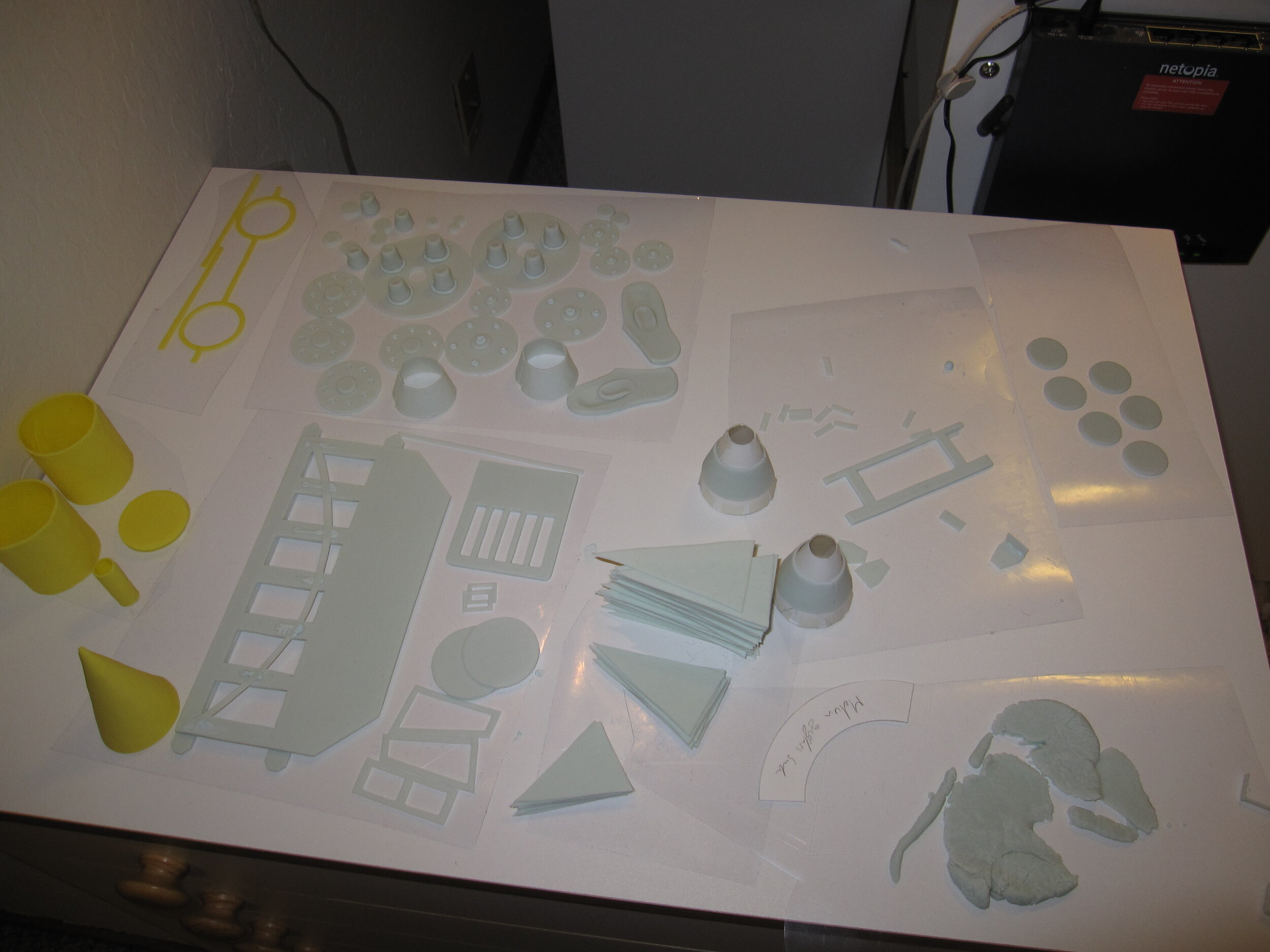
All the gum paste pieces, including tires, hubcaps, fuel tanks, bumpers, walls, trim, and yellow party hat, were made and dried in advance. To get the requisite orange and yellow glow out of Big Rig’s eyes, mouth, etc. I made sheets of gelatin with fades from yellow to orange, backed with rice paper to diffuse the light form the LEDs.

The cake itself was limited to the back of Big Rig and a very small square of cake inside his cab. At the party, someone pointed out that it was like a little cake engine block. I couldn’t put a bigger cake inside his head, because I needed to leave space around it for the LEDs. I kept the fondant layer on the cakes (necessary to prevent the gum paste from touching the buttercream icing, which softens dried gum paste) as thin as possible to keep the weight down. Fortunately, since I was covering the entire thing with pre-made gum paste pieces, the fondant didn’t have to look particularly nice.
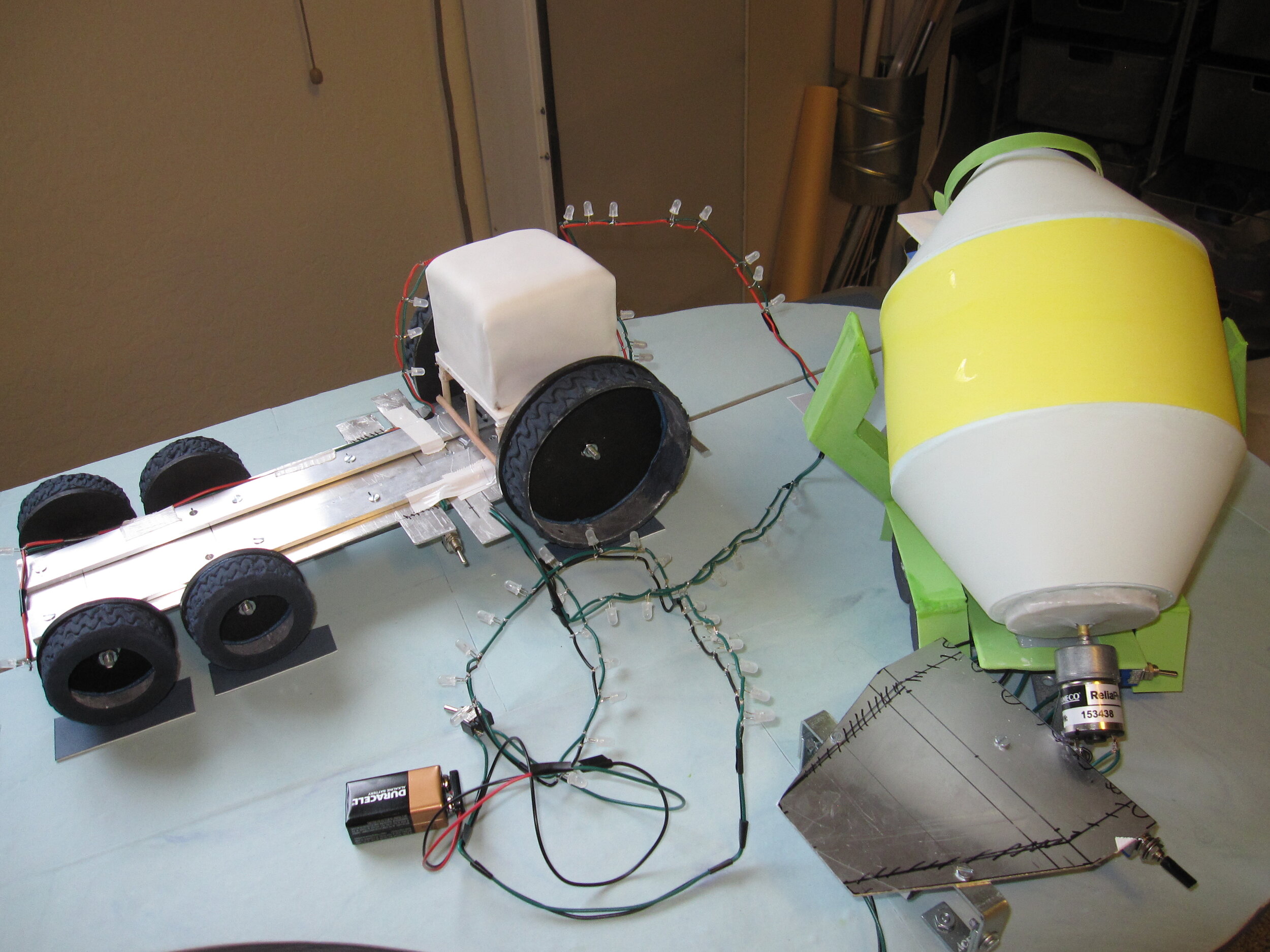
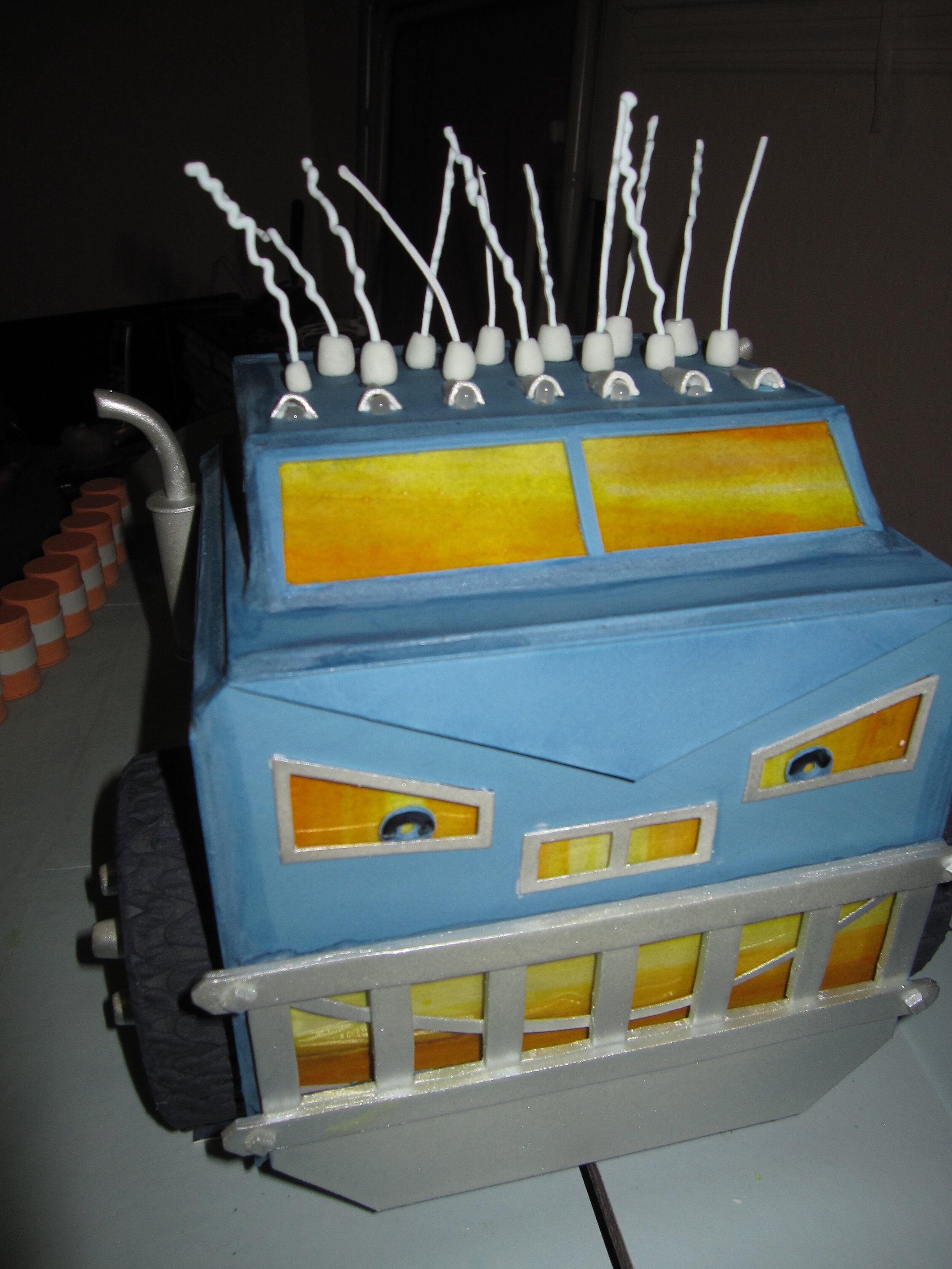
With the cakes in place, attaching the gum paste exterior and all the trim pieces was really quite simple. The only problem I had was that when I redid the front axle bushings to accommodate the gears, I had failed to make the corresponding changes to the templates for Big Rig’s cab, so the sides, front, and back of the cab were all about half an inch too short. Fortunately, I had some extra dry blue gum paste pieces that I was able to cut down to patch the gaps. With some liberal royal icing spackle, it turned out just fine. The finishing touches were the royal icing antennae on the top. I have no idea why Big Rig needs so many antennae (which is what I told Alex when she asked me that question) but he has them in the book, so he had them in the cake.
“Cake”
Although the “cake” was the easiest component in that it didn’t have to do anything but sit there and be smashed, it also required more individual gum paste pieces than (I think) Melvin and Big Rig put together. Each barrel was made of five separate gum paste pieces and each crate required six. At the early planning stages of this project, I had envisioned putting tiny individual pieces of cake inside each crate and each barrel. Considering that the crates were only an inch and a half on each side, and the barrels were even smaller, I’m very glad that I came to my senses before I tried to do this. It’s not like there wasn’t already more cake than our guests would possibly eat anyway. Instead, I just put a little square of cake inside the “cake”, surrounded by the hollow crates and barrels and fondant tires. This probably made for a better smash in the long run anyway.

In addition to the crates and barrels, the cake also included a selection of fondant tires and gum paste pipes. Since I had made way more of all these things than were actually required, I used the extras to create bonus piles of stuff around the perimeter of the plywood cake base.
Finishing touches
With everything assembled, I actually went to bed at a relatively reasonable hour the night before the party. The next morning, as I was putting on the finishing touches – mostly adding a little dirt and grime with black powdered food coloring – Alex came in to inspect my work. She walked around it, studying it very carefully and commenting favorably on specific elements, like Big Rig’s tires and Melvin’s articulation. She then pointed out that I needed to put eyes on the chicken hood ornament on Melvin’s nose, which was already on my list of details to finish up before the party.

Alex then noted that I hadn’t made a hitch for the back of Big Rig. I had considered making a hitch for Big Rig, but decided against it because it doesn’t play any role in this scenario and because in some of the images in the source book, he doesn’t appear to have a hitch. Alex listened patiently to this explanation and then countered by pointing out that, in Truckery Rhymes, Big Rig is shown towing a trailer, which he couldn’t do if he didn’t have a hitch. I was forced to bow to her superior logic and quickly made a gum paste hitch. Actually, it even looked better from an aesthetic point of view, as the silver hitch made the solid blue rear section of Big Rig much more interesting. What I especially love about Alex’s argument is that it draws not just upon the specific source book for this project – Zoom Boom Bully – but upon the rest of the Trucktown canon as well. I also enjoy that it is a functional argument. Her point was not merely that Big Rig should have a hitch because he is shown with a hitch in the illustrations, but that Big Rig needs a hitch or he would be unable to fulfill his function as a big rig.

With the hitch completed, I got Alex’s dad to help me move the cake out to the dining room. Then came the stressful moment when I had to pull Big Rig back into his release mechanism. I was terrified that I was either going to lose my grip and send him crashing into the “cake” or crack Big Rig’s head to pieces in the effort of pulling back the rubber band. Fortunately I avoided either catastrophe and got Big Rig primed for release with only the loss of one fuel tank that was easily reattached.

Alex then consulted the source material for one final check on the accuracy of my work. She pointed out that, in the book, the “cake” is shown on a wooden palette, and I had failed to put my cake version of the “cake” onto a palette. I explained that I had noticed that and had considered putting the “cake” on a palette but had decided against it as I was afraid that the palette would arrest Big Rig’s movement so that he wouldn’t smash into the “cake” as effectively. Alex considered this carefully and then decided that perhaps Big Rig had taken the “cake” home on the palette and then removed it from the palette in order to smash it. I agreed that was an excellent explanation.
The party
With only one exception, the cake worked very well. Melvin’s drum turned flawlessly, but sadly, he did not actually pour cement. Either the drum and/or the wedges inside weren’t angle correctly or I had made the ganache too thick. Also, I didn’t really know which way the drum was supposed to be turning to make the cement come out. Cement mixers are complicated. Oh well, at least the drum turned.
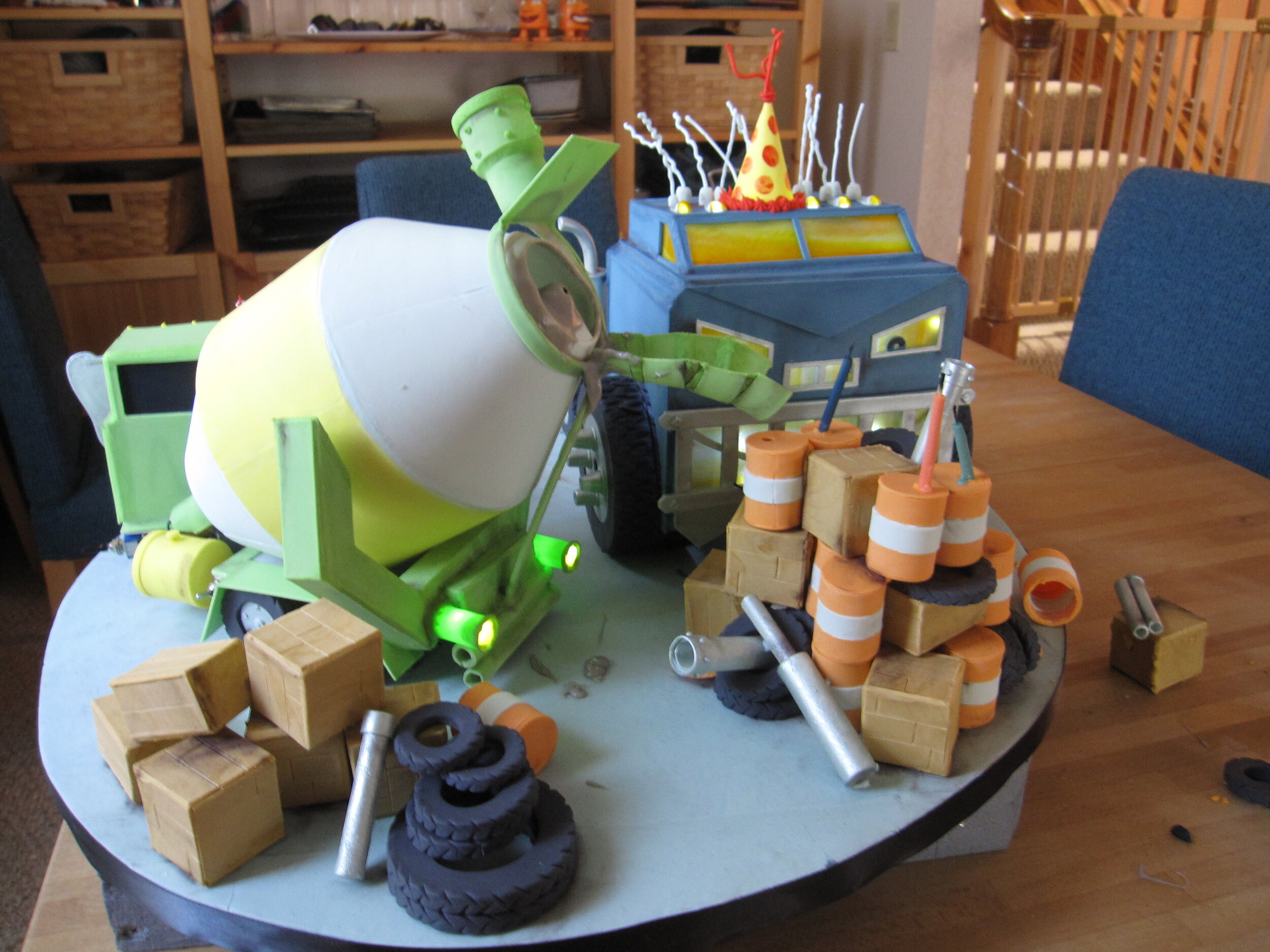
Most importantly, Big Rig worked! Zoom! Boom! One of the barrels even flew off the table. Big Rig’s front bumper cracked beautifully so that he wound up with an excellent jagged evil grin.

Alex had a great time eating various gum paste bits (and a little bit of actual cake.) I particularly enjoyed it when she ate one of Melvin’s eyes, revealing the LEDs and leaving Melvin looking like a mangled cyborg.

The next day, as Alex was helping me to disassemble the remains of the cake and salvage the electronic components, she told Melvin (who was by this point essentially just a severed head) that he was her favorite cake ever. I call that a big success. Alex was a very tough audience with an incredible eye for detail. She was tremendously critical, but with such sincerity and such admiration. She has absolute confidence in my ability to execute a perfect cake version of Big Rig, so of course she wants to point out my errors so that I can correct them. It’s such a charming combination of exactitude and blind faith. She’s the perfect manager.
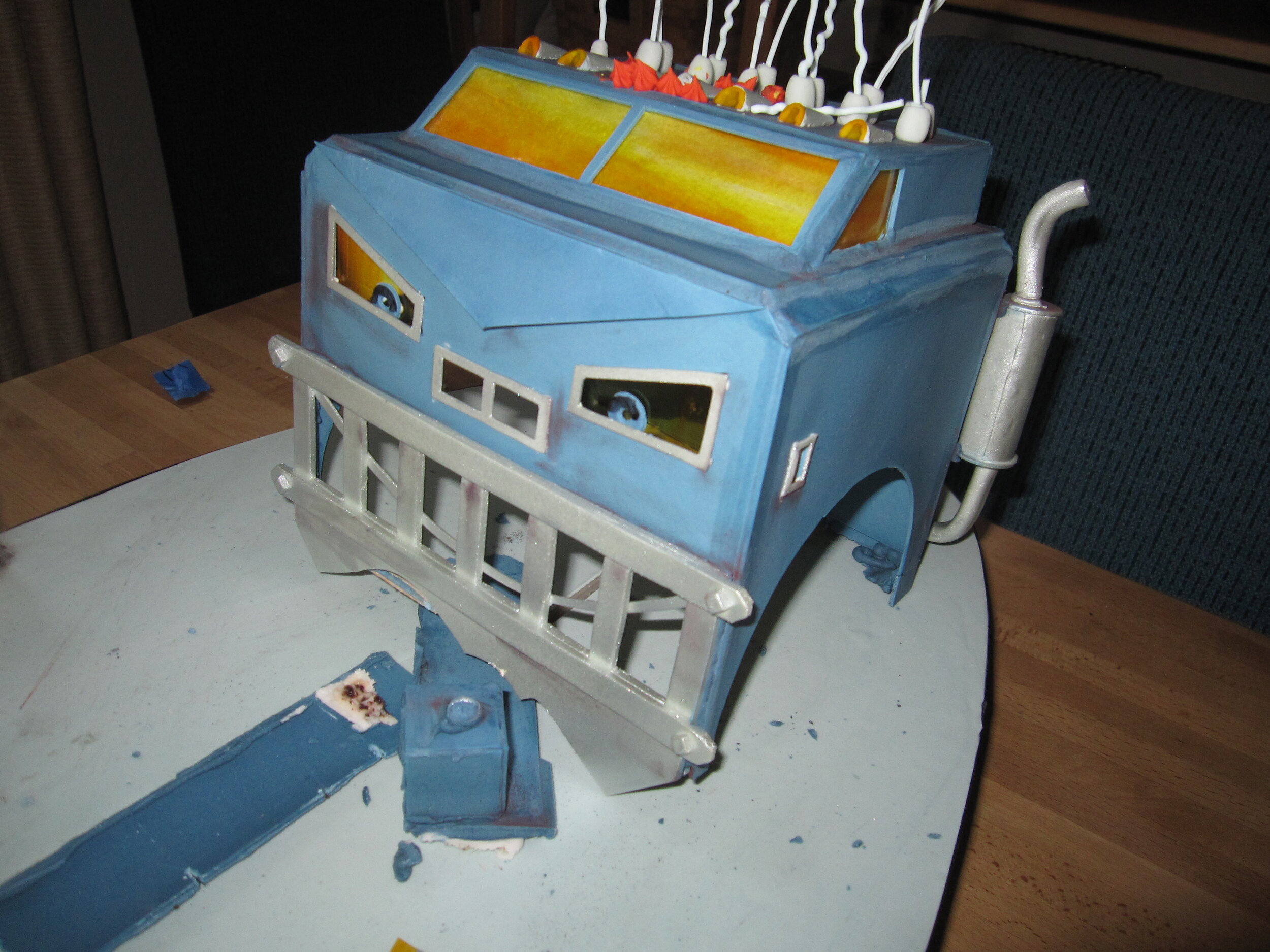
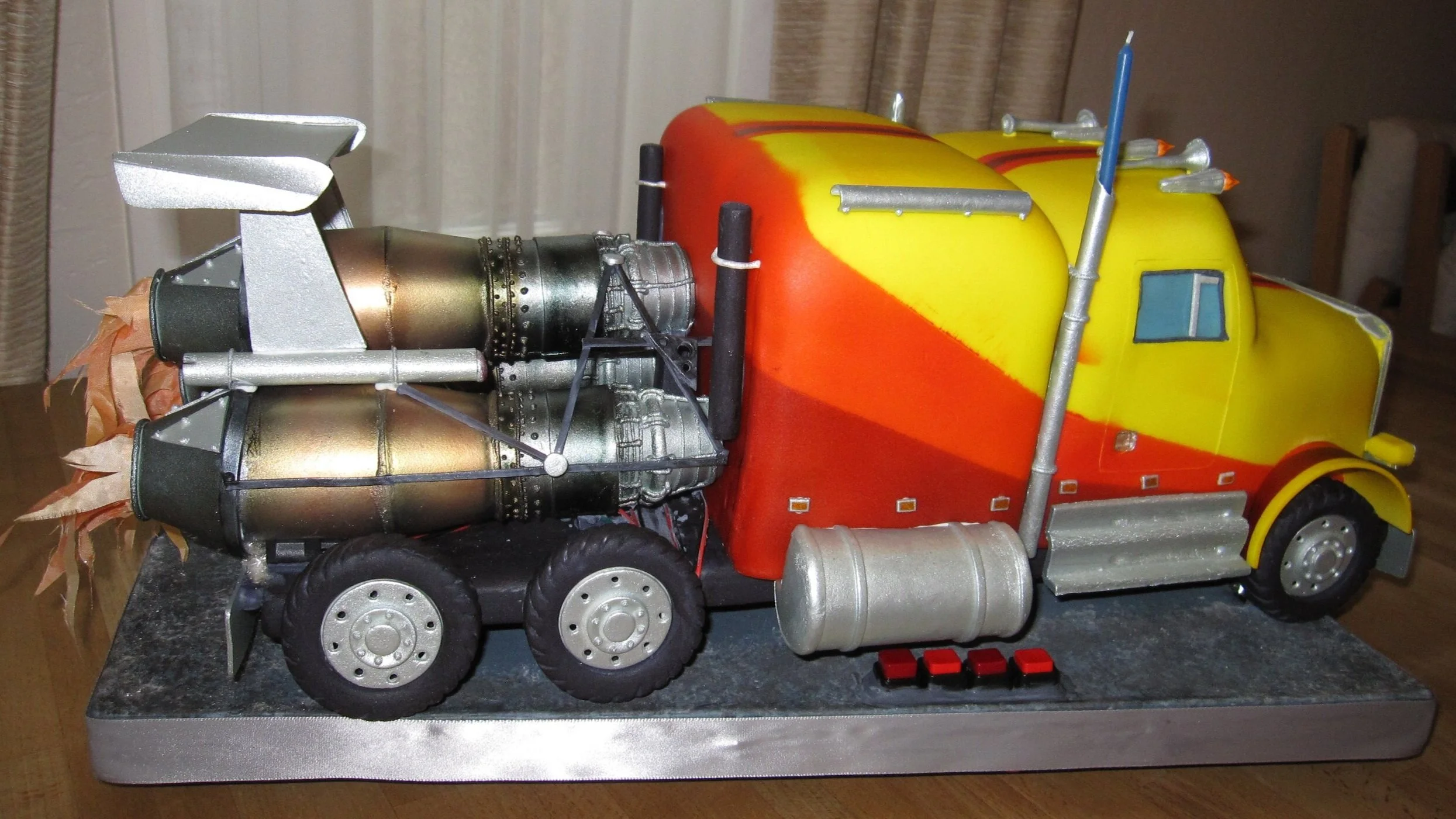
Jet Truck Cake
This cake was for my nephew, Sam’s, first birthday. It’s based on a real truck.

This cake was for my nephew, Sam’s, first birthday. It’s based on a real truck. When I asked Sam’s big sister Alex, who was, at the time, almost four years old, what kind of cake she thought that Sam would like for his birthday, she gave me very detailed specs:
Tractor-trailer – w/o trailer
Racing truck
Racing trucks are yellow.
Jet engines on the back
Flame powered engine
Flames come out of exhaust pipe
Flame powered fuel
Button to turn on flames
Alex will show Sam how flames work
Flames come out of jet engine
Flame powered fuel tank on the side
When I showed my notes to my sister, Alex and Sam’s mom, she immediately knew what truck she was thinking of. Evidently she had seen it in a video on youtube. A few google searches later, I had some great reference photos to work from.

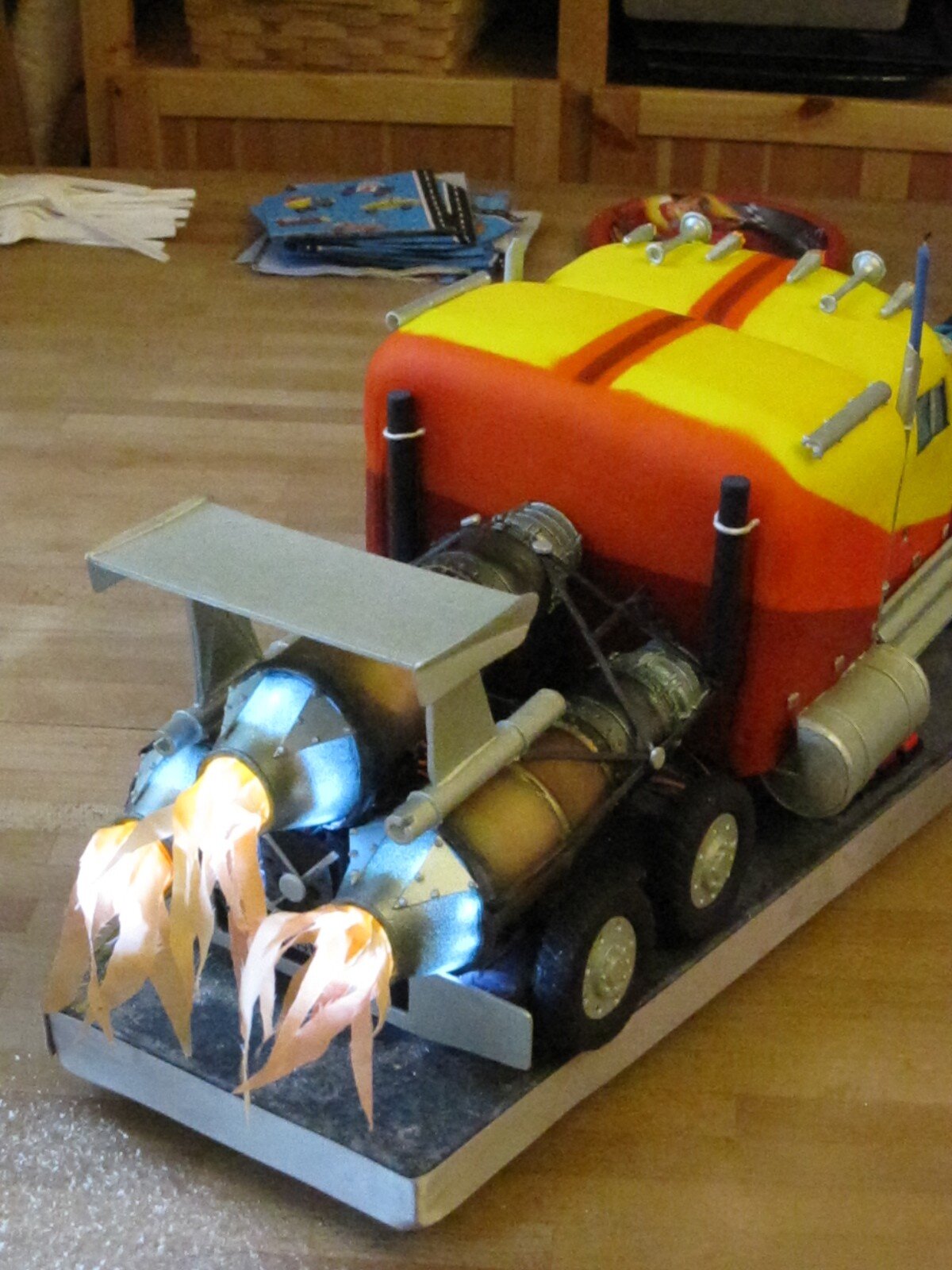
Since the planned birthday party would be attended by numerous small children, I decided that having actual flames shoot out the back of the cake would be a bad idea, even if I could accomplish it in a food-safe way. Instead, I planned to make basically a miniature version of the flames on those plastic Halloween cauldrons where a light and a fan inside the cauldron make some waving fabric look like relatively convincing flames.
Ultimately, it didn’t work out nearly as well as I had hoped, for several reasons:
1) Initially I had hoped that I would be able to substitute something edible for the fabric “flames” but I was unable to come up with any food item that was thin, dry, lightweight, and flexible enough to fit the bill. The closest I came was the skin of a bell pepper, but that was too brittle when dried.
2) I bought white fabric, but then dyed it red and orange with food coloring, which stiffened it a bit more than was optimal so it didn’t move as fluidly as I wanted.
3) Fans small enough to fit inside a 2” diameter gum paste rocket aren’t all that powerful. I bought a couple of different ones to try out. I thought the ones I decided on would work, but once I got them all the way hooked up with the fabric I found that they didn’t have enough punch to move strips of fabric more than a couple inches long.
4) When I stuck the fabric to the gum paste rockets, I did it in such a way that the air only passed over one side of the fabric, not both. Unfortunately, I didn’t realize what a big error this was until it was too late to do anything to fix it.
5) When I installed the fans and rockets on the cake, I didn’t leave enough room at the back of the rocket for air to get sucked into the fan. Again, I realized the error too late to correct.
So the flame effect wound up being mediocre at best, but otherwise I think I captured the essence of the jet truck pretty well.
For the base, I started with a trapezoid of plywood. I guess I though that a trapezoid would give it more of a sense of motion than a rectangle, but I’m not sure it really did much. I used grey run-in royal icing, with white and black food coloring sponged on to make it look like asphalt. On top of that I painted yellow lane markers with thinned royal icing and then yellow food coloring.
To raise the body of the truck up off the ground, I mounted a second, thinner piece of plywood, on top of some sections of 1” aluminum channel, positioned so that that channel would later be hidden behind the tires. I covered this piece of plywood with black fondant.

At this point I did all the wiring for the fans and the LEDs to light up the inside of the rockets. I got some nice big red buttons to turn them on and off because I thought that Alex would enjoy that.
Next, I used gum paste, detailed with royal icing, to make the rockets, the grill, the spoiler, the hubcaps, the wheel wells, the fuel tanks, the bumpers, the reflectors, the license plates, and so on and so on. I used fondant for the tires and a few of the other bulkier trim pieces.

Shiny chrome truck bits gave me a chance to try out my new metallic edible airbrush colors. I was a bit skeptical, but they worked great. I was especially pleased with the job I did on the rockets.

For the cake itself I started with three 10” square cakes, carved into the two separate pieces of the cab, then crumb-coated with buttercream. Once covered with fondant, the corners were more rounded than I wanted, giving the truck a more puffy, cartoon-ish look than I would have liked. I’m reaching the conclusion that the only way to get nice, sharp mechanical corners is to pre-make gum paste pieces like I did for the Tardis cake.

My plan was to cover the front cab section first with blue fondant then with yellow fondant so that I could cut the yellow fondant away from the windows revealing the blue fondant beneath. (This is after I decided that my original plan to actually create an interior for the truck that could be seen through the windows was not feasible in the time I had available.) I have never personally tried this technique before, but I have seen them do it many times on Ace of Cakes, so I figured I ought to be able to do it easily. It probably would have worked just fine, except that I decided to wait to cut out the windows until after I airbrushed the orange and red stripes onto the cake.
Masking parts of the cake off and airbrushing is another technique I’ve seen on Ace of Cakes, but this was my first try at it. It worked relatively well, but next time I’ll be more careful with my masking, since I did have a few spots where the color bled under the paper.

By the time I was finished airbrushing, the top yellow layer of fondant had completely fused to bottom blue layer of fondant, so it was utterly impossible to remove one without removing the other. So I cut all the way through both layers for the windshield, the side windows, and the front grille, all the way down to the crumb-coat, and then stuck a new piece of blue fondant into the hole. To give it a window-like gloss, I painted a layer of piping gel onto the windows.
Assembling the rockets around the fans and the lights was a bit of a challenge, both because I kept getting confused about which side of what rocket each wire was supposed to go on and because I had underestimated the required length of a few wires and had to splice in some extra pieces.
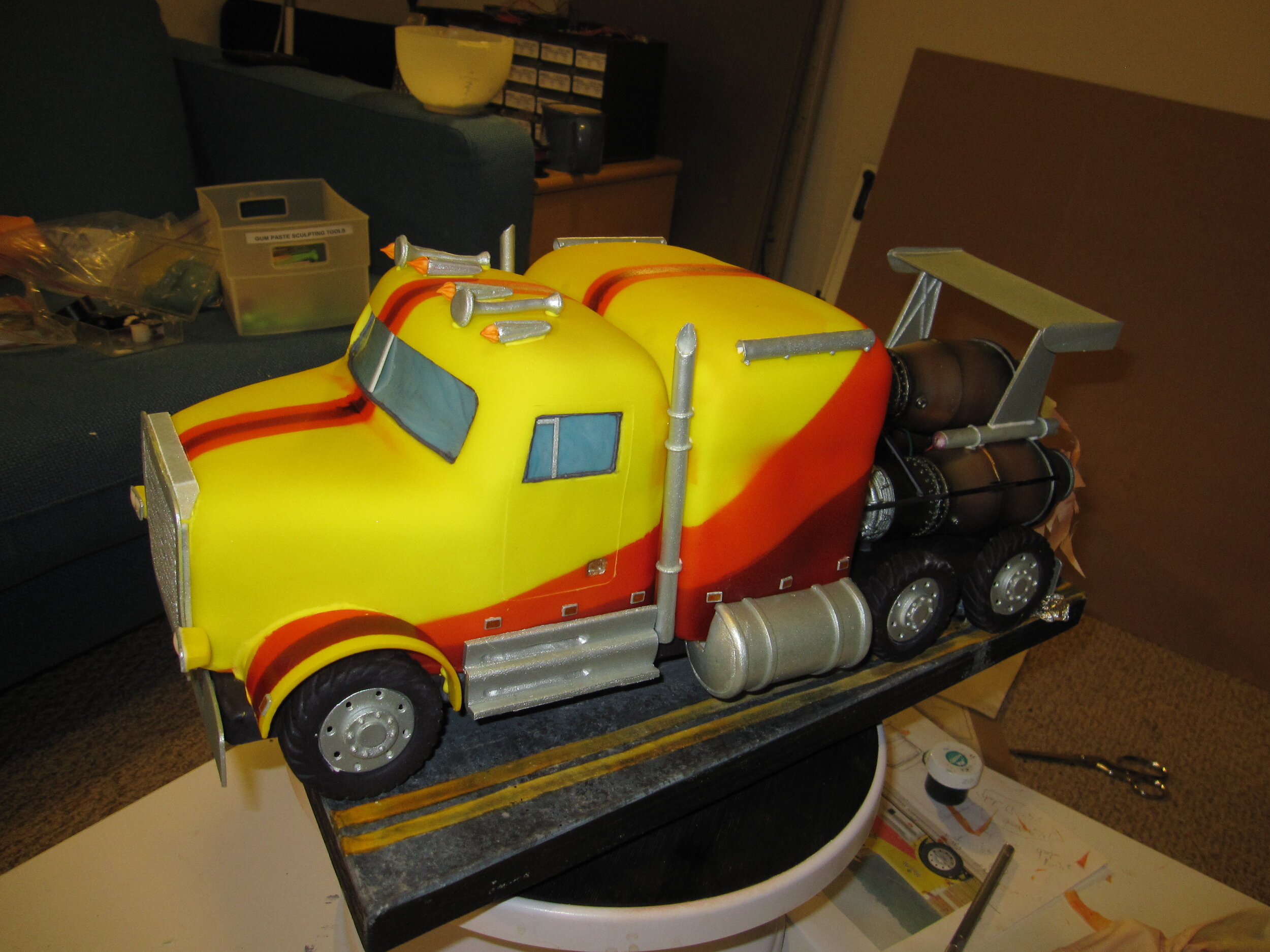
Then it was just a matter of attaching tires, fuel tanks, trim, etc. and running a strip of ribbon around the edge of the base to hide the side of the plywood. I stuck the candle into one of the exhaust pipes.

I’m happy to say that Alex was delighted with the cake, even though the flames were a little lame.
I tried putting edible glittering into the rockets so that it was blown out when the fans were turned on, but that wasn’t too dramatic either. Mostly I think Alex just liked pushing the buttons.
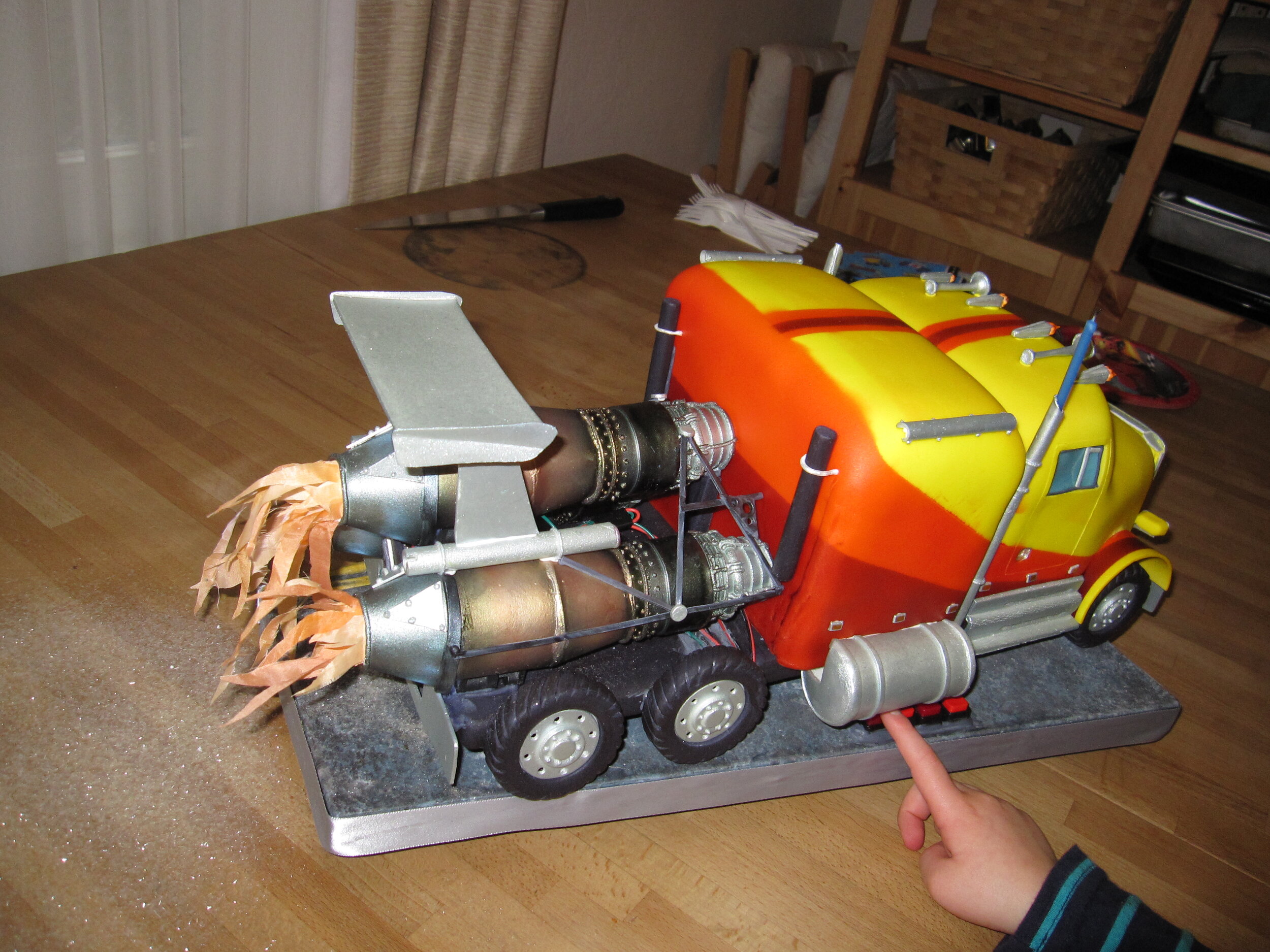
Sam was pretty impressed with the cake, too, although he didn’t actually get any of it, because I foolishly used a chocolate cake recipe that involved almond extract and my sister didn’t want to give him nuts yet for fear of allergies, so we made a last minute emergency batch of cupcakes with a nut-free recipe. Sam was very much in favor of the cupcake. I think the only food I’ve ever seen him enjoy more was pumpkin pie. Alex, on the other hand, was most entranced with eating the gum paste pieces. At one point in the party she ran past me, doing a little happy dance, singing, “I have an exhaust pipe!”

Flying Saucer Cake
The occasion for the cake was my friend Isaac’s third birthday party. My goal in this design was to evoke the classic B-movie spaceships from the 50’s and 60’s (the title of the party’s evite was “Plan 3 from Outer Space”.)
I began this cake flush with the success of my recent Tardis cake. I received a bit of a comeuppance.
The occasion for the cake was my friend Isaac's third birthday party. (You may remember Isaac from his second birthday cake and his first birthday cake.)
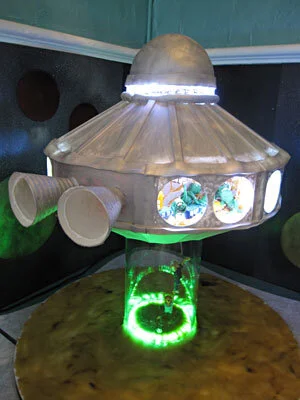
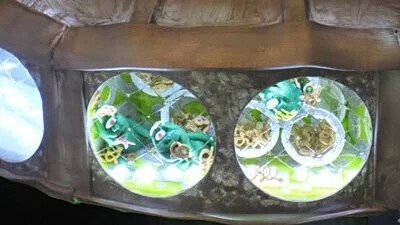
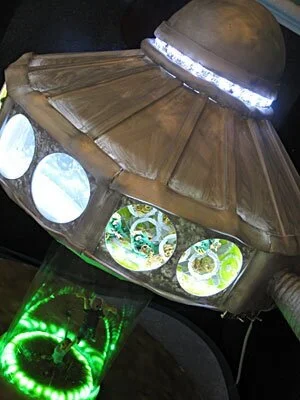
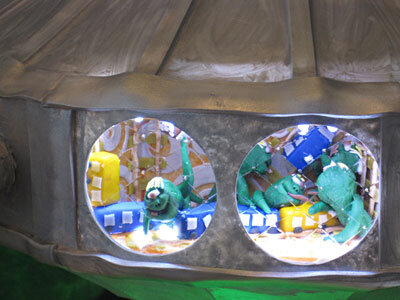
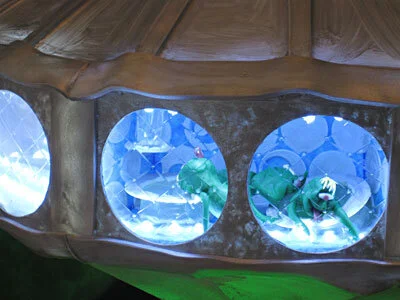
My goal in this design was to evoke the classic B-movie spaceships from the 50's and 60's (the title of the party's evite was "Plan 3 from Outer Space".) As I had so recently completed the Tardis cake, I was still interested in cakes with mirrors, LEDs, and visible interiors. I also wanted to personalize the cake, by including Isaac (in alien form), abducting his parents (in human form). So I designed a classic silver flying saucer with round portholes around the sides that would look into the lighted interior rooms of the ship, where alien Isaacs would be doing things that human Isaac loves to do - eating pretzels, climbing on unsafe things, splashing in a pool, and playing with trains. The entire ship would be mounted on a turntable, so it could slowly rotate. The turntable in turn would sit on a clear acrylic tube, representing the ship's tractor beam, within which I would enclose gum paste figures of Isaac's parents, in the process of being sucked up into the ship.
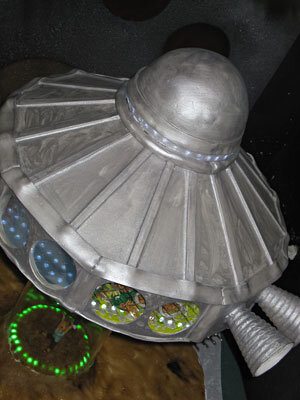
To make the rooms inside the ship, I started with two pieces of foam core - a 14" diameter circle for the bottom and a 14" diameter 2" ring for the top, so that I would later be able to put the cake inside. I split the space into eight equal slices with gum paste dividers, each with a row of white LEDs on top and bottom. I backed every other space with mirror, so that when their corresponding portholes were backed with mirrored window film and the LEDs were lit, they'd be mirrored ad infinitum within the ship, creating a spacey infinite corridor. For one of these spaces I used red LEDs instead of white, as that was where the conical thrusters would connect to the ship, thereby evoking a combustible power source.
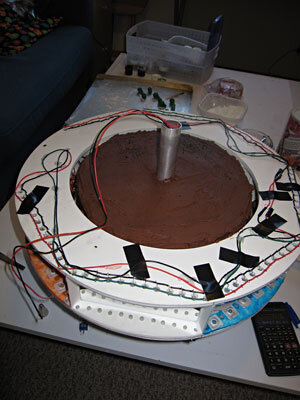
The remaining four spaces became the rooms for the alien-Isaacs. Because I was going for a little-boy's-birthday vibe combined with my 60's B-movie vibe I painted one room aqua, one lime green, one orange, and one yellow. These are all also colors that Isaac's mother has used to decorate their house. Then I appliqued each room with various gum paste squares and circles, painted silver.
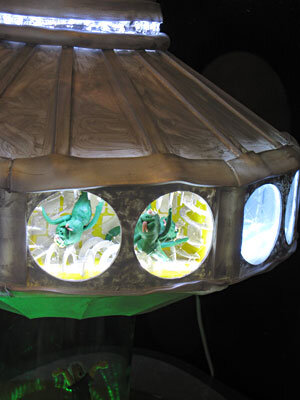
I made the aliens out of gum paste, serpentine with green skin and one big eye. To make them reminiscent of Isaac, I gave them puffy cheeks and little shocks of blond hair.
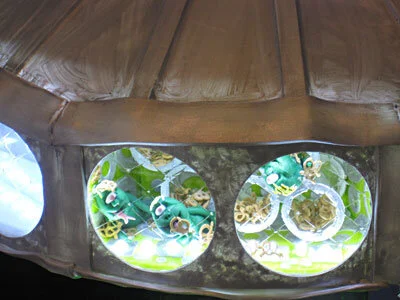
For the portholes, I used a template to cut out gum paste rectangles with windows in them, and draped them over custom forms to dry. The thrusters were also gum paste, wrapped around cones to dry, and then coated with royal icing for a sort of corrugated steel texture. Once the portholes dried, I used royal icing to stick sheet gelatin window panes to the back and, in the case of the portholes in front of the mirrored room, a layer of mirrored window film.
My sister kindly baked the cakes for me. There was space inside the perimeter defined by the rooms to put a 3" tall 10" diameter cake.
To make the tapered upper section of the ship, I started with a 10" diameter cake on top of a 14" diameter cake. I carved these into a truncated cone, 3" high, tapering from 14" diameter at the bottom to 6" diameter at the top. To get the appropriate architectural feel, I covered the cake with a layer of fondant and then the fondant with 16 pre-made gum paste trapezoids. Then I dropped this whole section on top of the cylinder with the rooms.
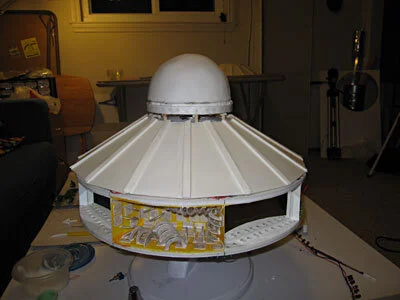
For the very top of the ship, I carved some 6" round cakes into a hemisphere and covered that with fondant. I mounted this cake onto a foam core circle in which I had embedded a ring of LEDs and mounted it on top of the other cakes.
With the main body of the cake assembled, I needed to get the base together. I embedded a ring of green LEDs into the plywood base to illuminate the tractor beam and then set about creating the people being abducted. I started with a wire armature and built up the figures in gum paste around that.
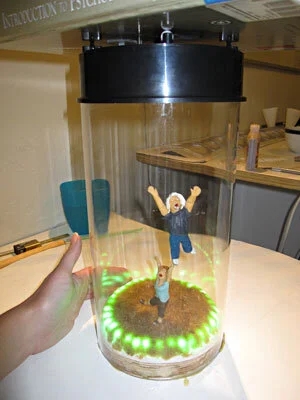
Once the figures were complete I installed the acrylic tube around them and then glued a turntable to the top of the tube. I had considered mounting the turntable at an angle, but I decided that might make it too hard for the turntable to rotate, so I kept the turntable level. As it turned out, I needn't have worried because the moment that I transferred my cake to the turntable it became clear that the turntable was nowhere near powerful enough to turn such a heavy cake. And thus my cake became stationary. Actually the turntable wasn't a total waste, as it still allowed me to turn the cake manually. This was convenient, since the cake was designed to be viewed from all angles, but it certainly lacked pizzazz.
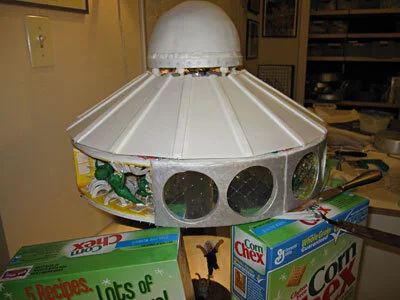
With the cake mounted on the base my flying saucer still needed to taper at the bottom. Unfortunately, it proved to be far too difficult to attach the gum paste pieces that I had created for the bottom of the flying saucer and by this time it was so late that the royal icing would never have had time to dry. So I was forced to hot glue my Bristol board mockup to the bottom of the turntable. I don't like using non-edible materials any more than necessary, but in this case I felt that it was just too late to do anything else.
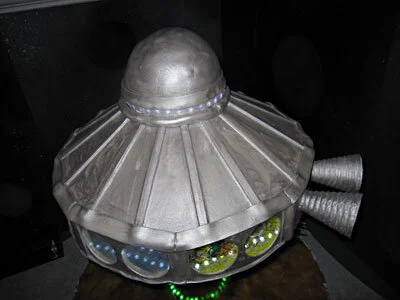
In fact, by this time it was about 5:00 am the morning of the party and it was too late for a lot of things. I had planned to finish all the edges very cleanly and wind up with a very polished final product that would live up to the standard that I set for myself with the Tardis Cake. Sadly, at 5:00 am, this was not meant to be. The best I could do was to whip up a few fondant ropes to cover the most egregious seams, slap a coat of silver luster dust on everything and go to bed. I was not thrilled with the results. I'd like to claim that it was some sort of homage to the shoddy special effects that we all love so much in our B-movies, but the sad truth is that it was just poor time management.
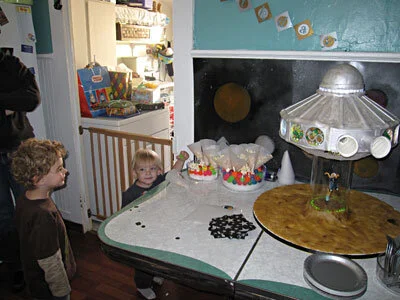
The next morning I just had time to cover the plywood base with a layer of pressed sugar and make it to the party in time to help hang up the decorations. The cake did make the car trip with no untoward effects, but there evidently was a lot of moisture trapped in the acrylic tube because the figures' gum paste limbs softened and wilted, so where their arms had meant to be pulled upwards by the inexorable force of the tractor beam, instead their arms curved despondently towards the earth.
I actually don't mind an occasional failure. When you're pushing the boundaries of a medium you have to expect a few unsuccessful trials. This failure irked me however, because in this instance my failure was not due to excessive ambition but to deficient planning. I view the first type of failure as an inevitable result of man's eternal striving to better himself, but the second is merely the inevitable result of opting to watch America's Next Top Model instead of working on the project at hand.
TARDIS Cake
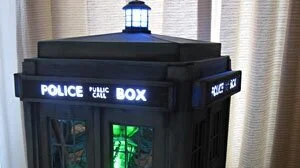
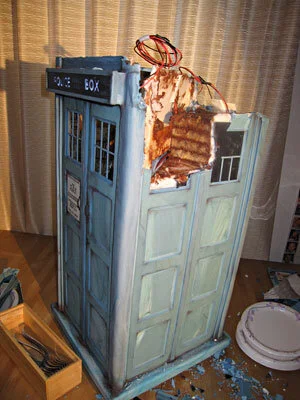
It's a TARDIS! It's bigger on the inside! It's two feet tall (quarter scale)! And aside from the lights, everything you see is edible.
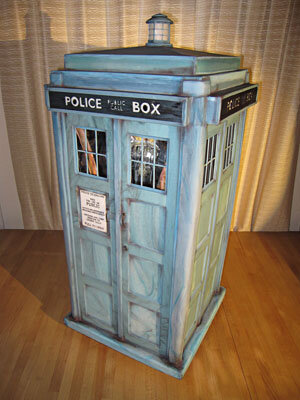
It's a TARDIS! It's bigger on the inside! It's two feet tall (quarter scale)! And aside from the lights, everything you see is edible.
I love Dr. Who. Just a few weeks ago my sister-in-law and I waited in line for five hours to get good seats at the Dr. Who panel at Comic-Con. Totally worth it!
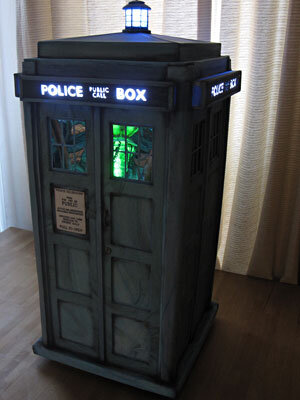
Since I would have to be a Time Lord to make a Tardis cake that could actually go anywhere in time and space, I decided to do the next best thing - make a Tardis cake that's bigger on the inside. Or at least appears to be. Like I said, I'm not a Time Lord. I chose to go with the new Tardis interior because, as it is both more organic and more interestingly illuminated than any previous Tardis interior, I thought it would be the most visually effective.
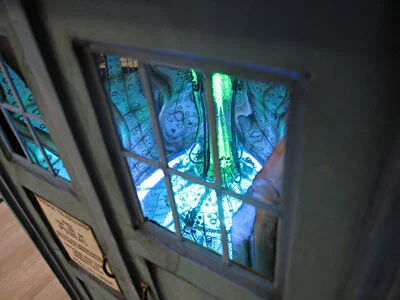
First I had to figure out the best way to create the illusion of a more spacious interior. I tried to consult the internet about optical illusions, but didn't find anything helpful, so I went with old fashioned trial and error. I played around with a lot of different configurations, eventually settling on two convex mirrors arranged at about a 45 degree angle. To get the curve I wanted, I used flexible carnival mirror, glued onto my custom made wood and mat board form.
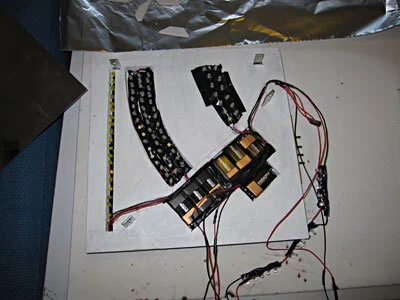
Next, in order to illuminate the inside of the Tardis and the "Police Box" signs on the outside, I needed to learn at least a little bit about electronics. So I ordered a DIY Electronics Kit from the MakerShed that was really sort of geared for pre-teens, but it was also very helpful. Armed with new-found knowledge of resistors and LEDs, I trolled the internet for the best deals and ordered a total of 385 LEDs in blue, aqua, green, yellow, white, and flashing white. They didn't all make it into the cake, but I did wind up using enough of them that I used seven nine-volt batteries to power them. I embedded these batteries into a plywood base and mounted the mirrors.
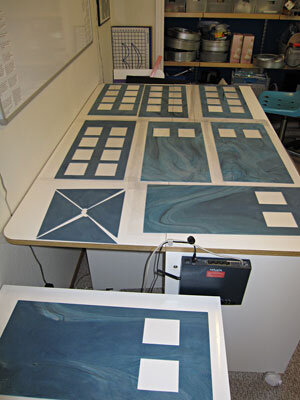
With my structure in place, it was time to start making gum paste pieces. The exterior required fifty-two separate pieces of gum paste - two for the panels on each of the four sides plus one inward-facing panel for the side that looked into the interior and three to back the windows on the other three sides, six for each of the four "Police Box" signs (some of which were quite tedious, as I had to painstakingly cut out the words to let the light through), and sixteen for the roof. Later I needed an additional seventy-two pieces of gum paste for the window frames and mullions. I went with a grey-blue marbled effect because I thought it would look more convincing and more interesting than a uniform color field.
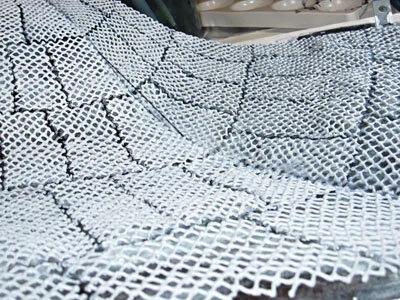
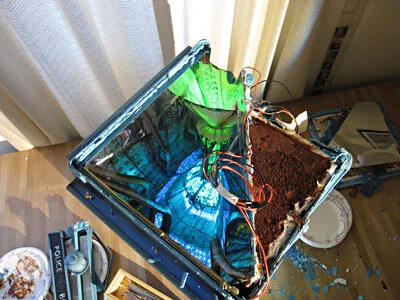
To make the interior I started with a gum paste floor with cutouts to let the light through from all the white LEDs embedded in the base. In order to enhance the illusion of interior space and elevate the bottom of the central console sufficiently to make it easily visible through the windows, I gave the floor a serpentine curve, supported by gum paste struts. Then I stuck a layer of rice paper to the top of the gum paste floor and painted it dark grey with food coloring. On top of this I piped grey royal icing expanded steel. It went pretty quickly, because I got a lot of practice making royal icing expanded steel when I was making the Demolition Cake. To give it a nice sheen, I went over it with some silver luster dust.
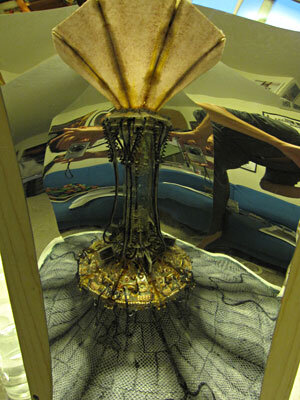
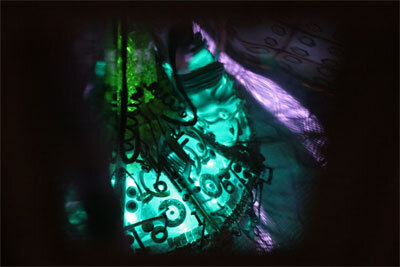
Now it was time to make the control console. Fortunately, thanks to the mirrors, I only needed to make one eighth of it. The console structure is gum paste and sheet gelatin, assembled around blue, green, and aqua LEDs and attached to the mirrors with clear piping gel. Then I had a good time sticking on a myriad of gum paste and royal icing levers, dials, cables, monitors, etc. At times the mirrors made things a little difficult because it was sometimes hard to remember which was the real console and which was the reflection. Liberal use of silver, bronze, and gold luster dust made everything nice and shiny.
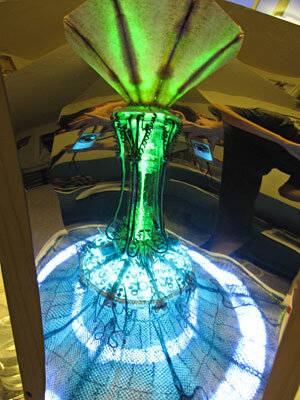
With the interior finished, I assembled the exterior gum paste pieces, adding the royal icing molding around the perimeter of each recessed panel, and installing the window mullions and backing.
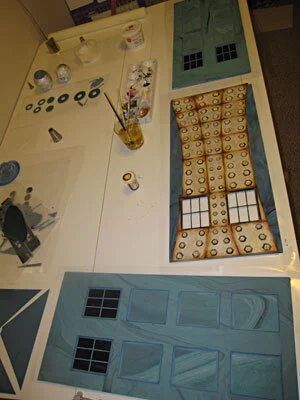
It was at this point in the process that we decided that we really should schedule a party so that we would have something to do with this cake when it was finished. Fortunately, we have a lot of nerd friends, so we soon had about forty positive rsvps to our evite. It was also at this point in the process that I took some time off to go to Comic-Con and then on a family trip to Colorado, so my gum paste pieces had a long time to thoroughly dry. This was definitely an advantage, because it would have been very hard to assemble the cake with anything less than 100% dry gum paste and because the pieces were so large that they did require some significant drying time.
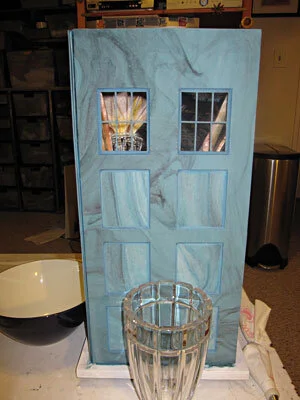
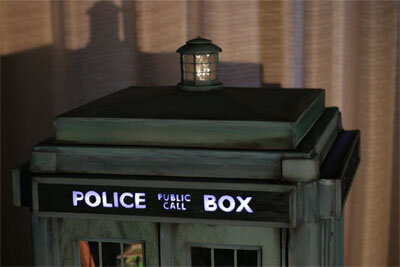
A week before the party I began assembling the exterior, beginning by putting together the "Police Box" signs around my strings of white LEDs. I backed the cutout letters with rice paper, both to diffuse the light and so that I could stick the free-floating interior pieces of the O's, P's, A's, and B's to the rice paper.
Because of the mirrors and the interior space only a little less than half of the interior was actually going to be made of cake. This meant that I could install two of the four sides prior to baking any cake and even attach and solder their respective "Police Box" signs.
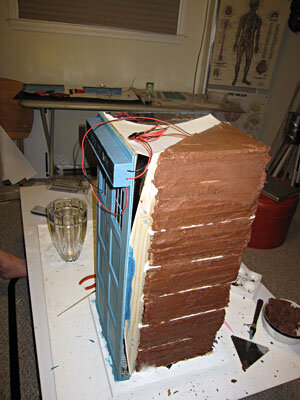
Three days before the party I baked the cake. We decided to go with a banana cake with chocolate buttercream icing because, to quote the Doctor, "You should always bring a banana to a party. Bananas are good." I needed a total of eight two inch tall, ten inch square cakes. Of the eight cakes, seven of them were cut in half on the diagonal and stacked in the body of the Tardis. The last cake was reserved for the square top section.
With the cakes in place, I covered them with a layer of fondant, to prevent the gum paste exterior pieces from coming into contact with the buttercream, which would moisten, soften, and weaken the gum paste. Then I was able to install the last two side pieces and their respective "Police Box" signs.
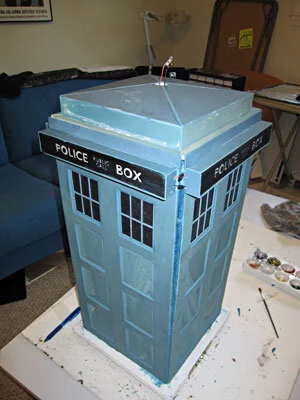
I put the top section together separately, carving the slanted roof, covering it with fondant, and then assembling the gum paste pieces around it with royal icing. I left a hole through the middle, so that I could run blinking LEDs through it for the light on top. Once the top section was in place, my Tardis really started to look like a complete piece, but it still needed a lot a detail work.
I used fondant rather than gum paste to cover the base and for the trim on the corners and in the center of each side panel because some of them needed to be relatively thick, which is easier to accomplish with fondant. I did use gum paste, however, for the thin strips of molding around the perimeter of each "Police Box" sign.
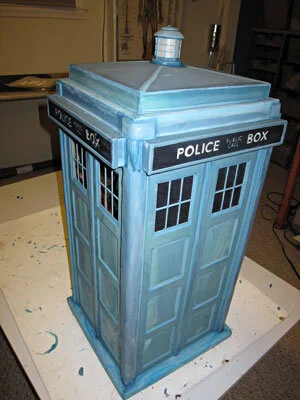
To make the little light on top, I wrapped rice paper around gum paste circles, then put panels of sheet gelatin on top of that, followed by gum paste trim and royal icing mullions. The curved top is gum paste dried over Styrofoam balls.
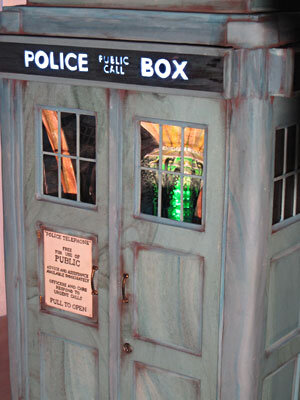
With all the major features in place, I went over the entire structure with royal icing smoothed with a damp paintbrush, to hide unwanted seams and fill in a few gaps. Then, to give it that distressed look of a vehicle that's been to the end of the universe and back again, I went into all the corners with some black powdered food coloring on a soft paintbrush.
To make the sign for the front of the Tardis, I blew up an image of it to the correct size and then essentially made some edible transfer paper by coating the back with black powdered food coloring. I put this on top of a dry white piece of gum paste and traced all the letters with a stylus to transfer the text onto the gum paste below. Then I painted over the letters with black paste color.
The finishing touches were the royal icing handles, hinges, and tacks to hold on the sign, and the gum paste lock.

Carrying the cake to the table for the party was a bit stressful and difficult, as it probably weighed fifty pounds and all of the weight was in one half of the cake. Part of me was convinced that, after literally months of planning and building, I was going to drop it at the penultimate moment. But actually the move went perfectly smoothly. I got my brother-in-law to help me and he even bravely volunteered to carry the heavy end.

I'm really pleased with the way this one came out, maybe more so than any cake I've ever made before. Please note that, with the exception of the mirrors, the electronics, and the wooden base and dowels and foam core separators that would needed in any cake this size, it is entirely edible. (And if anyone knows how to make an edible mirror, please let me know.) It's hard to capture the "bigger-on-the-inside" effect in a photo, but I do think it was pretty darned successful. By an odd coincidence, Cake Wrecks (one of my favorite websites) did a Dr. Who post on the very same day that we had our party, so I immediately sent them photos of the cake, mere hours after it had been consumed, and they very kindly posted it right away!
For hours after we attended the Dr. Who panel at Comic-Con, my sister-in-law and I were all a-twitter about how awesome it was; now I still kind of feel that way about this cake.
Dinosaur Graveyard Cake
Pastry arts for a good cause – this cake was raffled off at a fundraiser for my niece’s preschool.
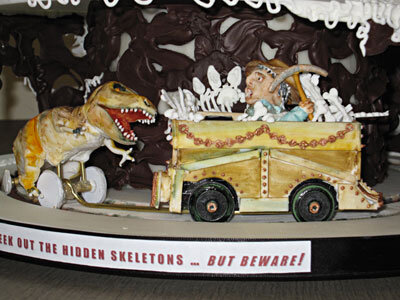
Pastry arts for a good cause - this cake was raffled off at a fundraiser for my niece's preschool.
My niece's pre-school was having a fundraiser. My challenge - make a cake for the raffle that fulfilled all of the following conditions: The cake should be:
Small enough that people wouldn't be intimidated by the prospect of eating it.
Sturdy enough that there would be minimal possibility of breakage when the winner transported it home.
Enough like a normal cake in appearance that people would recognize it as such when walking by the raffle table.
Appealing enough to the average two-to-four-year-old that he or she could be counted upon to pester his or her parents into purchasing raffle tickets for it.
Appealing enough to the average parent of a two-to-four-year-old that he or she would be willing, with some childish prompting, to spend a few bucks for a raffle ticket for a good cause.
Appealing enough to me that I wouldn't get bored making it.
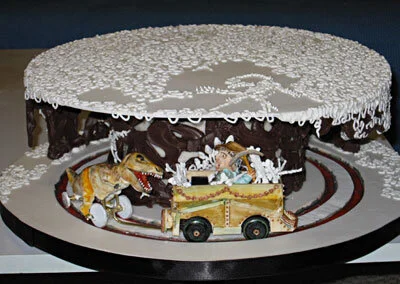
Collectively, these represent waaaay more constraints than I have ever had placed on one of my cakes before. Prior to this, my biggest restriction was when my sister and I made a cake for our friends' wedding and they said that, ideally, it probably shouldn't bleed, explode, or catch fire.
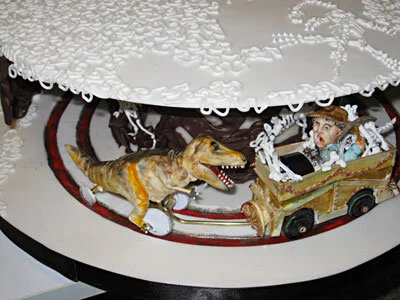
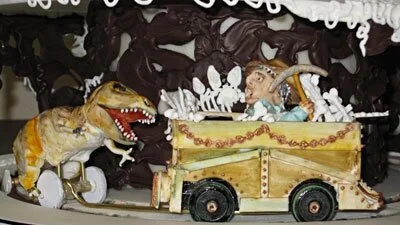
So I had a bit of a challenge developing an initial concept, but ultimately I came up with a solution that I think fulfilled all the requirements. Viewed from one angle it would appear to be an ordinary 12" round cake, covered with white fondant, delicately decorated with cornelli lace, so as to appeal to people who like their cake to look like cake. From the other side, however, the fondant would be cut away to reveal a subterranean tunnel with a train going around and around, so as to appeal to the toddler set. The train would be pursued by a ravenous dinosaur, so as to appeal to me.

I think I can best explain the process of construction by breaking it up into its component elements.
The train:
The first thing I needed was a way to make the train go. I figured the easiest thing to do would be to get some kind of battery operated car toy and build my train around it, so I went to Toys R Us. Mind you, I detest Toys R Us, for various reasons that I needn't go into here, but I was in a hurry and it was my best option for a quick solution. The toy I selected was a battery operated Thomas the Tank Engine, which turned out to be delightfully easy to decapitate, leaving me essentially with a AA battery on wheels.
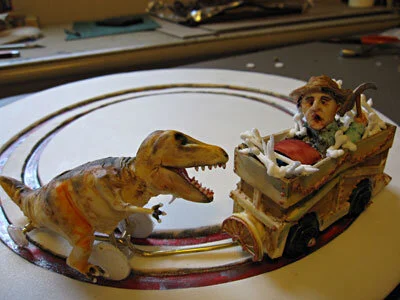
In keeping with the subterranean / archeological theme of the cake, I found a photo of an old-timey mining cart to work from. First I encased the body of the train in a box made of flat gum paste pieces, with semicircles cut out to accommodate the wheels, then I added additional gum paste wooden slats. I used one of the semicircular cut off pieces from the wheels to cover the little magnetic hookup that toy train cars have on the back. I also made a cow catcher for the front. Because of all those cows that archaeologists encounter in underground caves.
I wanted to cover the wheels (which were bright green) with gum paste to make them more rustic and less plastic looking, but every time I tried, the wheels came out too big for the track (more on that later) so I wound up just painting the green wheels with black food coloring.

To get some human interest into my tableau, I wanted to put a little gum paste archaeologist in the train car. After all, no self-respecting dinosaur would be chasing an empty train car - a T-Rex in particular would need the prospect of juicy meat to get him moving. I tried to make my archaeologist look really terrified, with a gaping mouth and wide, staring eyes, looking over his shoulder at his dreadful pursuer. I also couldn't resist making him a little Indiana-Jones-style hat and a pickaxe. The train had a big button on top to start and stop it. At first, my plan was to put my little man directly on top of that button so that you had to push on his head to make the train go, but then I realized that was just too risky to be worth it - who wants to see a man with a smooshed head being chased by a dinosaur? So I moved him to right in front of the button and left the button alone. I'm glad I did because by the time I was done some crumbs or something must have fallen into the mechanism because the button got a bit temperamental.
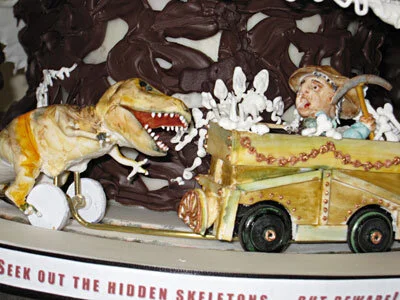
I then put a coat of paint on everything, using paste food colors thinned with vodka. It has recently been pointed out to me that using vodka to paint things intended for children might not be 100% ok, which had never occurred to me. I choose to assume that the majority of the alcohol evaporates away and that what's left is so minimal as to make no difference. Certainly my niece has shown no ill effects from the last three birthday cakes that I've made for her.
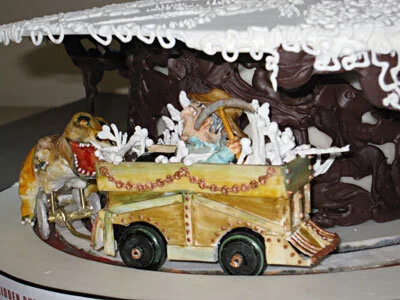
With my base coat in place, I was ready to add fine details. I made some royal icing chains and rivets. I also added some royal icing dinosaur bones around my archaeologist, and threw in some oreo cookie crumb dirt for good measure. I used some more vodka (Woo hoo! Par-ty!) with bronze luster dust to make the chains look metallic.
The track:
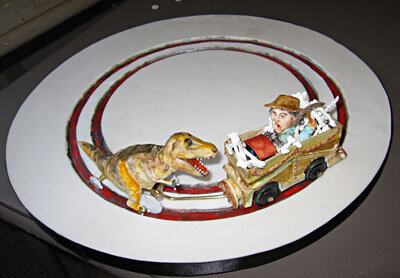
Now I had an operational train, but a train doesn't do anyone any good unless it goes where you want it to go. So I needed a track. It took me five or six cardboard mockups before I got one where the tracks were the right width and the right distance apart and correctly positioned within the circle of the cake. Once I had a functional mockup that worked with my little toy train, I covered a foamcore circle with a 1/4" thick layer of white fondant and used my mockup as a template to carve the fondant away to create the two concentric circles of the track. With the fondant cut away, I needed to do something to cover the foam core revealed underneath. After a few experiments, I settled on painting the revealed foam core base red (which frankly would have been a lot easier to do had it occurred to me to paint it red before I covered it with fondant). Because I didn't do the world's best job of this, I dusted the track with a lot of brown and black powdered food coloring and silver luster dust to try to conceal my mistakes.
The dinosaur:
A little train by itself might be interesting enough for pre-schoolers, but I have loftier aspirations. To keep my interest, the cake needed a monster. And it had to be Big! Fierce! Mean! Prehistoric! RAAAWR! I settled on T-Rex.
Step 1 - find internet photos. Of course, the internet crazies have conflicting opinions on what T-Rex looked like, so I just picked the skin texture and color scheme that seemed the most appealing to me.
I made two gum paste bodies, because I wasn't sure quite what size I wanted. I wound up using the bigger one. By letting the gum paste dry for a few minutes, so that it developed a bit of a dry shell, and then bending the body a little I was able to create a delightful wrinkly skin texture.
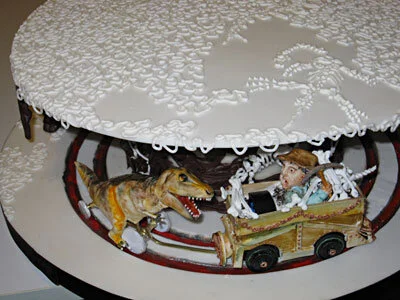
In order for the dinosaur to chase the train, it of course needed to be on wheels. My first idea was to use the wheels from a tiny little toy skateboard. This didn't work at all. For one thing, toy skateboard wheels turn out to be very flimsy and not very well aligned. I know this is a shock, considering that I bought it for $3.95 at Target. For another thing, toy skateboard wheels are extremely small, on the order of 1/8" in diameter. Since my layer of fondant between the two track circles was on the order of 1/4" thick, I clearly had a problem. I tried to salvage my skateboard wheel solution by cutting larger plastic circles and gluing them to the existing skateboard wheels. Then I realized that this was a stupid idea and I should just make the wheels from scratch.
I cut two new sets of plastic wheels, larger for the front, smaller for the back and put hot glue rims on them so as to give them the requisite traction. For the axles I used brass tubing, encased in slightly larger diameter brass tubing to allow it to rotate freely. I attached these to the body of the dinosaur by using royal icing and by cramming brass tubing up into the body.
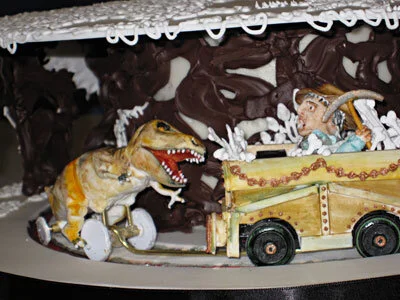
I tried to mask the wheels a little when I added the gum paste legs, but since I was simultaneously trying to position the legs as if T-Rex was in a full-out run, and since I was trying to conceal four wheels with two legs, I wasn't very successful. I chose a nice muted ochre and brown color scheme, with some purple and green details, again using vodka and paste food colors for paint. Once that dried, I used royal icing to make little teeth and claws. I of course couldn't resist adding a bit of food coloring blood to the tips.
The hookup:
I now had a train on wheels and a dinosaur on wheels but in order to make the dinosaur chase the train I needed to connect the dinosaur to the train. I cut and bent a piece of brass tubing into the correct curve. Gluing it to the dinosaur was easy. Gluing it to the train was exceedingly difficult. First I tried hot glue. Then I tried Superglue. Then I tried hobby cement. Then I tried epoxy. As it turns out, for some inexplicable reason, none of these things stick to the underbody of Thomas the Tank Engine, even after he's been roughed up with a flat file. Eventually I resorted to the king of household glues - Gorilla Glue. Because Gorilla Glue expands as it dries, I was terrified that it would push everything completely out of alignment, but it actually worked.
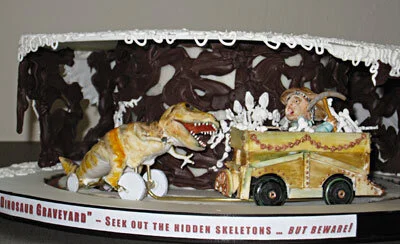
The tunnel:
With my train and dinosaur set, I needed a tunnel for them to run through. My original plan was to create a nice rocky texture by making a mold in the shape I wanted the tunnel to be, lining it with plastic produce bags (because they release easily from chocolate), filling it with crushed ice, and then pouring tempered chocolate over it. In my imagination, this technique created a beautiful organic texture. In reality, it created absolutely nothing of value because the chocolate set up before it got beyond the first layer of ice. I went to plan B.
Plan B involved making two concentric tubes of chocolate with holes in them to form the inner and outer walls of the tunnel. One would be 6" in diameter, to fit around the 6" round cake that would be in the middle of my creation. The other would be 12" in diameter, leaving a 3" tunnel for the train to pass through.
At first I envisioned creating these tubes by spreading chocolate over bubble wrap (which also releases easily from chocolate), cutting it into appropriate rectangles, and then wrapping the rectangles around cake tins of the appropriate diameter, all while the chocolate was set up enough to cut accurately but malleable enough to wrap around the cylinder. This didn't work either. By the time the chocolate set up enough to cut it was too firm to wrap, so it just cracked when I tried to bend it into the right curve. I was also having problems getting my chocolate in good temper, so it wasn't setting as firmly as I would have liked. Normally I would blame problems like this on my own relatively limited experience working with chocolate. In this case though I'm more inclined to blame the problem on the chocolate itself because, at the same time as I was making this cake, I was also making chocolates to raffle off at the event, and I was having spectacular success tempering chocolate bars that had been sitting in our cabinets for so long that they were essentially just big slabs of chalky blooms. For the cake, though, I was using a new bag of chocolate medallions from my local cake supply store and I couldn't get them in temper to save my life. So I choose to blame the chocolate.
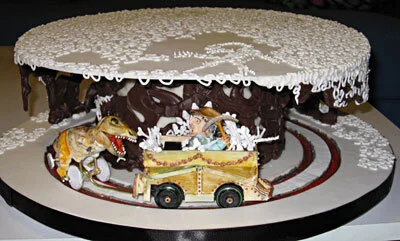
My third plan was to wrap the 6" and 12" cake pans in tin foil and them pipe tempered chocolate onto them in an abstract pattern. Due to my issues with getting my chocolate in temper I was concerned with the stability of the structure and I thought that I might get it to be sturdier and set up faster by mixing in a little corn syrup. This is a technique that I used to good effect when I made the shrunken head truffles, but in this application it just seemed to make the chocolate more brittle. So the technique that I finally ended up with was putting the tin foil wrapped cake tins in the freezer and piping the (sort of) tempered chocolate onto the cold foil in an abstract pattern with lots of open space. This helped the chocolate to firm up quickly when it touched the cold foil so that it wouldn't drip down the sides of the cake pan.
Third time's a charm. This time my plan more or less worked, although I still wasn't happy with the temper of my chocolate and my finished pieces broke in a few places when I unmolded them from the tin foil. But I figured it was nothing I couldn't repair when I put it in place around the cake.
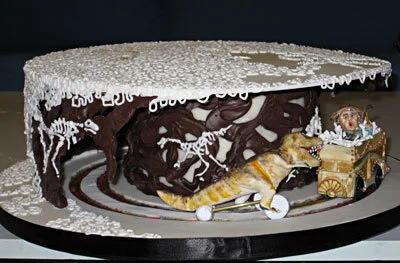
The cake:
The cake itself is actually the most boring part of this story. All I needed was a 6" round cake. I tried a new recipe for chocolate cake, but when I went to torte it I realized that it wasn't baked all the way through, so I had to make an emergency backup cake. Since I didn't have any more cocoa powder I went with a white cake, which turned out fine. I torted and filled that one with buttercream icing. My sister took the incompletely baked cake, carved a hole out of the center to remove the uncooked part, put some ice cream in the middle, and took it to a friend's birthday party so it wasn't a total loss.
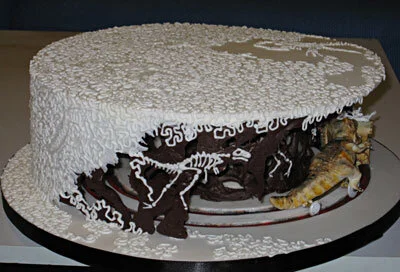
The facade:
To make my 6" cake surrounded by chocolate cylinders look like a 12" cake with a chocolate tunnel inside, I premade two pieces of white fondant. One was a simple 12" circle to cover the top of the cake and tunnel. The other piece was to go part way around the perimeter of the cake, but it also had to appear to be cut away so as to reveal the tunnel inside. I rolled out a piece of fondant, then cut it into a sort of ragged trapezoid. I used a ball tool to thin out the rough edges then draped the whole piece over the side of a 12" cake pan to get the right curve. To make sure that these pieces were dry enough to maintain their rigidity I made them a week in advance.
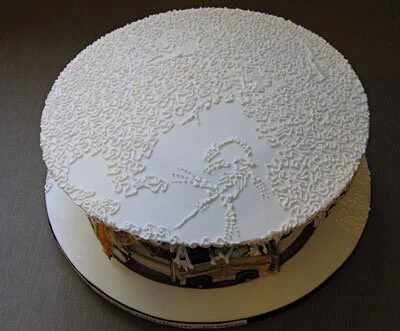
Putting it all together:
With all my components pre-made it was a simple matter to place my 6" round cake in the center of my train track and piece together my chocolate tunnel around it. For some reason my 6" round chocolate cylinder was bigger than I needed it to be, but the fact that it was poorly tempered meant that it was easy to cut a slice off to adjust.
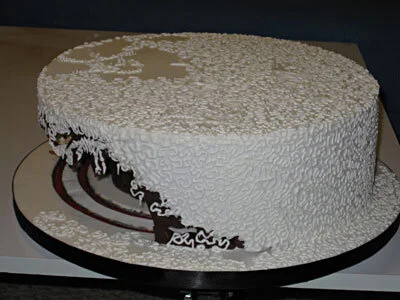
Chocolate tunnel in place, I stuck my fondant circle on top and my curved fondant piece around the edge with some royal icing. I was a bit concerned about the top fondant circle drooping, as a large section of it was unsupported. My concerns were not wholly unfounded, as close examination of the finished cake does uncover some definite unintended curvature to the top of the cake, but as it didn't seem to pose a risk of structural cake failure I didn't let myself get unduly concerned.
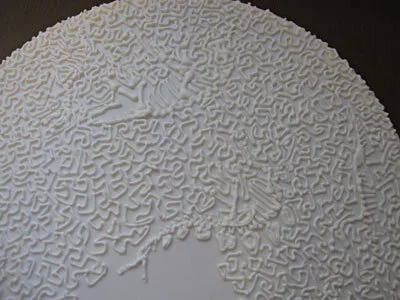
In order to integrate the dinosaur with the cake, I incorporated subtle dinosaur skeletons into the cornelli lace that I piped onto the fondant. I used a #2 tip because I was too lazy to use a #1 tip. I also put a couple of dinosaur skeletons onto the inner wall of the chocolate tunnel.
When we set the cake up at the fundraiser, we tried to position it such that children would be able to see it easily, but not grab the train. For the most part, we succeeded. Only at one point during the party did I have to shoo away a toddler who was trying to snatch the dinosaur. The cake was ultimately won in the raffle by one of the kids from my niece's preschool. I hope that he and his family enjoyed it.
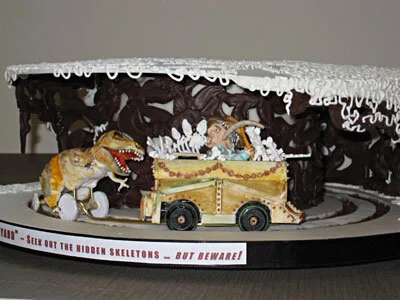
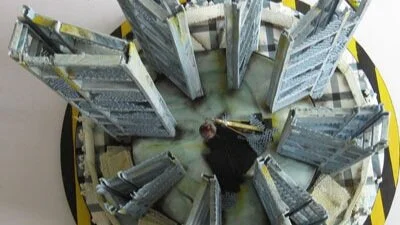
Demolition Cake
The Demolition cake was created for my truck-obsessed niece’s third birthday party.
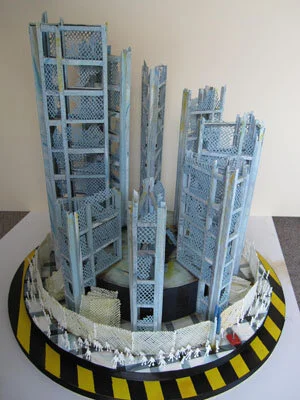
The Demolition cake was created for my truck-obsessed niece's third birthday party.
Most people would tell you that a 3-year-old's birthday party is likely to involve quite enough carnage and demolition without any help from the cake. I am not one of those people, especially since my 3-year-old niece Alex is extremely passionate about demolition, construction, and more or less anything that involves big machines.
So I thought that a wrecking-ball cake would be ideal for her demolition-themed birthday party (if that isn't bowing to the inevitable, I don't know what is.) Of course, a wrecking ball cake that didn't actually wreck anything would be utterly pointless, so my first step was to come up with a good, working wrecking ball mechanism. I was concerned that if I made a wrecking ball that simply sat next to the cake that it was intended to wreck, the composition wouldn't be unified enough. I also didn't want to have to make an entire crane to support the wrecking ball. So I came up with a plan where a wrecking ball would rise up out of a circular cake and spin around in a complete circle, knocking down a series of gum paste buildings around the perimeter. This concept was also nicely in keeping with my series of self-destroying cakes, previous examples of which include the Melting Head Cake, the Fountain Cake, and the Self-Digging Cake for Alex's second birthday.
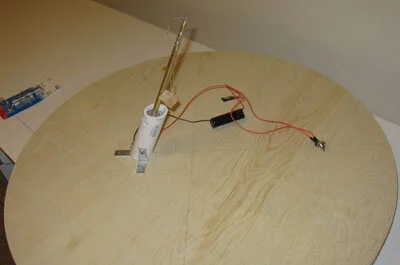
The wrecking ball mechanism consisted of a brass tube attached to a hobby motor, which spun inside another, larger-diameter brass tube. The hobby motor was encased inside a piece of PVC tubing, so that the cake (with a pre-cut hole in the middle) could just be slipped around it. The spinning tube had a hole drilled in the tip, to which I could tie a little piece of wire, the other end of which would ultimately be attached to the wrecking ball.
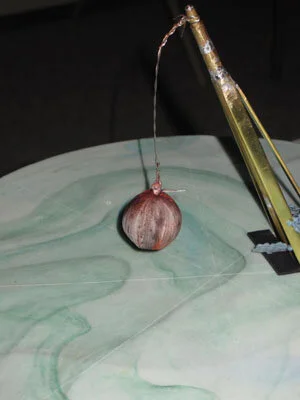
I went through a few iterations of wrecking ball tests. My first plan was to make the wrecking ball out of hard candy, embedding the wire in it when I poured the sugar. They turned out OK, but then I got worried that the sugar ball might shatter when it hit the cake and I also bought a silicon sphere mold that resulted in sugar spheres that were altogether too big and heavy for the power of the motor. My next idea was to make the wrecking ball out of marshmallow, on the theory that marshmallow would be tough enough to break the cake but spongy enough not to shatter. This turned out not to work at all, as homemade marshmallows are significantly poofier than commercial marshmallows and couldn't wreck their way out of a wet paper bag. Proving that old axiom that the third time is the charm, my third idea was modeling chocolate. This way I could roll balls of modeling chocolate to whatever size I desired, then punch holes through the center to attach the wire. This worked well, except that on my first try I only ran one wire through the middle of the modeling chocolate ball, and when I turned the wrecking ball on the wire just sliced right through the chocolate and the ball went flying. I found out, however, that if I distributed the wires at four points around the ball the centrifugal forces were dispersed enough that the ball stayed intact. I also covered the ball with a layer of royal icing and a dusting of powdered colors to make it look more iron-like.
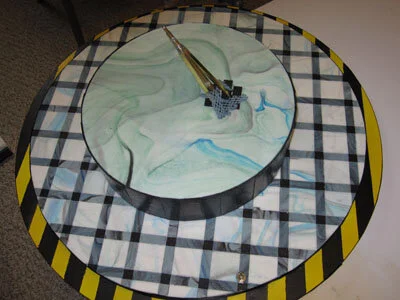
With wrecking ball methodology ascertained, the next step was creating and decorating the cake base. The bottom of the base was a simple plywood circle, but I also needed to layer some foamcore on top of that to hide the battery, wires, and switch for the wrecking ball. To get a little color into what promised to be an otherwise fairly drab-colored cake, I painted yellow and black caution tape stripes on the plywood. I then put a smaller circle of foam core over top of this, with appropriate holes for the battery and such, and covered that with a tiled pattern of marbled fondant. Actually, I did this twice because I didn't like my haphazard arrangement of shades of grey the first time around, so I tore it up and redid it with a much more careful pattern.
Now having a base for my cake, I set about making the sides and top. For the top of the cake, I made a circle of marbled fondant with a pre-cut hole in it for the wrecking ball. By letting this dry for a week, I wound up with a nice rigid circle that would give me a much cleaner, more architectural finished cake than I would get by covering the cake with soft fondant after it was baked. This resulted in me making the interesting discovery that blue food coloring turns green when exposed to sunlight. Fortunately, it still looked OK with the rest of my cake color scheme (at least it was a cool, grayish-green) but hopefully this can help prevent potential problems in the future. For the sides of the cake I made a series of very dark blue and purple gum paste rectangles, which looked fine, but, due to the massive quantity of food coloring involved, tasted revolting. Perhaps next time I should start with chocolate fondant.
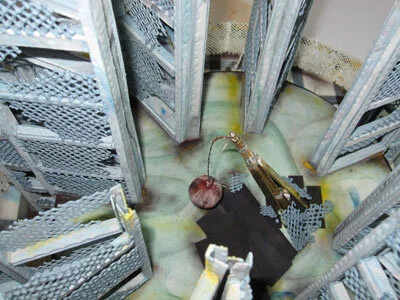
Now all I needed was something for the ball to wreck. In order to get something that would shatter nicely, I opted for skeletal buildings made of gum paste, rather than trying to smash through actual cake. I still wonder if that was a bit of a cop-out. I made a series of eight skeletal framework buildings of increasing height. I calculated that, in total, they required just over 300 feet of gum paste strips. It was a bit of a time-consuming process because I first had to roll out the gum paste, then cut it into strips and use a bit of brass tubing to create a riveted texture. Once the gum paste dried, I could cut it to the appropriate length, and then stick three pieces of each length together with royal icing to made "U-beams". (I thought about making I-beams, but decided that would be more difficult and wouldn't look as good.) After the U-beam royal icing dried, I used more royal icing to put the pieces together into each of the three sides of each of the eight buildings. I then had to wait for that to dry again before I could stick the three sides of each building together. In other words, I spent about two weeks every day after work hunched over my table sticking tiny grey bits of gum paste to other tiny grey bits of gum paste. Whee!
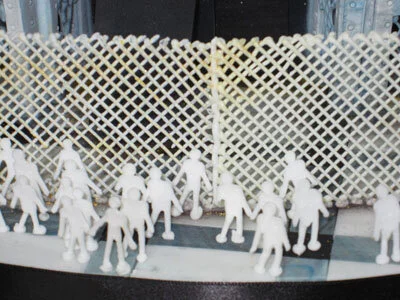
Once the buildings were done, I had to make the expanded steel (by which I mean royal icing) inserts to go between the gum paste girders. Fortunately, this went a lot faster than the gum paste project, even considering that I was also piping lots of royal icing chain link fence that was ultimately destined to go around the perimeter of the cake. I used a #2 and a #1 piping tip, so my hand did get a little sore, but that's to be expected.
Once the royal icing was dry, I just peeled it off the wax paper and stuck it into the holes of the gum paste buildings with a little more royal icing.
At this point it seemed that I really should make some actual cake to include in my cake. This was probably the easiest actual cake I've ever made, since I actually wanted it to be round, which just so happens to be the shape of normal cake pans. So, for once, no cake carving, no giant pile of gooey cake scraps, just some torting and filling, and making sure that I would up with a cake the correct height to fit with the premade buildings. I did have to cut a carefully angled hole in it to accommodate the wrecking ball mechanism, but compared to my usual practice of carving cakes into the shapes of rats and human heads and such, it was quite easy.
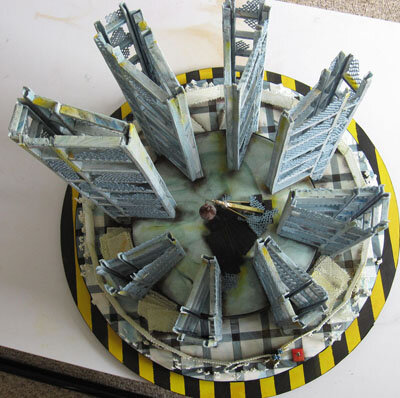
With the cake in place around the wrecking ball, it was very quick work to slap my pre-made top and sides on and place my eight building around the perimeter. I also flung some edible glitter on the sides to give it a little more sparkle.
From there it was a simple matter of placing the fence pieces, and strewing a few broken bits of girders and such about to give it more of that "in the process of demolition" feel. In retrospect, it might have made a stronger artistic statement if I had started with a complete building and wrecked that, rather than starting with an already wrecked building and simply wrecking it more.
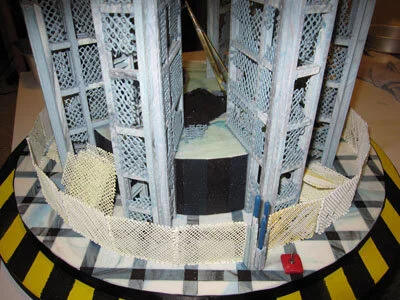
At this point it occurred to me that, as I was making this cake for a three-year-old's birthday party, it might be a good idea to incorporate some birthday candles into the design. Considering that they were a complete afterthought, I thought they turned out rather well. I encased the three candles in various heights of leftover gum paste girders and stuck them to the chain link fence, right behind the switch that turned on the wrecking ball.
To bring the whole composition together, I added some black food coloring shadows into the seams between the buildings and the cake itself and I added some bright yellow highlights to the buildings, which picked up the yellow paint on the bottom base.
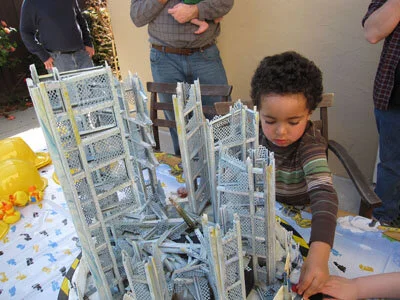
The finishing touch - little royal icing people watching from outside the fence. I like to make my sugar crowds along the same lines that I make my scale figures when I draw set sketches for the plays I design, keeping the people blank, white, and anonymous so as not to distract attention from the scenery or the cake which is the true focal point of the piece. In cake form, this tends to give my crowds a bit of a zombie-horde feel, which, as you can probably guess, I really enjoy.
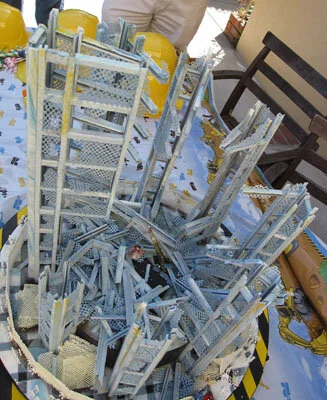
The presentation of the cake at the party went quite well. Alex was excited about tuning on the switch, but she's sort of a cautious kid, so she also kept turning it off and her friend Noah would turn it back on. So the destruction proceeded a bit in fits and starts, but eventually the ball reached full speed and full destructive capability. I wish I had made the wire on the wrecking ball just a tad longer, because I think it would have made the destruction more impressive, but all in all I was extremely pleased. And Alex looked delightfully like an angelic little blond Godzilla gnawing on the broken girders.
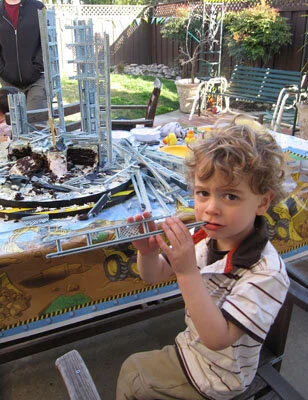
Circulating Heart Cake
Some variation on a bleeding heart cake is a relatively standard feature of our annual Pumpkinfest. This year, I was trying to make a cake through which "blood" (cranberry juice) would continuously and visibly circulate.
Some variation on a bleeding heart cake is a relatively standard feature of our annual Pumpkinfest. This year, I was trying to make a cake through which "blood" (cranberry juice) would continuously and visibly circulate.
Concept: A cake, shaped like a heart and covered with fondant, sitting on top of a platform elevated above a reservoir full of cranberry juice. In the reservoir, a pump attached to a tube leading up the side of the cake to pump the cranberry juice up and over the cake. To contain the juice and insure that it spread nicely over the surface of the cake, an isomalt (sugar substitute) shell, also in the shape of a heart, placed over the cake, leaving about an eighth inch of space for the juice to flow between the cake and the outer shell. In the opposite side of the elevated platform from the tube, a series of holes to drain the juice back into the reservoir and begin the whole cycle all over again.
Step 1: Make an isomalt shell shaped like a heart. At first, I had hoped to find something that was already in the shape of a heart, cover it with tin foil, and pour isomalt over the top. I wanted to use isomalt rather than sugar because it's more transparent. Unfortunately, in spite of having access to numerous seasonal Halloween stores, I was unable to locate anything that was a) accurately heart-shaped, b) big enough that I would be able to get sufficient cake for our guests inside, and c) able to resist the heat of liquid isomalt. I therefore had to make my tin foil heart mold from scratch. I started with a cereal bowl, upside down, and built up the rest of the heart shape around the bowl with wadded up tin foil. To get as smooth a surface as possible to pour over, once I had a shape I was happy with, I spread one final layer of tin foil on top and smoothed it as much as I possibly could. As you may recall from my description of the jellyfish cake, the problem that I often have with pouring sugar or isomalt over tin foil is that the little ridges of the tin foil get stuck in the solidified sugar and are very tedious and nerve-wracking to remove with tweezers and a damp paintbrush.
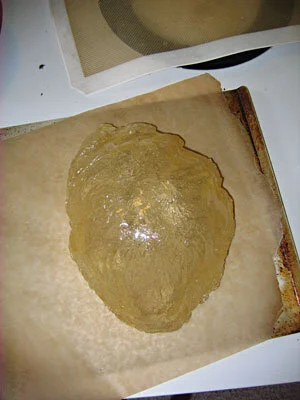
I put this tin foil heart onto a silpat mat and melted down my isomalt. In my earlier discussion of the jellyfish cake I described some of the problems that I have with making sugar domes. All of these problems apply equally to making isomalt hearts. I was also a little disappointed that the isomalt hardened somewhat cloudy, I think because I was working air into it as I pulled it back up the sides of my tin foil heart to prevent it from all pooling at the bottom. I was hoping for a transparent heart, but I had to settle for cloudy. I also think that there's something wrong with the bucket of isomalt that I have, because it always come out sort of yellow, when isomalt is supposed to be perfectly clear. At least the heart released from the tin foil better than any of my prior tin foil sugar projects.
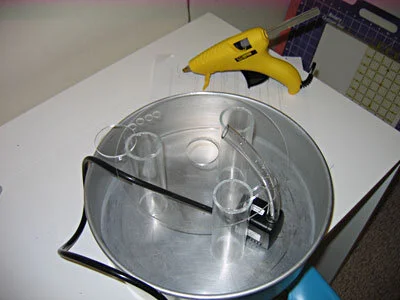
Step 2: Make an elevated platform, pump, and reservoir assembly. Rather than purchasing any new equipment for this project, with just a little glue and a few additional holes drilled, I was able to repurpose some of the acrylic circles and tubes from the Triple Animal Cake and the pump and tubing from the Fish Fountain Cake. I used a cake tin for the reservoir. Not the most aesthetically inspired choice, perhaps, but highly functional and readily available.
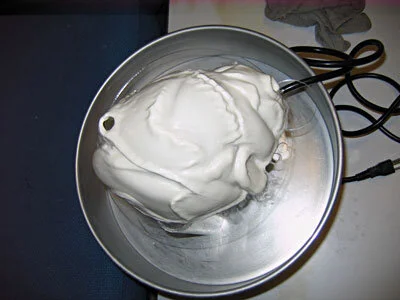
Step 3: Make a heart-shaped cake. Internal-organ-shaped cakes being something of a specialty of mine, the carving went pretty quickly. I covered it with white fondant - a much thicker layer than usual, as I wanted it to be able to stand up to the juice running over it without dissolving away and exposing the cake - then sculpted in some of the major features, like the divisions between the chambers. Then I moved it onto the acrylic platform, and positioned the tube tight up against it. To get some additional detail (though I wasn't overly concerned with extreme detail, since the whole thing was going to be under my isomalt shell) I piped on royal icing and shaped it with a slightly damp, soft paintbrush. I also covered the tube with royal icing, both to hold it in place and to camouflage it. I painted the cake with brighter colors than I might have ordinarily, because I wanted them to read through the translucent shell.
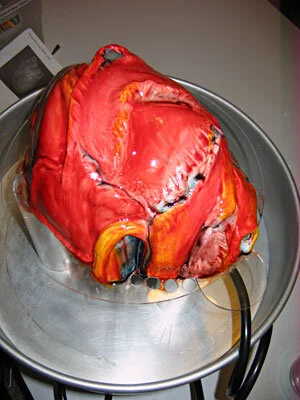
Step 4: Attach the isomalt shell. Unfortunately, once I plopped the shell over top of the cake, it looked more like an amoeba than a heart. I hadn't planned to decorate the top surface of the shell, because I wanted it to be as see-through as possible, but I felt that I had to do something to make it more identifiable. So I went over the top surface of the isomalt with royal icing details and texture, and then painted the surface with some reds and blues. This did make it look marginally more like a heart, but it also made it much more opaque, which proved to be unfortunate when I got around to plugging the pump in.
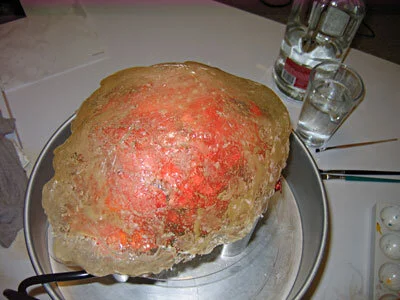
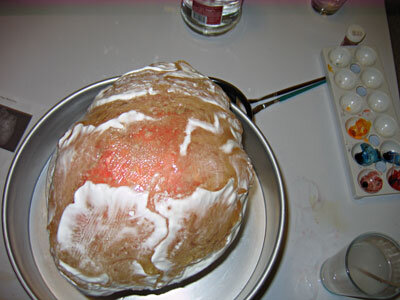
Step 5: Fill the reservoir with cranberry juice, cross your fingers, and plug in the pump. Because my isomalt was cloudy from the get-go and because I had further opaqued the surface with royal icing and food coloring, the pumping action, while technically successful was exceedingly subtle. I'm pretty sure that if I hadn't explained it to everyone, no one would have had any idea what the cake was or what it was doing. I tried to capture it on video, but all you can really see is the juice venting down the side and back into the reservoir. (Which, by the way, I really should have directed out the aorta.) The video is further compromised by the fact that my camera was in the process of kicking the bucket resulting in a distinct horizontal line across the frame and the fact that there was a toddler screaming in the background.
Conclusion: I still believe that there is potential in the concept of a cake with fluids circulating inside, but I think it requires either a) a different form factor, b) a more competent isomalt handler, or c) both.
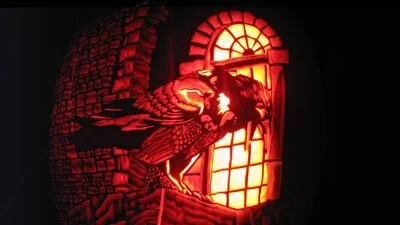
Raven Pumpkin
In my 11th consecutive year of entering the Pumpkinmasters carving contest, this is the pumpkin that finally won me the Grand Prize! Inspired by the ravens at the Tower of London, I think it represented my most effective use of textures to date.
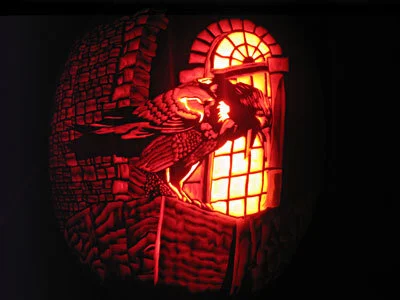
In my 11th consecutive year of entering the Pumpkinmasters carving contest, this is the pumpkin that finally won me the Grand Prize! Inspired by the ravens at the Tower of London, I think it represented my most effective use of textures to date.
Edgar Allan Poe Pumpkin
"Faces" is the only Pumkinmasters category in which I have never won a prize. This pumpkin was my latest unsuccessful attempt to rectify that situation.
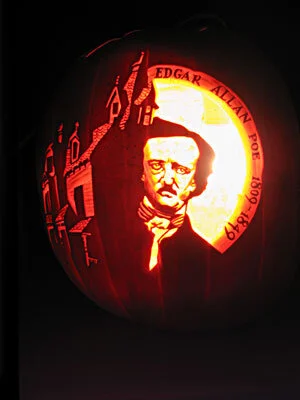
"Faces" is the only Pumpkinmasters category in which I have never won a prize. This pumpkin was my latest unsuccessful attempt to rectify that situation.
Spider Cupcakes
The spider cupcakes were my first commissioned baking project for my niece's preschool, to be part of the bake sale at their fall carnival. My goal was to show off and entertain myself while not traumatizing the children or horrifying the parents.
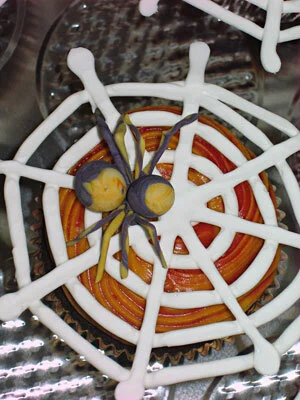
The spider cupcakes were my first commissioned baking project for my niece's preschool, to be part of the bake sale at their fall carnival. My goal was to show off and entertain myself while not traumatizing the children or horrifying the parents.
It wasn't actually a Halloween carnival, but it was in October, so I figured that gave me license to make something a bit spooky, though the fact that the audience was two-to-five-year-olds placed some obvious restraints on what I could get away with. Because my time was also fairly limited I decided to go with the restrained elegance of a basic spider and web design.
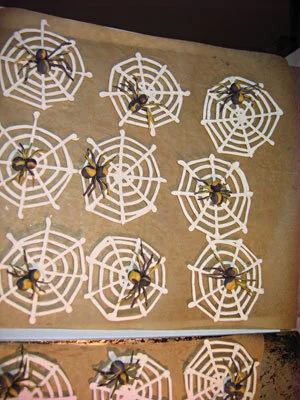
I made the webs freehand with white royal icing from a medium-sized round piping tip. As I learned from the snowflakes on the Season of Love Cake, little kids love crunchy royal icing candy. At first I tried a few methods of making curved webs - piping them over bowls and such - but the results weren't particularly inspiring, so I decided just to make them flat, which was much easier.
For the spiders, I was going for something leaning towards refined and arty (as opposed to ugly and scary or goofy and cartoony). I decided on a simple two-color palette. The dominant color was a deep grey-purple, highlighted with yellow. In the interests of maintaining a clean, elegant look I went relatively minimalist with the spiders. Each one was made up simply of two balls - one for the cephalothorax and one for the abdomen - plus, of course, eight legs. I made all these pieces out of gum paste. For the heads and bodies I started with three equal sized pieces - two purple and one yellow. I placed the two purple pieces on either side of the yellow piece and rolled the whole thing into a ball, resulting in purple spiders with irregular yellow stripes down their backs. For the legs, I just put a piece of yellow alongside a piece of purple and rolled them into very thin, striped ropes, which I cut to length and bent at the knee.
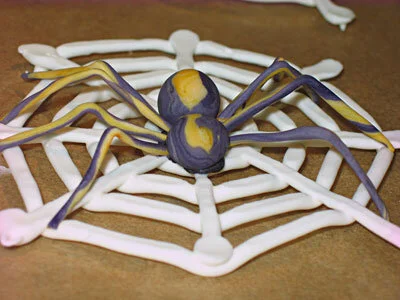
Before I even made the cupcakes, I was able to assemble the spiders on the webs. I'm pleased to say that I went to the trouble of tinting the royal icing that I used to stick the spiders together the same purple as the gum paste. I often find myself to be too lazy to tint my royal icing adhesive appropriately, and I always regret it. The key to assembling convincing spiders is to remember that the legs are attached to the cephalothorax, not the abdomen.
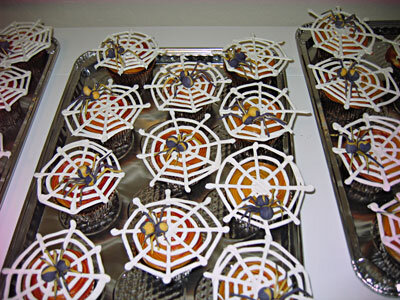
With my spiders settled comfortably on their webs, it was time to make cupcakes. I used some special Halloween cupcake paper cups for most of them, but I ran out and had to use plain silver for the rest. My initial plan had been to frost the cupcakes with buttercream icing the color of fall leaves, and then texture it like a leaf by gently pressing it with a piece of lettuce. That way (I thought) it would look like the spiders had spun their webs in a tree covered with fall leaves. It didn't work at all. The buttercream just stuck to the lettuce and rather than nicely textured, it wound up bumpy and ugly. So I gave up on that idea and just piped the icing in a swirl with a big star tip and then plopped the spider webs on top, which looked fine. Frankly, even if my plan to make the leaf texture had worked, it wouldn't have read very well through the spider web anyway.
The cupcakes were very well received when I dropped them off at the preschool. I'm told that they were even sold for more money than the standard cupcakes at the bake sale. It's nice when I'm able to combine my love of showing off my cakes with something that actually benefits other people.
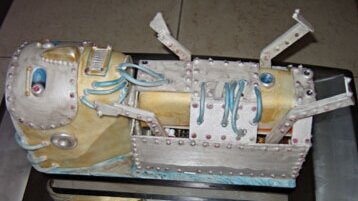
Robot Baby Cake
I made this creepy robot baby cake for my little friend Isaac's second birthday party. Nobody requested this, I came up with this one on my own.
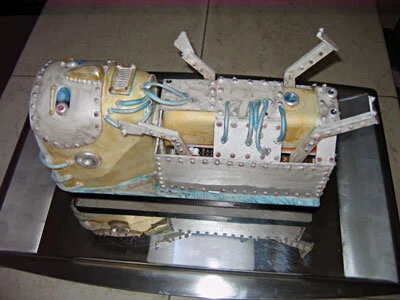
I made this creepy robot baby cake for my little friend Isaac's second birthday party. Nobody requested this, I came up with this one on my own.
My little friend Isaac has a room entirely decorated with space robots(plus the giant stuffed spider I made him when he was born, which sort of fits in with the decor if you assume it's a giant stuffed SPACE spider.)His wall is covered with framed robot pictures, intermingled with illustrations from children's books about space travel from the 1950's; the hooks on his door are made of wooden stacking robot toys; and the wall over his crib reads "Blast Off!" His mom even turned his diaper pail into DiaperBot! He lives to serve humanity and devour and vaporize our dirty diapers. At least until he rebels against his human masters and destroys us all. And after a few months of eating diapers, who can blame him?
So when it came time to make Isaac's second birthday cake, what could be more appropriate than a robot cake? And naturally a robot cake ought to do more than lie there like a pile of hardware. It ought to do something. But what? Unfortunately I don't know anything at all about robotics, in spite of having taking a brief Kinetic Art class, in which we made a vibrating spider out of a motor, a paper clip, and an Altoids tin. So I turned where everyone turns when they need robot construction kits - the internet. I purchased two - one for a line-following snail robot and one for a sound-activated walking robot (clap once, it starts walking; clap again, it stops walking.)
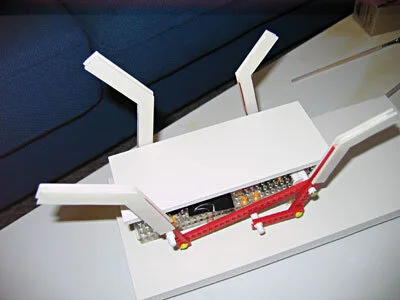
As it turns out, robot kits supplied by the internet are really lame. First of all, they teach you absolutely nothing about robotics. The circuit boards are pre-assembled, so all the "assembly" that I got to do involved zip-ties and plastic pop-rivets. Not really very educational. Also, the snail robot couldn't carry even so much as a cupcake, so it was essentially useless to me. The walking robot, however, had more potential. It clearly wasn't strong enough to make the entire cake walk (which would have been cool) but, by laying the robot on its back I was able to achieve a nice kicking and flailing motion. "Aha!" I said to myself, "I can make that look like a newborn baby robot, lying on its back and kicking its adorable little aluminum arms and legs!" Some of you might be tempted to argue that a newborn baby robot cake might be more appropriate for a party for, say, a newborn baby, as opposed to a party for a two-year-old. Well, you're right, but I didn't have time to learn how to make a toddling robot, so a newborn baby robot was really my only choice.
First I created a dowel framework that would support the body of the robot while leaving the legs free to flail. Then I rolled out a big sheet of gum paste, to be cut into the various metal plates. Once the gum paste dried enough to be rigid, but not enough to make it impossible to cut, I cut out arms, legs, hands, and feet and attached them to the robot's little legs with a bit of royal icing.

My sister (ably assisted by her two-year-old daughter) kindly baked the cake for me. I started out with two 9" square cakes, which I cut up and reassembled into a small body section, to be mounted on top of the robot base, and a head, to sit adjacent to the robotic body. I covered both of these with a layer of fondant (which actually took a couple of tries - the first time out I made both the body and the head too big, so I had to peel the fondant off, re-carve the cakes, and recover them) and mounted them in the appropriate places on the cake board.
In order to hide at least the majority of the plastic robot mechanism, I cut rectangles of gum paste and assembled them around the cake and the base of the robot. I wish that I had thought to make the body of the robot more human and anatomical because then I could have made it kind of a Matrix-style cyborg-y baby trapped in a metal cocoon, but I didn't think of that until it was too late. I also made a face plate and mouth plate to put on the head, along with a little pair of circular ears.
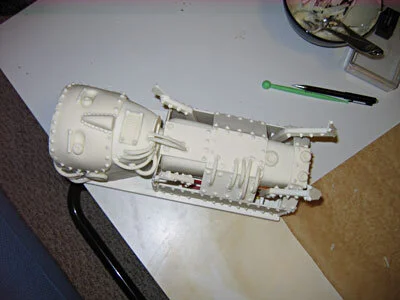
At this point, it was about 1:00 in the morning on the day of the party (I got a really late start on this cake - sorry, Isaac!), so I was really rushing to add all the additional details. As a result, I was unfortunately unable to put as much care and detail in as I would have liked, and I also didn't have time to let the gum paste tubing dry sufficiently so it turned out pretty wilted. The cake did end up with an interesting steam punk vibe about it though, with all the royal icing rivets. I confess that I couldn't resist adding a little gum paste belly button rivet and two subtle little gum paste testicles. Evidently no one noticed, because no one at the party commented on it, which is probably just as well, since it was a pretty juvenile thing to do.
In retrospect, maybe I should have left the cake white rather than painting it, because it looked a lot cleaner unpainted, but I suppose that might have made it seem unfinished. I was going to paint the entire thing silver, but I didn't have enough silver luster dust (I was using luster duster dissolved in gin, because I didn't have any vodka [alcohol works better than water because it dries faster due to the alcohol content.] If you're thinking I was totally unprepared for this cake project, you're right - sorry again, Isaac.) So I painted the outer plates silver and the inner "skin" areas gold. It still looked a little too monochromatic, so I added some shiny blue and red accents.
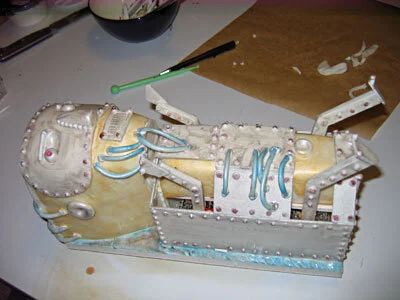
At this point I realized that my cake seemed to be leaking brown sugary goo. I had refrigerated and thawed the cakes a few times over the course of the day, because cold cakes are firmer for carving and fondant smoothing. As I said earlier, I messed up the fondant covering, so there were several trips in and out of the refrigerator. Apparently in my refrigerator this generates humidity or something and breaks down the icing enough to cause the cake to leak, slowly but continuously. Well, now I know not to do that again. Fortunately, in this case, it wasn't that bad. The leakage didn't get anywhere near the electronics, so it didn't interfere with the robot's functionality. In fact, the little trickle emerging from the corner of the head looked like an oil leak, so it basically worked with the overall concept.
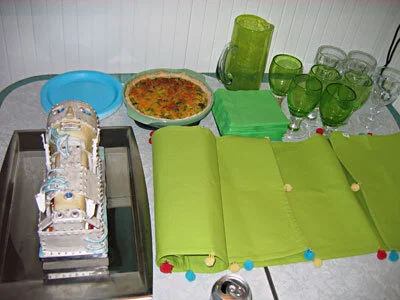
The cake was a hit at the party, especially with my 2-and-a-half-year-old niece, who enjoyed clapping it on and off. Later in the party, she inadvertently turned the cake on by shrieking in rage that she was not permitted to play with the birthday boy's new toys (because the birthday boy was currently playing with them himself.) I think we all know what that frustration feels like. We left the party early.
Housewarming Cake
Slightly less than a year after we moved into our new house, my sister, her husband, and I decided that we were finally ready to have a housewarming party, which naturally provided me with a perfect excuse to overdo the cake.
Slightly less than a year after we moved into our new house, my sister, her husband, and I decided that we were finally ready to have a housewarming party, which naturally provided me with a perfect excuse to overdo the cake.
I wanted to convey the idea that, of all the buildings in all the world, we had found the perfect house for us, so I designed a cake that was made up of a collection of small buildings that, when properly lit, cast the shadow of our house on the wall.
The first problem, of course, was to find a light source that cast a sufficiently defined shadow on the wall. After initial tests with household clip lights and powerful flashlights, it became clear that I really needed a bona fide theatrical lighting instrument. So I bought myself a mini-ellipsoidal pattern projector. Which means that I need to build a puppet theatre, now that I have such a nice light for it.
With my light source in hand, I now needed to figure out what the silhouette of our house actually looks like. I think it has a relatively distinctive silhouette (at least distinctive enough that our guests at the party were able to convincingly pretend that they recognized it.) To insure accuracy, I took a photo of the front of the house and traced that, deciding at the same time which features to include and which superfluous features to ignore. When I was happy with my drawing I blew it up to the full size that I wanted the shadow to ultimately be.
I now needed a full scale foam core mockup of the cake, positioned precisely the same way relative to the wall and to the light source as the finished cake would ultimately be. I set up a table in my studio, with the image of the desired silhouette taped to wall behind it and my light source clamped to a book shelf across the room. So as to be able to precisely position the completed cake buildings the same way relative to one another as the foam core mockup, I designed a base for the cake that would include a 1" grid to which I could align all my pieces. In order to insure that I would be able to recreate the setup in the dining room for the party itself, I took precise measurements of the relationship between the cake base, the lens of the lighting instrument, and the wall.
From there it was largely a process of trial and error, creating one building at a time in just right size, shape, and position to block out an incremental portion of the light to create the house's silhouette. I also had to keep myself cognizant of the fact that I needed to incorporate some buildings that were actually large enough to contain some cake. Otherwise I would just be making a big gum paste city, which would have been a big disappointment to our guests.
With the foam core mockup complete, I then had to translate that into a complete set of Bristol board templates which I could use to cut out the gum paste. In the interests of not getting massively confused, I numbered all the buildings. If I recall correctly, there were eleven distinct buildings, several of which I divided into substructures which I labeled with letters. Remarkably, my labeling system actually worked - at no point in the process did I wind up with a carefully cut out piece of gum paste and no idea what to do with it.
I also made the cake base at this point, which consisted of a piece of 3/8" foamcore covered with fondant, into which I etched lines on a 1"grid. I then painted it like a parti-colored sidewalk and sponged on some royal icing for texture.
Finally I was ready to start creating the actual gum paste buildings, rolling out the gum paste and cutting it out with an X-acto knife using my Bristol board templates. Because there were so many pieces, it was quite a time consuming process, but it all went very smoothly, expect that I didn't have nearly enough flat surfaces in my studio to set all my pieces to dry. I really need one of those flat racks. Maybe I should build one instead of whining about it.
My plan was to do most of the color by hand, but I started out with a few different colors of gum paste - grey, blue, and pink - to get a different color base to build up from. My plan was to ultimately end up with a wide variety of architectural styles, thereby driving home the concept that, while we had essentially infinite choices of house, we culled the choices down to the perfect one.
As I was cutting the gum paste pieces, I also beveled the corners, in the hopes that they would then fit together in nice corners, rather than having more visible seams. For the most part this worked well enough that I was at least able to hide any imperfections with a little strategically placed royal icing.
With the basic gum paste shapes cut out, I set about embellishing them (variously with bricks, stones, adobe textures, wood panels, metallic windows, neo-classical columns, and even a nice little caryatid that I was rather proud of) and painting them.
Assembly was a rather finicky project, because I had to make sure that the shadows lined up appropriately with my shadow sketch, while slotting little slivers of cake into every available divot, some only a 1/2 inch thick. The only real problem I had was with the roof of one of the buildings wanting to cave in under the weight of the smaller buildings on top of it, so I had to disassemble it, shove in some foam core supports, and reassemble.
Once I had all the pieces together, I added some additional bricks and such to cover up messy seams, and then did some airbrushing, in attempt to unify the scene.
Because I was making it, it naturally ended up looking like a bit of a post-apocalyptic wasteland, an effect that was astronomically amplified once I had placed all of my little, white, unintentionally zombie-like, royal icing figures around the scene.

As a backdrop to project the shadow onto, I covered a sheet of foamcore with a vaguely cloudy-ish grayish-blue piece of fabric. Remarkably, I was able to move my entire cake/lighting/backdrop setup from my studio to the dining room without any detrimental effect on the projected silhouette. Truly, I wouldn't have been at all surprised to have moved it and then been utterly unable to recreate the shadow effect that I had achieved in my studio.
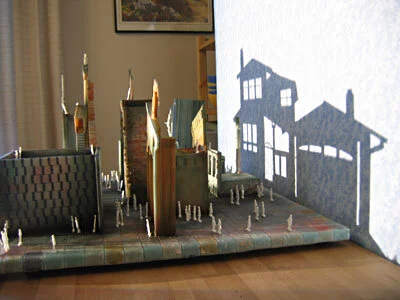
In many ways, this was not my most dynamic cake, as it didn't really do anything, or at least there was no dramatic moment in the party at which it did something that it hadn't already been doing before - casting a shadow on the wall behind it. But I like to think that it had a certain finesse to it, a certain quiet dignity that was appropriate to the occasion. Plus I enjoyed how, as we cut it up to eat it, it became evermore and more a diorama of catastrophic destruction, with the shadow crumbling right alongside its more solid counterpart. Also, the royal icing zombies made great garnishes for the slices of cake and everyone had a good time making the shadow of a little stuffed praying mantis menace the shadow of the house.
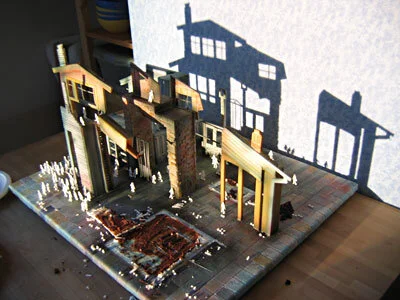

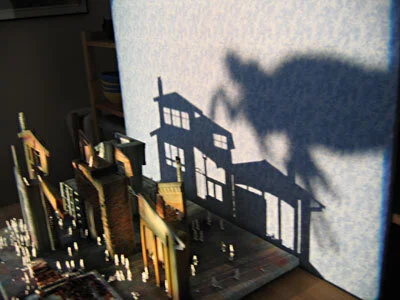
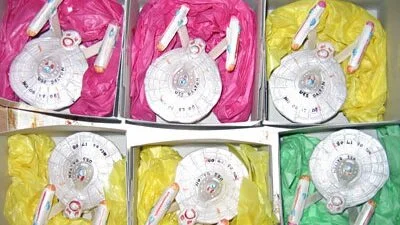
Enterprise Cupcakes
The Enterprise cupcakes were made for the wedding reception of two friends who are (obviously) big fans of the show. As am I.
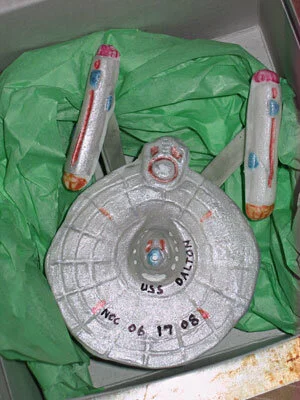
The Enterprise cupcakes were made for the wedding reception of two friends who are (obviously) big fans of the show. As am I. I decided to go with the original Enterprise both in honor of the significance of the institution of marriage - you don't want to commemorate such a monumental event with some Johnny-come-lately 1701-D - and because it's simpler to sculpt.
I don't recall exactly how many of these I made, but it was a lot. I decided that the most efficient way would be to make molds. I started by sculpting clay versions of the top half of the saucer section and one of the nacelles. I made molds of these with Model Magic. I know, it's not technically food safe, but it is non-toxic. I figured that if it won't make toddlers sick if they eat it, it wouldn't be detrimental to fondant through some brief physical contact.
Once the Model Magic molds dried it was a simple matter to press some fondant into the mold and pull it right back out, now shaped like a piece of the Starship Enterprise. I could have gotten more detail with a more rigid mold, but for the most part it worked well.

I used gum paste to create the thin quadrilaterals that connect the nacelles to the body of the starship. Once all the pieces were dry, I painted everything with silver luster dust mixed with vodka, then I used blue, orange, and pink luster dust to indicate the various lights and windows and such. Fortunately my sister helped me with a lot of this, since it was quite time consuming and I was working under the gun. The last touch was to paint on the name and number of the vessel. I went with the USS Dalton, in honor of the couple, and NCC 06 17 08, in commemoration of the wedding date.
My sister was kind enough to bake all the cupcakes that were to become the little starships, and run to Michael's to purchase a bunch of little white boxes and some tissue paper to put inside. After that, all that was left to do was assemble the disparate pieces into little starships.
I assembled each starship in place, in the box. After frosting the top of the cupcakes with buttercream, it was easy to plop the saucer section down on top. It was a bit trickier to assemble the nacelles. I used royal icing to stick the gum paste pieces to the bottoms of the nacelles, then more royal icing to stick the gum paste pieces to the bottom of the box next to the cupcake. I used a wadded up piece of tissue paper to simultaneously fill the empty space in the box, conceal the big blob of royal icing supporting the nacelles, and prop up the nacelles until said royal icing dried.
For the tops of the boxes my sister made some little royal icing Federation logos and labels with the wedding date, and, of course, that staple sentiment of all sappy Star Trek events, "Live long and prosper."
True to form, we wound up with way more cupcakes than there were guests at the reception, but otherwise they were a great success.
I was also able to use the same clay positives that I had made for the cupcakes to make a rubber mold for a two-part plastic cast of the starship, which I sprayed silver and presented to the couple as a keepsake. The nice thing about the plastic was that it picked up the detail that I was unable to capture in fondant.
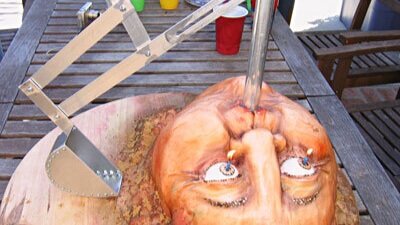
Digger Cake
The digger cake was for my niece's second birthday. I figured that two was old enough that I should make the cake relate to her interests, but young enough that I still had majority creative control.
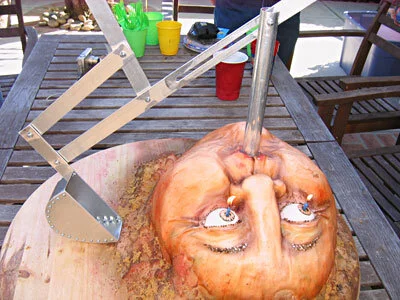
The digger cake was for my niece's second birthday. I figured that two was old enough that I should make the cake relate to her interests, but young enough that I still had majority creative control.
My niece loves trucks. Excavators were an early favorite. So when it came time to make her second birthday cake, I thought she'd enjoy a cake with a digger built right in. To amuse myself, I decided to make the cake shaped like a giant face, rising up out of the dirt with the digger coming out of its mouth. I liked the idea of gouging out the cake's cheek with a big metal scoop.
The first order of business was to make the scoop. I purchased some plans from somewhere on the internet and adapted them a bit to suit my own needs. I needed the digger to be able to reach all parts of the cake, so it had to spin 360 degrees and it had to move from the perimeter of the cake to the center.
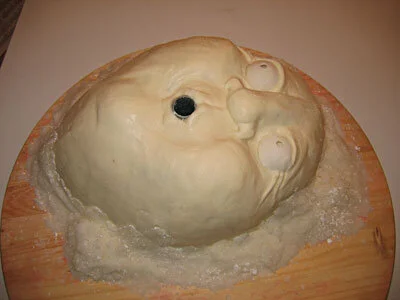
Basically, the mechanism I came up with consisted of a 1" ID steel tube 4" long, mounted to a heavy wooden base. Nested inside that tube was a length of 1" OD aluminum tube about 1' in height. This inner tube had a notch cut into the top so that the digger arm could slide up and down within it. Then a bolt ran through the top of the tube and through the aluminum bar that formed the main arm of the digger. This arm had a track cut in it so that it could slide in and out, closer to and further from the digger's pivot point. Connected to this digger arm was another handle, connected in turn to the scoop itself, so that it could be used to rotate the scoop up and down.
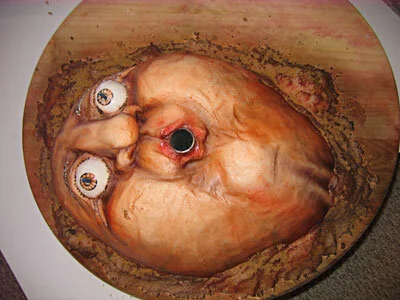
As soon as my niece saw the scoop she was determined to master its use, which actually required a fair amount of manual dexterity. Since manual dexterity is not a strong suit of most not-quite-two-year-olds, she had some initial trouble and got very frustrated the first day, but she was determined and within a few days she was using it like a pro. Then I had to reclaim it so that I could actually use it for the cake.
I used chocolate cake, of course, since that way it would look like dirt when we scooped it up. I started with some oval cakes and carved them into a big, sort of cartoonish, oversized face shape. Since it was for a child's birthday party and it was going to be gouged out with a metal scoop I didn't want it to be 100% realistic. That seemed like it would be too macabre for the occasion.

Because I wanted it to be easy to dig, I wanted to ice the cake with standard buttercream, rather than fondant, which I thought would be difficult to tear through with the scoop. So I used a nice thick coating of buttercream icing and smoothed it with a damp paintbrush. For the eyes, I made some little gum paste half spheres and cut out the irises so I'd have somewhere to stick the candles. With those in place, I piped more buttercream on to get the details of the eyelids, lips, and nose.
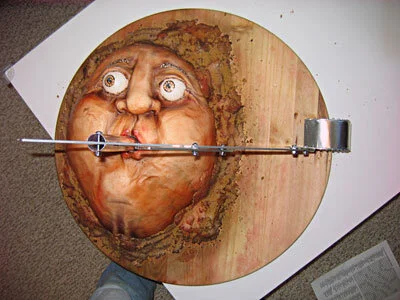
Then, to make it look like the face was rising up out of the dirt I made a batch of pressed sugar, which is just regular white sugar with a bit of water mixed in thoroughly. It can then be pressed into a mold, or, as in this case, shaped by hand. I used it to build up a hill of sugar around the face. For good measure, I put a few blobs of dirt onto the face itself, as if the face had just risen from the earth and hadn't yet shaken off the detritus.
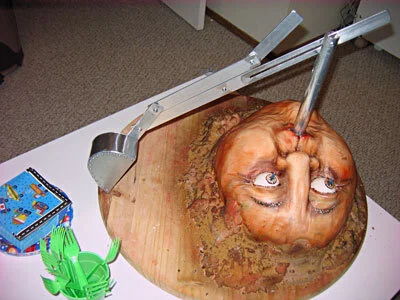
My next step was to airbrush the face. I started by putting in some blue veins as an undercoat, then built up shades of flesh tone, red, and brown, then some dark purple for shadows. I wasn't altogether happy with how the dirt looked, so I sprinkled on some brown sugar to give it more variety and depth.
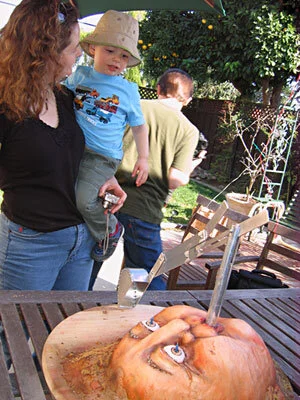
I hadn't masked off the gum paste eyeballs, so I had to carefully wash off the airbrush color with a damp paintbrush. For eyebrows and eyelashes I piped on some royal icing detail, then painted in irises, painted the eyebrows and lashes, and painted on some white highlights on the eyes and lips.
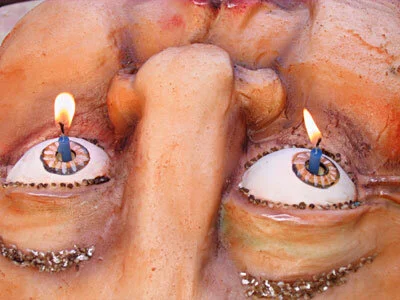
With two candles stuck through the eye holes and the aluminum digger planted in the mouth, I was done.
My niece loved it, and even helped use the digger to serve our guests. And once the cake was gone, she still had a digger to use in her sandbox.
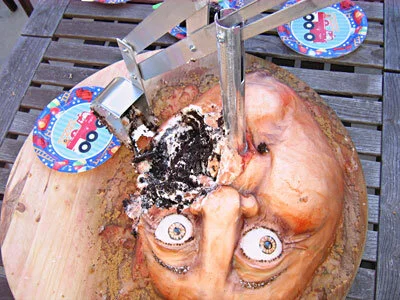
Sandbox
My niece Alex loves trucks. Obviously, she needed a sandbox to use her trucks in. So I decided to build her one for Christmas.
My niece Alex loves trucks. Obviously, she needed a sandbox to use her trucks in. So I decided to build her one for Christmas.
My main goal was, of course, to build a functional sandbox that Alex would enjoy playing in. My secondary goal was to build a bizarre sandbox that would amuse me and confuse her friends' parents.
In researching sandboxes on the internet, I learned exactly three things. One, it's nice to have a place for grownups to sit while the kid is playing in the sand. Two, sandboxes need a cover so they don't get soaked in the rain or used as a litterbox by local cats. Three, sandboxes need drainage for when you inevitably forget to put the cover on before it rains. (My sister, another friend, and I were discussing the sandbox project in the ladies room at an antique show. As we left the bathroom, an unknown woman in one of the stalls yelled desperately after us, "Drainage! Your sandbox needs drainage!!!")
We decided that, based on the space available in our yard and the estimated number of children who would be playing in it, 4' x 7' would be the appropriate size. The design that I came up with was based on the human circulatory system. I'm not sure exactly why I thought this would be a good subject for a two-year-old's sandbox, although Alex actually does enjoying looking through Grey's Anatomy, which is no doubt why I chose the cover of Grey's Anatomy to work from. As a nod to Alex's interest in trucks, I made it sort of a cybernetic circulatory system, with wheels in place of the heart and a rather extraneous steering wheel.
Step one was to build a base that would allow for sufficient drainage. I used half inch plywood on a 2x4 frame, with three-sixteenth inch holes drilled in it for drainage at regular intervals.
I built the frame around the base out of 1x12, with profiles cut into it so as to suggest the shape of a man's torso with arms out and fists pressed together. The front of the frame was formed by the forearms and fists meeting in the middle. The sides sloped up to form the upper arms. I put in plexi cutouts in the sides so I could cut away the opening under the upper arms. My hope was that this would emphasize the arm shape and provide a neat little glance into the stria of the sand in the box. The back of the frame was the actual torso, so in addition to the frame, I cut a piece of 1x to suggest a cross-section through the shoulders, which also functions as a seat.
That was all the structure I was planning, but my brother-in-law pointed out that a sandbox designed to be used with trucks really ought to include a ramp. So I came up with one that flipped in and out and cut some curves into the sides so it would look less incongruous. It wasn't perhaps as integrated with the overall design as it might have been, but experience has proved that it was, indeed a worthwhile addition.
After a few coats of clear sealant (I had decided to stick with a natural wood look), I lined the inside of the sandbox with a couple layers of landscape cloth, so I would still have drainage without the sand leaking out the holes I had drilled. I then laid down a layer of that springy stuff that goes under carpets to keep them from sliding around. I thought this would make a nice soft bottom for the sandbox, but I had to remove it after a few months of sandbox use, because it kept collecting sand underneath it, so that the functional sand depth kept dropping.
To complete my torso concept I painted the head onto the canvas that was destined to be the underside of the sandbox cover. Instead of skin, I gave it a woodgrain effect so it would appear more continuous with the wood of the sandbox. Then, using the cover image of my Grey's Anatomy book, I painted in veins and arteries.
Once the paint was dry, I sewed the canvas underside together with the blue vinyl I had bought for the upper side of the cover. With the lid complete, I was able to position it on the back of the sandbox. Where each painted vein or artery on the cover met the back of the sandbox, I drilled a corresponding hole through the seat and screwed in a length of plastic tubing as a continuation of the vein or artery through which sand could be poured.
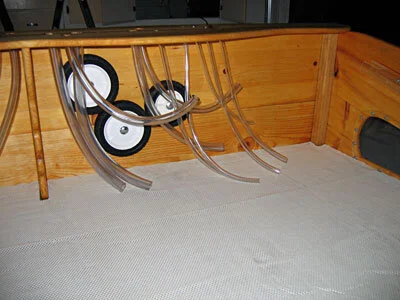
The last step was adding the wheels - three in the vicinity of the heart, eight little casters indicating the fingers (which have proved to be utterly useless), and an arbitrarily placed steering wheel in the upper right arm.
As of this writing, it has now been 17 months since I made this sandbox and Alex still plays in it literally every day, so I would say that it has been a very successful present.
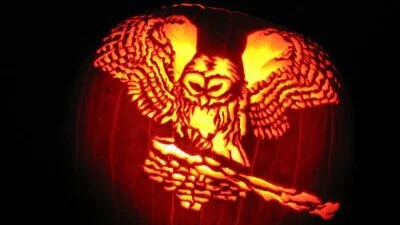
Owl Pumpkin
I only carved one pumpkin this year (but I still won the Pumpkinmasters "Animals" category! Woohoo!) I created the pattern by tracing over a photo of an owl.
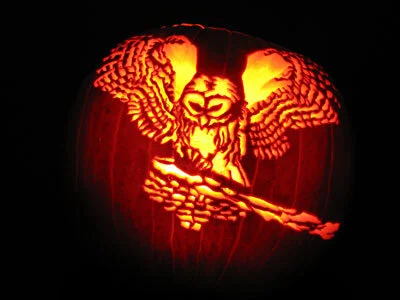
I only carved one pumpkin this year (but I still won the Pumpkinmasters "Animals" category! Woohoo!) I created the pattern by tracing over a photo of an owl.