March 29, 2009

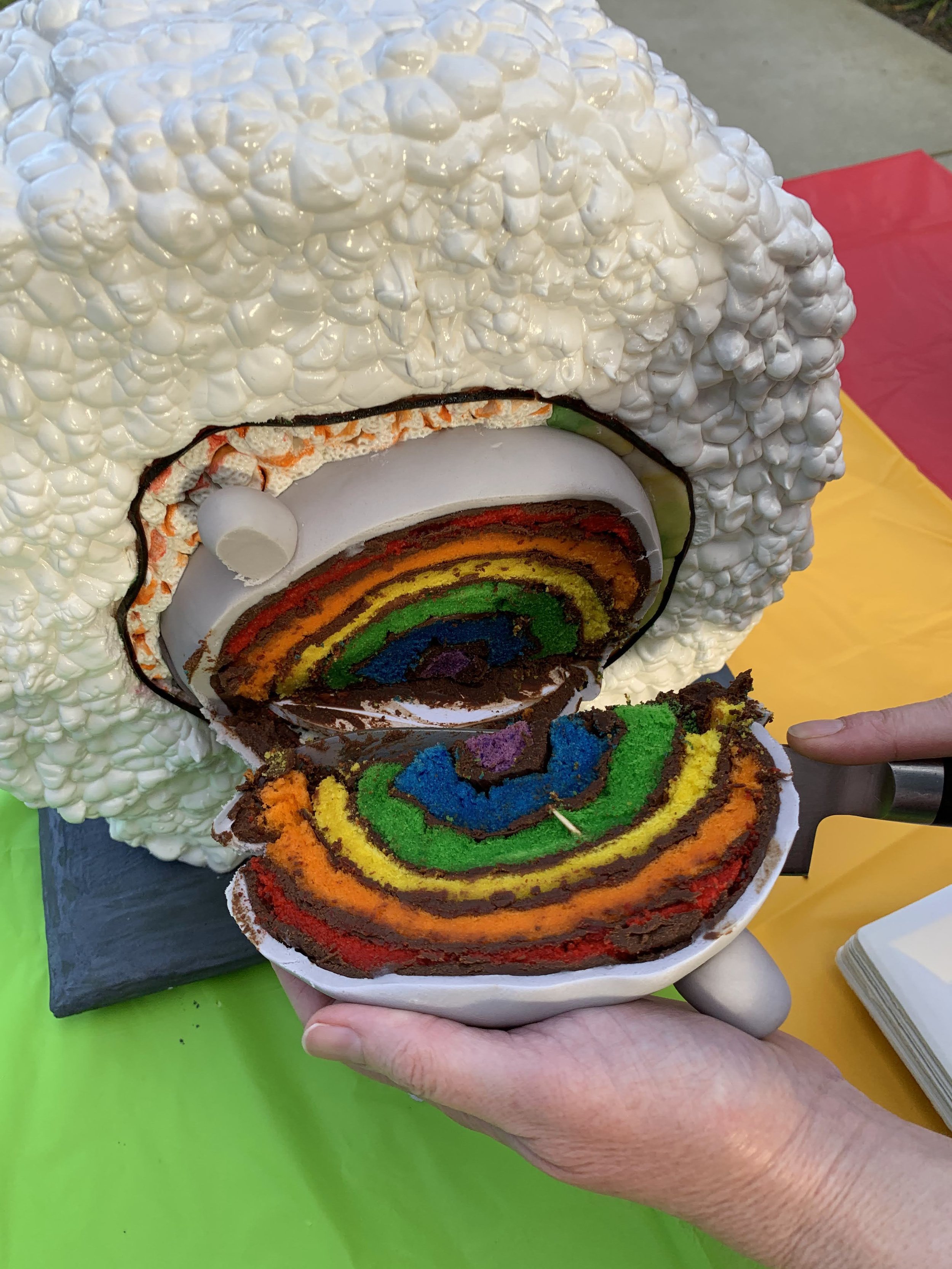
Dinosaur Graveyard Cake

Pastry arts for a good cause - this cake was raffled off at a fundraiser for my nephew's preschool.

Watch the train on YouTube
...and more
...and more

My nephew's pre-school was having a fundraiser. My challenge - make a cake for the raffle that fulfilled all of the following conditions:

The cake should be:

  1. Small enough that people wouldn't be intimidated by the prospect of eating it.
  2. Sturdy enough that there would be minimal possibility of breakage when the winner transported it home.
  3. Enough like a normal cake in appearance that people would recognize it as such when walking by the raffle table.
  4. Appealing enough to the average two-to-four-year-old that he or she could be counted upon to pester his or her parents into purchasing raffle tickets for it.
  5. Appealing enough to the average parent of a two-to-four-year-old that he or she would be willing, with some childish prompting, to spend a few bucks for a raffle ticket for a good cause.
  6. Appealing enough to me that I wouldn't get bored making it.

Collectively, these represent waaaay more constraints than I have ever had placed on one of my cakes before. Prior to this, my biggest restriction was when Barbara May and I made a cake for our friends' wedding and they said that, ideally, it probably shouldn't bleed, explode, or catch fire.

So I had a bit of a challenge developing an initial concept, but ultimately I came up with a solution that I think fulfilled all the requirements. Viewed from one angle it would appear to be an ordinary 12" round cake, covered with white fondant, delicately decorated with cornelli lace, so as to appeal to people who like their cake to look like cake. From the other side, however, the fondant would be cut away to reveal a subterranean tunnel with a train going around and around, so as to appeal to the toddler set. The train would be pursued by a ravenous dinosaur, so as to appeal to me.

I think I can best explain the process of construction by breaking it up into its component elements.

The train:
The first thing I needed was a way to make the train go. I figured the easiest thing to do would be to get some kind of battery operated car toy and build my train around it, so I went to Toys R Us. Mind you, I detest Toys R Us, for various reasons that I needn't go into here, but I was in a hurry and it was my best option for a quick solution. The toy I selected was a battery operated Thomas the Tank Engine, which turned out to be delightfully easy to decapitate, leaving me essentially with a AA battery on wheels.

In keeping with the subterranean / archeological theme of the cake, I found a photo of an old-timey mining cart to work from. First I encased the body of the train in a box made of flat gum paste pieces, with semicircles cut out to accommodate the wheels, then I added additional gum paste wooden slats. I used one of the semicircular cut off pieces from the wheels to cover the little magnetic hookup that toy train cars have on the back. I also made a cow catcher for the front. Because of all those cows that archaeologists encounter in underground caves.

I wanted to cover the wheels (which were bright green) with gum paste to make them more rustic and less plastic looking, but every time I tried, the wheels came out too big for the track (more on that later) so I wound up just painting the green wheels with black food coloring.

To get some human interest into my tableau, I wanted to put a little gum paste archaeologist in the train car. After all, no self-respecting dinosaur would be chasing an empty train car - a T-Rex in particular would need the prospect of juicy meat to get him moving. I tried to make my archaeologist look really terrified, with a gaping mouth and wide, staring eyes, looking over his shoulder at his dreadful pursuer. I also couldn't resist making him a little Indiana-Jones-style hat and a pickaxe. The train had a big button on top to start and stop it. At first, my plan was to put my little man directly on top of that button so that you had to push on his head to make the train go, but then I realized that was just too risky to be worth it - who wants to see a man with a smooshed head being chased by a dinosaur? So I moved him to right in front of the button and left the button alone. I'm glad I did because by the time I was done some crumbs or something must have fallen into the mechanism because the button got a bit tempermental.

I then put a coat of paint on everything, using paste food colors thinned with vodka. It has recently been pointed out to me that using vodka to paint things intended for children might not be 100% kosher, which had never occurred to me. I choose to assume that the majority of the alcohol evaporates away and that what's left is so minimal as to make no difference. Certainly my nephew has shown no ill effects from the last three birthday cakes that I've made for him.

With my base coat in place, I was ready to add fine details. I made some royal icing chains and rivets. I also added some royal icing dinosaur bones around my archaeologist, and threw in some oreo cookie crumb dirt for good measure. I used some more vodka (Woo hoo! Par-ty!) with bronze luster dust to make the chains look metallic.

The track:
Now I had an operational train, but a train doesn't do anyone any good unless it goes where you want it to go. So I needed a track. It took me five or six cardboard mockups before I got one where the tracks were the right width and the right distance apart and correctly positioned within the circle of the cake. Once I had a functional mockup that worked with my little toy train, I covered a foamcore circle with a 1/4" thick layer of white fondant and used my mockup as a template to carve the fondant away to create the two concentric circles of the track. With the fondant cut away, I needed to do something to cover the foam core revealed underneath. After a few experiments, I settled on painting the revealed foam core base red (which frankly would have been a lot easier to do had it occurred to me to paint it red before I covered it with fondant). Because I didn't do the world's best job of this, I dusted the track with a lot of brown and black powdered food coloring and silver luster dust to try to conceal my mistakes.

The dinosaur:
A little train by itself might be interesting enough for pre-schoolers, but I have loftier aspirations. To keep my interest, the cake needed a monster. And it had to be Big! Fierce! Mean! Prehistoric! RAAAWR! I settled on T-Rex.

Step 1 - find internet photos. Of course, the internet crazies have conflicting opinions on what T-Rex looked like, so I just picked the skin texture and color scheme that seemed the most appealing to me.

I made two gum paste bodies, because I wasn't sure quite what size I wanted. I wound up using the bigger one. By letting the gum paste dry for a few minutes, so that it developed a bit of a dry shell, and then bending the body a little I was able to create a delightful wrinkly skin texture.

In order for the dinosaur to chase the train, it of course needed to be on wheels. My first idea was to use the wheels from a tiny little toy skateboard. This didn't work at all. For one thing, toy skateboard wheels turn out to be very flimsy and not very well aligned. I know this is a shock, considering that I bought it for $3.95 at Target. For another thing, toy skateboard wheels are extremely small, on the order of 1/8" in diameter. Since my layer of fondant between the two track circles was on the order of 1/4" thick, I clearly had a problem. I tried to salvage my skateboard wheel solution by cutting larger plastic circles and gluing them to the existing skateboard wheels. Then I realized that this was a stupid idea and I should just make the wheels from scratch.

I cut two new sets of plastic wheels, larger for the front, smaller for the back and put hot glue rims on them so as to give them the requisite traction. For the axles I used brass tubing, encased in slightly larger diameter brass tubing to allow it to rotate freely. I attached these to the body of the dinosaur by using royal icing and by cramming brass tubing up into the body.

I tried to mask the wheels a little when I added the gum paste legs, but since I was simultaneously trying to position the legs as if T-Rex was in a full-out run, and since I was trying to conceal four wheels with two legs, I wasn't very successful. I chose a nice muted ochre and brown color scheme, with some purple and green details, again using vodka and paste food colors for paint. Once that dried, I used royal icing to make little teeth and claws. I of course couldn't resist adding a bit of food coloring blood to the tips.

The hookup:
I now had a train on wheels and a dinosaur on wheels but in order to make the dinosaur chase the train I needed to connect the dinosaur to the train. I cut and bent a piece of brass tubing into the correct curve. Gluing it to the dinosaur was easy. Gluing it to the train was exceedingly difficult. First I tried hot glue. Then I tried Superglue. Then I tried hobby cement. Then I tried epoxy. As it turns out, for some inexplicable reason, none of these things stick to the underbody of Thomas the Tank Engine, even after he's been roughed up with a flat file. Eventually I resorted to the king of household glues - Gorilla Glue. Because Gorilla Glue expands as it dries, I was terrified that it would push everything completely out of alignment, but it actually worked.

The tunnel:
With my train and dinosaur set, I needed a tunnel for them to run through. My original plan was to create a nice rocky texture by making a mold in the shape I wanted the tunnel to be, lining it with plastic produce bags (because they release easily from chocolate), filling it with crushed ice, and then pouring tempered chocolate over it. In my imagination, this technique created a beautiful organic texture. In reality, it created absolutely nothing of value because the chocolate set up before it got beyond the first layer of ice. I went to plan B.

Plan B involved making two concentric tubes of chocolate with holes in them to form the inner and outer walls of the tunnel. One would be 6" in diameter, to fit around the 6" round cake that would be in the middle of my creation. The other would be 12" in diameter, leaving a 3" tunnel for the train to pass through.

At first I envisioned creating these tubes by spreading chocolate over bubble wrap (which also releases easily from chocolate), cutting it into appropriate rectangles, and then wrapping the rectangles around cake tins of the appropriate diameter, all while the chocolate was set up enough to cut accurately but malleable enough to wrap around the cylinder. This didn't work either. By the time the chocolate set up enough to cut it was too firm to wrap, so it just cracked when I tried to bend it into the right curve. I was also having problems getting my chocolate in good temper, so it wasn't setting as firmly as I would have liked. Normally I would blame problems like this on my own relatively limited experience working with chocolate. In this case though I'm more inclined to blame the problem on the chocolate itself because, at the same time as I was making this cake, I was also making chocolates to raffle off at the event, and I was having spectacular success tempering chocolate bars that had been sitting in our cabinets for so long that they were essentially just big slabs of chalky blooms. For the cake, though, I was using a new bag of chocolate medallions from my local cake supply store and I couldn't get them in temper to save my life. So I choose to blame the chocolate.

My third plan was to wrap the 6" and 12" cake pans in tin foil and them pipe tempered chocolate onto them in an abstract pattern. Due to my issues with getting my chocolate in temper I was concerned with the stability of the structure and I thought that I might get it to be sturdier and set up faster by mixing in a little corn syrup. This is a technique that I used to good effect when I made the shrunken head truffles, but in this application it just seemed to make the chocolate more brittle. So the technique that I finally ended up with was putting the tin foil wrapped cake tins in the freezer and piping the (sort of) tempered chocolate onto the cold foil in an abstract pattern with lots of open space. This helped the chocolate to firm up quickly when it touched the cold foil so that it wouldn't drip down the sides of the cake pan.

Third time's a charm. This time my plan more or less worked, although I still wasn't happy with the temper of my chocolate and my finished pieces broke in a few places when I unmolded them from the tin foil. But I figured it was nothing I couldn't repair when I put it in place around the cake.

The cake:
The cake itself is actually the most boring part of this story. All I needed was a 6" round cake. I tried a new recipe for chocolate cake, but when I went to torte it I realized that it wasn't baked all the way through, so I had to make an emergency backup cake. Since I didn't have any more cocoa powder I went with a white cake, which turned out fine. I torted and filled that one with buttercream icing. My sister took the incompletely baked cake, carved a hole out of the center to remove the uncooked part, put some ice cream in the middle, and took it to a friend's birthday party so it wasn't a total loss.

The facade:
To make my 6" cake surrounded by chocolate cylinders look like a 12" cake with a chocolate tunnel inside, I premade two pieces of white fondant. One was a simple 12" circle to cover the top of the cake and tunnel. The other piece was to go part way around the perimeter of the cake, but it also had to appear to be cut away so as to reveal the tunnel inside. I rolled out a piece of fondant, then cut it into a sort of ragged trapezoid. I used a ball tool to thin out the rough edges then draped the whole piece over the side of a 12" cake pan to get the right curve. To make sure that these pieces were dry enough to maintain their rigidity I made them a week in advance.

Putting it all together:
With all my components pre-made it was a simple matter to place my 6" round cake in the center of my train track and piece together my chocolate tunnel around it. For some reason my 6" round chocolate cylinder was bigger than I needed it to be, but the fact that it was poorly tempered meant that it was easy to cut a slice off to adjust.

Chocolate tunnel in place, I stuck my fondant circle on top and my curved fondant piece around the edge with some royal icing. I was a bit concerned about the top fondant circle drooping, as a large section of it was unsupported. My concerns were not wholly unfounded, as close examination of the finished cake does uncover some definite unintended curvature to the top of the cake, but as it didn't seem to pose a risk of structural cake failure I didn't let myself get unduly concerned.

In order to integrate the dinosaur with the cake, I incorporated subtle dinosaur skeletons into the cornelli lace that I piped onto the fondant. I used a #2 tip because I was too lazy to use a #1 tip. I also put a couple of dinosaur skeletons onto the inner wall of the chocolate tunnel.

When we set the cake up at the fundraiser, we tried to position it such that children would be able to see it easily, but not grab the train. For the most part, we succeeded. Only at one point during the party did I have to shoo away a toddler who was trying to snatch the dinosaur. The cake was ultimately won in the raffle by one of the kids from my nephew's preschool. I hope that he and his family enjoyed it.

Labels: ,


READ THIS POST AND SEE MORE PICTURES!

March 8, 2009

Demolition Cake

The Demolition cake was created by Barbara Jo for her truck-obsessed nephew's third birthday party.
Watch the destruction on YouTube (part 1)
... and part 2

Most people would tell you that a 3-year-old's birthday party is likely to involve quite enough carnage and demolition without any help from the cake. I am not one of those people, especially since my 3-year-old nephew Nathan in extremely passionate about demolition, construction, and more or less anything that involves big machines.

So I thought that a wrecking-ball cake would be ideal for his demolition-themed birthday party (if that isn't bowing to the inevitable, I don't know what is.) Of course, a wrecking ball cake that didn't actually wreck anything would be utterly pointless, so my first step was to come up with a good, working wrecking ball mechanism. I was concerned that if I made a wrecking ball that simply sat next to the cake that it was intended to wreck, the composition wouldn't be unified enough. I also didn't want to have to make an entire crane to support the wrecking ball. So I came up with a plan where a wrecking ball would rise up out of a circular cake and spin around in a complete circle, knocking down a series of gum paste buildings around the perimeter. This concept was also nicely in keeping with my series of self-destroying cakes, previous examples of which include the Melting Head Cake, the Fountain Cake, and the Self-Digging Cake for Nathan's second birthday.

The wrecking ball mechanism consisted of a brass tube attached to a hobby motor, which spun inside another, larger-diameter brass tube. The hobby motor was encased inside a piece of PVC tubing, so that the cake (with a pre-cut hole in the middle) could just be slipped around it. The spinning tube had a hole drilled in the tip, to which I could tie a little piece of wire, the other end of which would ultimately be attached to the wrecking ball.

I went through a few iterations of wrecking ball tests. My first plan was to make the wrecking ball out of hard candy, embedding the wire in it when I poured the sugar. They turned out OK, but then I got worried that the sugar ball might shatter when it hit the cake and I also bought a silicon sphere mold that resulted in sugar spheres that were altogether too big and heavy for the power of the motor. My next idea was to make the wrecking ball out of marshmallow, on the theory that marshmallow would be tough enough to break the cake but spongy enough not to shatter. This turned out not to work at all, as homemade marshmallows are significantly poofier than commercial marshmallows and couldn't wreck their way out of a wet paper bag. Proving that old axiom that the third time is the charm, my third idea was modeling chocolate. This way I could roll balls of modeling chocolate to whatever size I desired, then punch holes through the center to attach the wire. This worked well, except that on my first try I only ran one wire through the middle of the modeling chocolate ball, and when I turned the wrecking ball on the wire just sliced right through the chocolate and the ball went flying. I found out, however, that if I distributed the wires at four points around the ball the centrifugal forces were dispersed enough that the ball stayed intact. I also covered the ball with a layer of royal icing and a dusting of powdered colors to make it look more iron-like.

With wrecking ball methodology ascertained, the next step was creating and decorating the cake base. The bottom of the base was a simple plywood circle, but I also needed to layer some foamcore on top of that to hide the battery, wires, and switch for the wrecking ball. To get a little color into what promised to be an otherwise fairly drab-colored cake, I painted yellow and black caution tape stripes on the plywood. I then put a smaller circle of foam core over top of this, with appropriate holes for the battery and such, and covered that with a tiled pattern of marbled fondant. Actually, I did this twice because I didn't like my haphazard arrangement of shades of grey the first time around, so I tore it up and redid it with a much more careful pattern.

Now having a base for my cake, I set about making the sides and top. For the top of the cake, I made a circle of marbled fondant with a pre-cut hole in it for the wrecking ball. By letting this dry for a week, I wound up with a nice rigid circle that would give me a much cleaner, more architectural finished cake than I would get by covering the cake with soft fondant after it was baked. This resulted in me making the interesting discovery that blue food coloring turns green when exposed to sunlight. Fortunately, it still looked OK with the rest of my cake color scheme (at least it was a cool, grayish-green) but hopefully this can help prevent potential problems in the future. For the sides of the cake I made a series of very dark blue and purple gum paste rectangles, which looked fine, but, due to the massive quantity of food coloring involved, tasted revolting. Perhaps next time I should start with chocolate fondant.

Now all I needed was something for the ball to wreck. In order to get something that would shatter nicely, I opted for skeletal buildings made of gum paste, rather than trying to smash through actual cake. I still wonder if that was a bit of a cop-out. I made a series of eight skeletal framework buildings of increasing height. I calculated that, in total, they required just over 300 feet of gum paste strips. It was a bit of a time-consuming process because I first had to roll out the gum paste, then cut it into strips and use a bit of brass tubing to create a riveted texture. Once the gum paste dried, I could cut it to the appropriate length, and then stick three pieces of each length together with royal icing to made "U-beams". (I thought about making I-beams, but decided that would be more difficult and wouldn't look as good.) After the U-beam royal icing dried, I used more royal icing to put the pieces together into each of the three sides of each of the eight buildings. I then had to wait for that to dry again before I could stick the three sides of each building together. In other words, I spent about two weeks every day after work hunched over my table sticking tiny grey bits of gum paste to other tiny grey bits of gum paste. Whee!

Once the buildings were done, I had to make the expanded steel (by which I mean royal icing) inserts to go between the gum paste girders. Fortunately, this went a lot faster than the gum paste project, even considering that I was also piping lots of royal icing chain link fence that was ultimately destined to go around the perimeter of the cake. I used a #2 and a #1 piping tip, so my hand did get a little sore, but that's to be expected.

Once the royal icing was dry, I just peeled it off the wax paper and stuck it into the holes of the gum paste buildings with a little more royal icing.

At this point it seemed that I really should make some actual cake to include in my cake. This was probably the easiest actual cake I've ever made, since I actually wanted it to be round, which just so happens to be the shape of normal cake pans. So, for once, no cake carving, no giant pile of gooey cake scraps, just some torting and filling, and making sure that I would up with a cake the correct height to fit with the premade buildings. I did have to cut a carefully angled hole in it to accommodate the wrecking ball mechanism, but compared to my usual practice of carving cakes into the shapes of rats and human heads and such, it was quite easy.

With the cake in place around the wrecking ball, it was very quick work to slap my pre-made top and sides on and place my eight building around the perimeter. I also flung some edible glitter on the sides to give it a little more sparkle.

From there it was a simple matter of placing the fence pieces, and strewing a few broken bits of girders and such about to give it more of that "in the process of demolition" feel. In retrospect, it might have made a stronger artistic statement if I had started with a complete building and wrecked that, rather than starting with an already wrecked building and simply wrecking it more.

At this point it occurred to me that, as I was making this cake for a three-year-old's birthday party, it might be a good idea to incorporate some birthday candles into the design. Considering that they were a complete afterthought, I thought they turned out rather well. I encased the three candles in various heights of leftover gum paste girders and stuck them to the chain link fence, right behind the switch that turned on the wrecking ball.

To bring the whole composition together, I added some black food coloring shadows into the seams between the buildings and the cake itself and I added some bright yellow highlights to the buildings, which picked up the yellow paint on the bottom base.

The finishing touch - little royal icing people watching from outside the fence. I like to make my sugar crowds along the same lines that I make my scale figures when I draw set sketches for the plays I design, keeping the people blank, white, and anonymous so as not to distract attention from the scenery or the cake which is the true focal point of the piece. In cake form, this tends to give my crowds a bit of a zombie-horde feel, which, as you can probably guess, I really enjoy.

The presentation of the cake at the party went quite well. Nathan was excited about tuning on the switch, but he's sort of a cautious guy, so he also kept turning it off and his friend Noah would turn it back on. So the destruction proceeded a bit in fits and starts, but eventually the ball reached full speed and full destructive capability. I wish I had made the wire on the wrecking ball just a tad longer, because I think it would have made the destruction more impressive, but all in all I was extremely pleased. And Nathan looked delightfully like an angelic little blond Godzilla gnawing on the broken girders.

Labels: ,


READ THIS POST AND SEE MORE PICTURES!

November 1, 2008

Circulating Heart Cake

Some variation on a bleeding heart cake is a relatively standard feature of our annual Pumpkinfest. This year, I was trying to make a cake through which "blood" (cranberry juice) would continuously and visibly circulate.

Watch on YouTube

Concept: A cake, shaped like a heart and covered with fondant, sitting on top of a platform elevated above a reservoir full of cranberry juice. In the reservoir, a pump attached to a tube leading up the side of the cake to pump the cranberry juice up and over the cake. To contain the juice and insure that it spread nicely over the surface of the cake, an isomalt (sugar substitute) shell, also in the shape of a heart, placed over the cake, leaving about an eighth inch of space for the juice to flow between the cake and the outer shell. In the opposite side of the elevated platform from the tube, a series of holes to drain the juice back into the reservoir and begin the whole cycle all over again.

Step 1: Make an isomalt shell shaped like a heart. At first, I had hoped to find something that was already in the shape of a heart, cover it with tin foil, and pour isomalt over the top. I wanted to use isomalt rather than sugar because it's more transparent. Unfortunately, in spite of having access to numerous seasonal Halloween stores, I was unable to locate anything that was a) accurately heart-shaped, b) big enough that I would be able to get sufficient cake for our guests inside, and c) able to resist the heat of liquid isomalt. I therefore had to make my tin foil heart mold from scratch. I started with a cereal bowl, upside down, and built up the rest of the heart shape around the bowl with wadded up tin foil. To get as smooth a surface as possible to pour over, once I had a shape I was happy with, I spread one final layer of tin foil on top and smoothed it as much as I possibly could. As you may recall from my description of the jellyfish cake, the problem that I often have with pouring sugar or isomalt over tin foil is that the little ridges of the tin foil get stuck in the solidified sugar and are very tedious and nerve-wracking to remove with tweezers and a damp paintbrush.

I put this tin foil heart onto a silpat mat and melted down my isomalt. In my earlier discussion of the jellyfish cake I described some of the problems that I have with making sugar domes. All of these problems apply equally to making isomalt hearts. I was also a little disappointed that the isomalt hardened somewhat cloudy, I think because I was working air into it as I pulled it back up the sides of my tin foil heart to prevent it from all pooling at the bottom. I was hoping for a transparent heart, but I had to settle for cloudy. I also think that there's something wrong with the bucket of isomalt that I have, because it always come out sort of yellow, when isomalt is supposed to be perfectly clear. At least the heart released from the tin foil better than any of my prior tin foil sugar projects.

Step 2: Make an elevated platform, pump, and reservoir assembly. Rather than purchasing any new equipment for this project, with just a little glue and a few additional holes drilled, I was able to repurpose some of the acrylic circles and tubes from the Triple Animal Cake and the pump and tubing from the Fish Fountain Cake. I used a cake tin for the reservoir. Not the most aesthetically inspired choice, perhaps, but highly functional and readily available.

Step 3: Make a heart-shaped cake. Internal-organ-shaped cakes being something of a specialty of mine, the carving went pretty quickly. I covered it with white fondant - a much thicker layer than usual, as I wanted it to be able to stand up to the juice running over it without dissolving away and exposing the cake - then sculpted in some of the major features, like the divisions between the chambers. Then I moved it onto the acrylic platform, and positioned the tube tight up against it. To get some additional detail (though I wasn't overly concerned with extreme detail, since the whole thing was going to be under my isomalt shell) I piped on royal icing and shaped it with a slightly damp, soft paintbrush. I also covered the tube with royal icing, both to hold it in place and to camouflage it. I painted the cake with brighter colors than I might have ordinarily, because I wanted them to read through the translucent shell.

Step 4: Attach the isomalt shell. Unfortunately, once I plopped the shell over top of the cake, it looked more like an amoeba than a heart. I hadn't planned to decorate the top surface of the shell, because I wanted it to be as see-through as possible, but I felt that I had to do something to make it more identifiable. So I went over the top surface of the isomalt with royal icing details and texture, and then painted the surface with some reds and blues. This did make it look marginally more like a heart, but it also made it much more opaque, which proved to be unfortunate when I got around to plugging the pump in.

Step 5: Fill the reservoir with cranberry juice, cross your fingers, and plug in the pump. Because my isomalt was cloudy from the get-go and because I had further opaqued the surface with royal icing and food coloring, the pumping action, while technically successful was exceedingly subtle. I'm pretty sure that if I hadn't explained it to everyone, no one would have had any idea what the cake was or what it was doing. I tried to capture it on video, but all you can really see is the juice venting down the side and back into the reservoir. (Which, by the way, I really should have directed out the aorta.) The video is further compromised by the fact that my camera was in the process of kicking the bucket resulting in a distinct horizontal line across the frame and the fact that there was a toddler screaming in the background. Please enjoy.

Conclusion: I still believe that there is potential in the concept of a cake with fluids circulating inside, but I think it requires either a) a different form factor, b) a more competent isomalt handler, or c) both.

Labels: ,


READ THIS POST AND SEE MORE PICTURES!

October 31, 2008

Raven Pumpkin

In my 11th consecutive year of entering the Pumpkinmasters carving contest, this is the pumpkin that finally won me the Grand Prize! Inspired by the ravens at the Tower of London, I think it represented my most effective use of textures to date.

Labels: ,


READ THIS POST AND SEE MORE PICTURES!

Edgar Allan Poe Pumpkin

"Faces" is the only Pumkinmasters category in which I have never won a prize. This pumpkin was my latest unsuccessful attempt to rectify that situation.

Labels: ,


READ THIS POST AND SEE MORE PICTURES!

October 24, 2008

Spider Cupcakes

The spider cupcakes were my first commissioned baking project for my nephew's preschool, to be part of the bake sale at their fall carnival. My goal was to show off and entertain myself while not traumatizing the children or horrifying the parents.

It wasn't actually a Halloween carnival, but it was in October, so I figured that gave me license to make something a bit spooky, though the fact that the audience was two-to-five-year-olds placed some obvious restraints on what I could get away with. Because my time was also fairly limited I decided to go with the restrained elegance of a basic spider and web design.

I made the webs freehand with white royal icing from a medium-sized round piping tip. As I learned from the snowflakes on the Season of Love Cake, little kids love crunchy royal icing candy. At first I tried a few methods of making curved webs - piping them over bowls and such - but the results weren't particularly inspiring, so I decided just to make them flat, which was much easier.

For the spiders, I was going for something leaning towards refined and arty (as opposed to ugly and scary or goofy and cartoony). I decided on a simple two-color palette. The dominant color was a deep grey-purple, highlighted with yellow. In the interests of maintaining a clean, elegant look I went relatively minimalist with the spiders. Each one was made up simply of two balls - one for the cephalothorax and one for the abdomen - plus, of course, eight legs. I made all these pieces out of gum paste. For the heads and bodies I started with three equal sized pieces - two purple and one yellow. I placed the two purple pieces on either side of the yellow piece and rolled the whole thing into a ball, resulting in purple spiders with irregular yellow stripes down their backs. For the legs, I just put a piece of yellow alongside a piece of purple and rolled them into very thin, striped ropes, which I cut to length and bent at the knee.

Before I even made the cupcakes, I was able to assemble the spiders on the webs. I'm pleased to say that I went to the trouble of tinting the royal icing that I used to stick the spiders together the same purple as the gum paste. I often find myself to be too lazy to tint my royal icing adhesive appropriately, and I always regret it. The key to assembling convincing spiders is to remember that the legs are attached to the cephalothorax, not the abdomen.

With my spiders settled comfortably on their webs, it was time to make cupcakes. I used some special Halloween cupcake paper cups for most of them, but I ran out and had to use plain silver for the rest. My initial plan had been to frost the cupcakes with buttercream icing the color of fall leaves, and then texture it like a leaf by gently pressing it with a piece of lettuce. That way (I thought) it would look like the spiders had spun their webs in a tree covered with fall leaves. It didn't work at all. The buttercream just stuck to the lettuce and rather than nicely textured, it wound up bumpy and ugly. So I gave up on that idea and just piped the icing in a swirl with a big star tip and then plopped the spider webs on top, which looked fine. Frankly, even if my plan to make the leaf texture had worked, it wouldn't have read very well through the spider web anyway.

The cupcakes were very well received when I dropped them off at the preschool. I'm told that they were even sold for more money than the standard cupcakes at the bake sale. It's nice when I'm able to combine my love of showing off my cakes with something that actually benefits other people.

Labels: ,


READ THIS POST AND SEE MORE PICTURES!

October 11, 2008

Robot Baby Cake

Barbara Jo made this creepy robot baby cake for our little friend Isaac's second birthday party. Nobody requested this, she came up with this one on her own.
Watch the robot baby kicking on YouTube
...and it's sound-activated!

My little friend Isaac has a room entirely decorated with space robots (plus the giant stuffed spider I made him when he was born, which sort of fits in with the decor if you assume it's a giant stuffed SPACE spider.) His wall is covered with framed robot pictures, intermingled with illustrations from children's books about space travel from the 1950's; the hooks on his door are made of wooden stacking robot toys; and the wall over his crib reads "Blast Off!" His mom even turned his diaper pail into DiaperBot! He lives to serve humanity and devour and vaporize our dirty diapers. At least until he rebels against his human masters and destroys us all. And after a few months of eating diapers, who can blame him?

So when it came time to make Isaac's second birthday cake, what could be more appropriate than a robot cake? And naturally a robot cake ought to do more than lie there like a pile of hardware. It ought to do something. But what? Unfortunately I don't know anything at all about robotics, in spite of having taking a brief Kinetic Art class, in which we made a vibrating spider out of a motor, a paper clip, and an Altoids tin. So I turned where everyone turns when they need robot construction kits - the internet. I purchased two - one for a line-following snail robot and one for a sound-activated walking robot (clap once, it starts walking; clap again, it stops walking.)

As it turns out, robot kits supplied by the internet are really lame. First of all, they teach you absolutely nothing about robotics. The circuit boards are pre-assembled, so all the "assembly" that I got to do involved zip-ties and plastic pop-rivets. Not really very educational. Also, the snail robot couldn't carry even so much as a cupcake, so it was essentially useless to me. The walking robot, however, had more potential. It clearly wasn't strong enough to make the entire cake walk (which would have been cool) but, by laying the robot on its back I was able to achieve a nice kicking and flailing motion. "Aha!" I said to myself, "I can make that look like a newborn baby robot, lying on its back and kicking its adorable little aluminum arms and legs !" Some of you might be tempted to argue that a newborn baby robot cake might be more appropriate for a party for, say, a newborn baby, as opposed to a party for a two-year-old. Well, you're right, but I didn't have time to learn how to make a toddling robot, so a newborn baby robot was really my only choice.

First I created a dowel framework that would support the body of the robot while leaving the legs free to flail. Then I rolled out a big sheet of gum paste, to be cut into the various metal plates. Once the gum paste dried enough to be rigid, but not enough to make it impossible to cut, I cut out arms, legs, hands, and feet and attached them to the robot's little legs with a bit of royal icing.

Barbara May (ably assisted by her two-year-old son) kindly baked the cake for me. I started out with two 9" square cakes, which I cut up and reassembled into a small body section, to be mounted on top of the robot base, and a head, to sit adjacent to the robotic body. I covered both of these with a layer of fondant (which actually took a couple of tries - the first time out I made both the body and the head too big, so I had to peel the fondant off, recarve the cakes, and recover them) and mounted them in the appropriate places on the cake board.

In order to hide at least the majority of the plastic robot mechanism, I cut rectangles of gum paste and assembled them around the cake and the base of the robot. I wish that I had thought to make the body of the robot more human and anatomical because then I could have made it kind of a Matrix-style cyborg-y baby trapped in a metal cocoon, but I didn't think of that until it was too late. I also made a face plate and mouth plate to put on the head, along with a little pair of circular ears.

At this point, it was about 1:00 in the morning on the day of the party (I got a really late start on this cake - sorry, Isaac!), so I was really rushing to add all the additional details. As a result, I was unfortunately unable to put as much care and detail in as I would have liked, and I also didn't have time to let the gum paste tubing dry sufficiently so it turned out pretty wilted. The cake did end up with an interesting steam punk vibe about it though, with all the royal icing rivets. I confess that I couldn't resist adding a little gum paste belly button rivet and two subtle little gum paste testicles. Evidently no one noticed, because no one at the party commented on it, which is probably just as well, since it was a pretty juvenile thing to do.

In retrospect, maybe I should have left the cake white rather than painting it, because it looked a lot cleaner unpainted, but I suppose that might have made it seem unfinished. I was going to paint the entire thing silver, but I didn't have enough silver luster dust (I was using luster duster dissolved in gin, because I didn't have any vodka [alcohol works better than water because it dries faster due to the alcohol content.] If you're thinking I was totally unprepared for this cake project, you're right - sorry again, Isaac.) so I painted the outer plates silver and the inner "skin" areas gold. It still looked a little too monochromatic, so I added some shiny blue and red accents.

At this point I realized that my cake seemed to be leaking brown sugary goo. I had refrigerated and thawed the cakes a few times over the course of the day, because cold cakes are firmer for carving and fondant smoothing. As I said earlier, I messed up the fondant covering, so there were several trips in and out of the refrigerator. Apparently in my refrigerator this generates humidity or something and breaks down the icing enough to cause the cake to leak, slowly but continuously. Well, now I know not to do that again. Fortunately, in this case, it wasn't that bad. The leakage didn't get anywhere near the electronics, so it didn't interfere with the robot's functionality. In fact, the little trickle emerging from the corner of the head looked like an oil leak, so it basically worked with the overall concept.

The cake was a hit at the party, especially with my 2-and-a-half-year-old nephew, who enjoyed clapping it on and off. Later in the party, he inadvertently turned the cake on by shrieking in rage that he was not permitted to play with the birthday boy's new toys (because the birthday boy was currently playing with them himself.) I think we all know what that frustration feels like. We left the party early.

Labels: ,


READ THIS POST AND SEE MORE PICTURES!

August 16, 2008

Housewarming Cake

This housewarming cake was made to celebrate (somewhat belatedly) the new house that Barbara May and her husband purchased and Barbara Jo moved into with them to play with their son and mooch off of their groceries.

Slightly less than a year after we moved into our new house, my sister, her husband, and I decide that we were finally ready to have a housewarming party, which naturally provided me with a perfect excuse to overdo the cake.

I wanted to convey the idea that, of all the buildings in all the world, we had found the perfect house for us, so I designed a cake that was made up of a collection of small buildings that, when properly lit, cast the shadow of our house on the wall.

The first problem, of course, was to find a light source that cast a sufficiently defined shadow on the wall. After initial tests with household clip lights and powerful flashlights, it became clear that I really needed a bona fide theatrical lighting instrument. So I bought myself a mini-ellipsoidal pattern projector. Which means that I need to build a puppet theatre, now that I have such a nice light for it.

With my light source in hand, I now needed to figure out what the silhouette of our house actually looks like. I think it has a relatively distinctive silhouette (at least distinctive enough that our guests at the party were able to convincingly pretend that they recognized it.) To insure accuracy, I took a photo of the front of the house and traced that, deciding at the same time which features to include and which superfluous features to ignore. When I was happy with my drawing I blew it up to the full size that I wanted the shadow to ultimately be.

I now needed a full scale foam core mockup of the cake, positioned precisely the same way relative to the wall and to the light source as the finished cake would ultimately be. I set up a table in my studio, with the image of the desired silhouette taped to wall behind it and my light source clamped to a book shelf across the room. So as to be able to precisely position the completed cake buildings the same way relative to one another as the foam core mockup, I designed a base for the cake that would include a 1" grid to which I could align all my pieces. In order to insure that I would be able to recreate the setup in the dining room for the party itself, I took precise measurements of the relationship between the cake base, the lens of the lighting instrument, and the wall.

From there it was largely a process of trial and error, creating one building at a time in just right size, shape, and position to block out an incremental portion of the light to create the house's silhouette. I also had to keep myself cognizant of the fact that I needed to incorporate some buildings that were actually large enough to contain some cake. Otherwise I would just be making a big gum paste city, which would have been a big disappointment to our guests.

With the foamcore mockup complete, I then had to translate that into a complete set of Bristol board templates which I could use to cut out the gum paste. In the interests of not getting massively confused, I numbered all the buildings. If I recall correctly, there were eleven distinct buildings, several of which I divided into substructures which I labeled with letters. Remarkably, my labeling system actually worked - at no point in the process did I wind up with a carefully cut out piece of gum paste and no idea what to do with it.

I also made the cake base at this point, which consisted of a piece of 3/8" foamcore covered with fondant, into which I etched lines on a 1" grid. I then painted it like a parti-colored sidewalk and sponged on some royal icing for texture.

Finally I was ready to start creating the actual gum paste buildings, rolling out the gum paste and cutting it out with an X-acto knife using my Bristol board templates. Because there were so many pieces, it was quite a time consuming process, but it all went very smoothly, expect that I didn't have nearly enough flat surfaces in my studio to set all my pieces to dry. I really need one of those flat racks. Maybe I should build one instead of whining about it.

My plan was to do most of the color by hand, but I started out with a few different colors of gum paste - grey, blue, and pink - to get a different color base to build up from. My plan was to ultimately end up with a wide variety of architectural styles, thereby driving home the concept that, while we had essentially infinite choices of house, we culled the choices down to the perfect one.

As I was cutting the gum paste pieces, I also beveled the corners, in the hopes that they would then fit together in nice corners, rather than having more visible seams. For the most part this worked well enough that I was at least able to hide any imperfections with a little strategically placed royal icing.

With the basic gum paste shapes cut out, I set about embellishing them (variously with bricks, stones, adobe textures, wood panels, metallic windows, neo-classical columns, and even a nice little caryatid that I was rather proud of) and painting them.

Assembly was a rather finicky project, because I had to make sure that the shadows lined up appropriately with my shadow sketch, while slotting little slivers of cake into every available divot, some only a 1/2 inch thick. The only real problem I had was with the roof of one of the buildings wanting to cave in under the weight of the smaller buildings on top of it, so I had to disassemble it, shove in some foam core supports, and reassemble.

Once I had all the pieces together, I added some additional bricks and such to cover up messy seams, and then did some airbrushing, in attempt to unify the scene.

Because I was making it, it naturally ended up looking like a bit of a post-apocalyptic wasteland, an effect that was astronomically amplified once I had placed all of my little, white, unintentionally zombie-like, royal icing figures around the scene.

As a backdrop to project the shadow onto, I covered a sheet of foamcore with a vaguely cloudy-ish grayish-blue piece of fabric. Remarkably, I was able to move my entire cake/lighting/backdrop setup from my studio to the dining room without any detrimental effect on the projected silhouette. Truly, I wouldn't have been at all surprised to have moved it and then been utterly unable to recreate the shadow effect that I had achieved in my studio.

In many ways, this was not my most dynamic cake, as it didn't really do anything, or at least there was no dramatic moment in the party at which it did something that it hadn't already been doing before - casting a shadow on the wall behind it. But I like to think that it had a certain finesse to it, a certain quiet dignity that was appropriate to the occasion. Plus I enjoyed how, as we cut it up to eat it, it became ever more and more a diorama of catastrophic destruction, with the shadow crumbling right alongside its more solid counterpart. Also, the royal icing zombies made great garnishes for the slices of cake and everyone had a good time making the shadow of a little stuffed praying mantis menace the shadow of the house.

Labels: ,


READ THIS POST AND SEE MORE PICTURES!

June 17, 2008

Enterprise Cupcakes

The Enterprise cupcakes were made for the wedding reception of two friends who are (obviously) big fans of the show. As am I. I decided to go with the original Enterprise both in honor of the significance of the institution of marriage - you don't want to commemorate such a monumental event with some Johnny-come-lately 1701-D - and because it's simpler to sculpt.

I don't recall exactly how many of these I made, but it was a lot. I decided that the most efficient way would be to make molds. I started by sculpting clay versions of the top half of the saucer section and one of the nacelles. I made molds of these with Model Magic. I know, it's not technically food safe, but it is non-toxic. I figured that if it won't make toddlers sick if they eat it, it wouldn't be detrimental to fondant through some brief physical contact.

Once the Model Magic molds dried it was a simple matter to press some fondant into the mold and pull it right back out, now shaped like a piece of the Starship Enterprise. I could have gotten more detail with a more rigid mold, but for the most part it worked well.

I used gum paste to create the thin quadrilaterals that connect the nacelles to the body of the starship. Once all the pieces were dry, I painted everything with silver luster dust mixed with vodka, then I used blue, orange, and pink luster dust to indicate the various lights and windows and such. Fortunately my sister helped me with a lot of this, since it was quite time consuming and I was working under the gun. The last touch was to paint on the name and number of the vessel. I went with the USS Dalton, in honor of the couple, and NCC 06 17 08, in commemoration of the wedding date.

My sister was kind enough to bake all the cupcakes that were to become the little starships, and run to Michael's to purchase a bunch of little white boxes and some tissue paper to put inside. After that, all that was left to do was assemble the disparate pieces into little starships.

I assembled each starship in place, in the box. After frosting the top of the cupcakes with buttercream, it was easy to plop the saucer section down on top. It was a bit trickier to assemble the nacelles. I used royal icing to stick the gum paste pieces to the bottoms of the nacelles, then more royal icing to stick the gum paste pieces to the bottom of the box next to the cupcake. I used a wadded up piece of tissue paper to simultaneously fill the empty space in the box, conceal the big blob of royal icing supporting the nacelles, and prop up the nacelles until said royal icing dried.

For the tops of the boxes my sister made some little royal icing Federation logos and labels with the wedding date, and, of course, that staple sentiment of all sappy Star Trek events, "Live long and prosper."

True to form, we wound up with way more cupcakes than there were guests at the reception, but otherwise they were a great success.

I was also able to use the same clay positives that I had made for the cupcakes to make a rubber mold for a two-part plastic cast of the starship, which I sprayed silver and presented to the couple as a keepsake. The nice thing about the plastic was that it picked up the detail that I was unable to capture in fondant.

Labels: ,


READ THIS POST AND SEE MORE PICTURES!

March 8, 2008

Digger Cake

The digger cake was for my nephew's second birthday. I figured that two was old enough that I should make the cake relate to his interests, but young enough that I still had majority creative control.

Testing the mechanism on YouTube
...and digging out the first piece

My nephew loves trucks. Excavators were an early favorite. So when it came time to make his second birthday cake, I thought he'd enjoy a cake with a digger built right in. To amuse myself, I decided to make the cake shaped like a giant face, rising up out of the dirt with the digger coming out of its mouth. I liked the idea of gouging out the cake's cheek with a big metal scoop.

The first order of business was to make the scoop. I purchased some plans from somewhere on the internet and adapted them a bit to suit my own needs. I needed the digger to be able to reach all parts of the cake, so it had to spin 360 degrees and it had to move from the perimeter of the cake to the center.

Basically, the mechanism I came up with consisted of a 1" ID steel tube 4" long, mounted to a heavy wooden base. Nested inside that tube was a length of 1" OD aluminum tube about 1' in height. This inner tube had a notch cut into the top so that the digger arm could slide up and down within it. Then a bolt ran through the top of the tube and through the aluminum bar that formed the main arm of the digger. This arm had a track cut in it so that it could slide in and out, closer to and further from the digger's pivot point. Connected to this digger arm was another handle, connected in turn to the scoop itself, so that it could be used to rotate the scoop up and down.

As soon as my nephew saw the scoop he was determined to master its use, which actually required a fair amount of manual dexterity. Since manual dexterity is not a strong suit of most not-quite-two-year-olds, he had some initial trouble and got very frustrated the first day, but he was determined and within a few days he was using it like a pro. Then I had to reclaim it so that I could actually use it for the cake.

I used chocolate cake, of course, since that way it would look like dirt when we scooped it up. I started with some oval cakes and carved them into a big, sort of cartoonish, oversized face shape. Since it was for a child's birthday party and it was going to be gouged out with a metal scoop I didn't want it to be 100% realistic. That seemed like it would be too macabre for the occasion.

Because I wanted it to be easy to dig, I wanted to ice the cake with standard buttercream, rather than fondant, which I thought would be difficult to tear through with the scoop. So I used a nice thick coating of buttercream icing and smoothed it with a damp paintbrush. For the eyes, I made some little gum paste half spheres and cut out the irises so I'd have somewhere to stick the candles. With those in place, I piped more buttercream on to get the details of the eyelids, lips, and nose.

Then, to make it look like the face was rising up out of the dirt I made a batch of pressed sugar, which is just regular white sugar with a bit of water mixed in thoroughly. It can then be pressed into a mold, or, as in this case, shaped by hand. I used it to build up a hill of sugar around the face. For good measure, I put a few blobs of dirt onto the face itself, as if the face had just risen from the earth and hadn't yet shaken off the detritus.

My next step was to airbrush the face. I started by putting in some blue veins as an undercoat, then built up shades of flesh tone, red, and brown, then some dark purple for shadows. I wasn't altogether happy with how the dirt looked, so I sprinkled on some brown sugar to give it more variety and depth.

I hadn't masked off the gum paste eyeballs, so I had to carefully wash off the airbrush color with a damp paintbrush. For eyebrows and eyelashes I piped on some royal icing detail, then painted in irises, painted the eyebrows and lashes, and painted on some white highlights on the eyes and lips.

With two candles stuck through the eye holes and the aluminum digger planted in the mouth, I was done.

My nephew loved it, and even helped use the digger to serve our guests. And once the cake was gone, he still had a digger to use in his sandbox.

Labels: ,


READ THIS POST AND SEE MORE PICTURES!

December 25, 2007

Sandbox

My nephew Nathan loves trucks. Obviously, he needed a sandbox to use his trucks in. So I decided to build him one for Christmas.

My main goal was, of course, to build a functional sandbox that Nathan would enjoy playing in. My secondary goal was to build a bizarre sandbox that would amuse me and confuse his friends' parents.

In researching sandboxes on the internet, I learned exactly three things. One, it's nice to have a place for grownups to sit while the kid is playing in the sand. Two, sandboxes need a cover so they don't get soaked in the rain or used as a litterbox by local cats. Three, sandboxes need drainage for when you inevitably forget to put the cover on before it rains. (My sister, another friend, and I were discussing the sandbox project in the ladies room at an antique show. As we left the bathroom, an unknown woman in one of the stalls yelled desperately after us, "Drainage! Your sandbox needs drainage!!!")

We decided that, based on the space available in our yard and the estimated number of children who would be playing in it, 4' x 7' would be the appropriate size. The design that I came up with was based on the human circulatory system. I'm not sure exactly why I thought this would be a good subject for a two-year-old's sandbox, although Nathan actually does enjoying looking through Grey's Anatomy, which is no doubt why I chose the cover of Grey's Anatomy to work from. As a nod to Nathan's interest in trucks, I made it sort of a cybernetic circulatory system, with wheels in place of the heart and a rather extraneous steering wheel.

Step one was to build a base that would allow for sufficient drainage. I used half inch plywood on a 2x4 frame, with three-sixteenth inch holes drilled in it for drainage at regular intervals.

I built the frame around the base out of 1x12, with profiles cut into it so as to suggest the shape of a man's torso with arms out and fists pressed together. The front of the frame was formed by the forearms and fists meeting in the middle. The sides sloped up to form the upper arms. I put in plexi cutouts in the sides so I could cut away the opening under the upper arms. My hope was that this would emphasize the arm shape and provide a neat little glance into the stria of the sand in the box. The back of the frame was the actual torso, so in addition to the frame, I cut a piece of 1x to suggest a cross-section through the shoulders, which also functions as a seat.

That was all the structure I was planning, but my brother-in-law pointed out that a sandbox designed to be used with trucks really ought to include a ramp. So I came up with one that flipped in and out and cut some curves into the sides so it would look less incongruous. It wasn't perhaps as integrated with the overall design as it might have been, but experience has proved that it was, indeed a worthwhile addition.

After a few coats of clear sealant (I had decided to stick with a natural wood look), I lined the inside of the sandbox with a couple layers of landscape cloth, so I would still have drainage without the sand leaking out the holes I had drilled. I then laid down a layer of that springy stuff that goes under carpets to keep them from sliding around. I thought this would make a nice soft bottom for the sandbox, but I had to remove it after a few months of sandbox use, because it kept collecting sand underneath it, so that the functional sand depth kept dropping.

To complete my torso concept I painted the head onto the canvas that was destined to be the underside of the sandbox cover. Instead of skin, I gave it a woodgrain effect so it would appear more continuous with the wood of the sandbox. Then, using the cover image of my Grey's Anatomy book, I painted in veins and arteries.

Once the paint was dry, I sewed the canvas underside together with the blue vinyl I had bought for the upper side of the cover. With the lid complete, I was able to position it on the back of the sandbox. Where each painted vein or artery on the cover met the back of the sandbox, I drilled a corresponding hole through the seat and screwed in a length of plastic tubing as a continuation of the vein or artery through which sand could be poured.

The last step was adding the wheels - three in the vicinity of the heart, eight little casters indicating the fingers (which have proved to be utterly useless), and an arbitrarily placed steering wheel in the upper right arm.

As of this writing, it has now been 17 months since I made this sandbox and Nathan still plays in it literally every day, so I would say that it has been a very successful present.

Labels: ,


READ THIS POST AND SEE MORE PICTURES!

October 31, 2007

Owl Pumpkin

I only carved one pumpkin this year (but I still won the Pumpkinmasters "Animals" category! Woohoo!) I created the pattern by tracing over a photo of an owl.

Labels: ,


READ THIS POST AND SEE MORE PICTURES!

October 28, 2007

Heart Cupcakes

In the past, my heart-shaped cakes have tended to get bigger and bigger, resulting in things like a heart the size of a small dog and the infamous Thoracic Cavity Cake. This year I decided to buck the curve and make very small, individual-portion-sized heart-shaped cakes.

There were 18 people coming to Pumpkinfest, so I needed to make 18 little, cupcake-sized hearts. I also wanted them to bleed because what would be the point of making heart-shaped cupcakes that didn't bleed? I thought it would be a nice touch to have both red blood (arterial) and blue blood (venous), so I made a batch of fresh raspberry sauce and a batch of fresh blueberry sauce. Both of these sauces are very delicious and very easy to make. The only ingredients are berries, sugar, and lemon juice, mixed up in a blender and strained through a sieve to remove the seeds. The blueberry sauce was perhaps less blue than it might optimally have been, but I think we all know how hard it is to find appetizing blue food.

To contain the sauces, I made two gum paste cylinders per cupcake, for a total of 36. The idea was that one of them would be the aorta (full of red blood) and the other the superior vena cava (full of blue blood). Mounted vertically on the top of each cupcake, they would hold the fruit sauces until the cupcakes were cut into, at which point they would spill their gory contents over the plate.

For the cake itself, I started with cupcakes, which are relatively heart-shaped to begin with. I removed the paper from each one and set them in the middle of white paper plates, the better to emphasize the soon-to-be-spilt fruit sauces, and covered them with a thick later of chocolate buttercream frosting.

I didn't want to use fondant to cover and sculpt these hearts because I thought that the proportion of fondant to cake would be overpowering at cupcake scale (not that it probably makes that much difference anyway since most people peel the fondant off before they eat the cake.) For some reason, I also decided not to use buttercream frosting. I don't recall why I made that decision because in retrospect, buttercream would clearly have been the way to go. Instead, I decided to use white modeling chocolate. I didn't do a very good job of making the modeling chocolate, so it came out very hard and a little grainy. I used it anyway. I rolled out circles of the modeling chocolate to drape over the whole cupcake and then shaped it a bit with some gum paste sculpting tools. Then I used royal icing to pipe on detail veins and attach the cylinders sticking off the top.

Because I had used modeling chocolate I needed to color the hearts with powdered food coloring mixed into cocoa butter. Water-based colors don't stick to chocolate. To get the hearts nice and shiny, I then painted on a layer of red- or blue-tinted piping gel. Because the piping gel is water-based, it didn't spread smoothly, but rather beaded in rills and pockets, which I thought was actually kind of a nice effect.

Right before serving, I filled the tubes with my two fruit sauces.

Reactions were mixed. Adults more or less agreed that the cake was tasty, but that the modeling chocolate was too thick, hard, and grainy to eat. I really should have used buttercream. One little boy, who had been promised a cupcake adamantly refused to accept that these were, in fact, cupcakes in a slightly different configuration and had to be supplied with a normal-looking cupcake that we fortunately had in reserve. His little brother, on the other hand, took to the little hearts immediately, breaking off the aorta and jugular vein and gleefully drinking the contents like a proper little cannibal.

Labels: ,


READ THIS POST AND SEE MORE PICTURES!

October 13, 2007

Poo-Flinging Monkey Cake

Barbara Jo made this creepy poo-flinging monkey cake for our little friend Isaac's first birthday party. This was a special request by Isaac's mother, who was also the recipient of the dancing yeti wedding cake.

Poo-flinging on YouTube
...and again

What does every little boy want for his first birthday? That's right - a cake shaped like a creepy-looking monkey! And what's even better than a creepy-looking monkey cake? That's right - a creepy-looking monkey cake that flings poo, just like a real monkey.

OK, maybe that's not exactly what my little friend Isaac would have requested for his first birthday cake, but he can't talk, and that is exactly what his mom requested.

The first step, of course, was to figure out exactly how the poo mechanism should work. My first thought was to make it a sort of catapult, but then I realized that it would be more fun if it could fling poo repeatedly without a complicated reset of the mechanism. So I decided to go with a spring-loaded hinge. I made an armature for the arm and hand out of wood and brass tubing - I felt that it was necessary to have a metal structure within each individual finger so they wouldn't break off when I pulled the arm back to release the poo. The arm was connected via the spring hinge to a post, which was in turn secured to the heavy wooden base of the cake.

Before I made the cake, I sculpted the arm out of gum paste and fondant around the wooden armature, which meant that I had a sort of ghostly white monkey arm on a stick. I did load it up with some raisinettes (aka cake monkey poo), which it flung quite effectively, so I was ready to move on to the cake.

My sister was kind enough to actually bake the cakes for me. Fortunately she baked more than I asked her to, because the amount that I asked her to make would not have been enough. I had to cut notches in each tier and slide them into place around the arm support post. When I was done, I had what appeared to be a squat, one-armed robot, at least until I carved it into a more monkey-like shape.

This cake marked my first experiment with using rice krispie treats to sculpt additively onto my cakes. It's a technique that I learned, like so many others, from reading Colette Peters' books. My plan was to sculpt the tail, haunches, and second arm out of rice krispie treats. Not having ever made rice krispie treats myself, for some reason I thought they solidified really quickly. "I'll have to work fast," I thought, "but once I get them into shape they'll hold really well." Yeah, it didn't work out that way at all.

I'm not sure whether it was because it was really wet out or just because that's the way rice krispie treats are, but they didn't behave at all the way I expected them to. As I started sculpting them, they were just gooey and collapsing everywhere. I hollered for my sister to bring me skewers! Hurry! Hurry! Yikes! I stuck in skewers, here, there, everywhere! Anything to hold those rice krispie treats together and to hold them in place. Pretty soon I had a proto-monkey which appeared to be undergoing a truly ghastly acupuncture session. But at least it had arms and legs. I added some detail to the hand and feet with fondant.

I made the facial features by piping buttercream and sculpting it with a paintbrush. It was kind of hard to make it look like a monkey rather than like a sort of withered old man, but I think I did OK. I was using one of my baby nephew's animal picture books as a reference. It was very nice of him to share it with me.

The ears I had made a few days in advance out of gum paste with skewers embedded in them so I could just stab them into place in the cake.

What's the point of a poo-flinging monkey without gross, matted fur? It would have been easy to make the fur out of frosting, but that tends to be too cartoonish for my taste. So I came up with a different plan - those little crunchy chow mein noodles. I know, I know it sounds a little weird. But potato chips and chocolate can be good. Those little shoestring potato snacks and chocolate can be good. I though it was workable. And they looked GREAT! It took me quite a while to cover the entire monkey and I seriously underestimated the amount of noodles it would take. Fortunately, there was some confusion as to who was buying how many packages of noodles, and we wound up buying approximately twice as many as I thought I would need. Which turned out to be just barely enough.

The noodles were already a pretty good base monkey color, so I just airbrushed in some mottling and some shadows. I painted the eyes with black food coloring and then went over that with clear piping gel to get the necessary depth and sheen. With that, the monkey itself was done. Left to my own devices I probably would have left it at that, but fortunately my sister gave me the kick in the ass that I needed to make it a better presentation. She came up with the idea of surrounding the monkey with bananas. So we bought about sixteen bananas and I made some gum paste leaves to fill in the gaps. It looked quite regal really, like he was a monkey king sitting on his banana throne.

The party was in an outdoor park, which was a great setting. We arranged the monkey on a picnic table underneath a big tree, with a convenient bowl of raisinettes to use as poo. The green leaves of the tree complimented the green leaves on the cake perfectly and I got to bask in the compliments of the guests at the party in the next picnic area as well as those of the guests at our party. I actually went to the party thinking that the cake was entirely innocuous and mainstream, at least compared to all my other cakes. But the unanimous verdict was that it was actually quite creepy, primarily due to the huge, hypnotic, glassy eyes.

The weight of all the gum paste and frosting and chow mein noodles on the arm made the poo flinging a little more sluggish than it was in my initial tests, so the monkey only threw his poo about two feet in front of him. Oh well, next time maybe I can get a better angle of release.

Cutting the cake was very funny because I had to cut it away around the arm mechanism. We ended up with a monkey arm hovering above a field of cake and banana carnage. The verdict on the chow mein noodles with the cake was mixed. Some people thought it worked quite well - a bit of crunch, a bit of salt - while others just found it weird and incongruous and ate around it. The birthday boy himself didn't weigh in on that particular issue, as he doesn't have enough teeth to get any of the chow mein noodles, but he certainly seemed to enjoy the cake. No one's quite sure how he got some on the back of his head, though.

Labels: ,


READ THIS POST AND SEE MORE PICTURES!

April 30, 2007

Centipede Cake

When I was in MBA school I had to take a class called Venture Creation, for which the final project was to write a business plan. Mine was for a cake business. We also had to do a presentation for people pretending to be potential investors, so, as part of that presentation, I naturally needed to make a cake. The Centipede Cake is what I came up with.

Since the name of my imaginary cake business was Kinetic Cakes, it was obvious that my cake had to do something. Since I didn't have all that much time blocked out in my schedule to make the cake, it was obvious that it wouldn't do anything too complicated. Since there would only be a few people at the presentation, it was obvious that it shouldn't be very big. Since moderation in cakes is not one of my strong suits, it was obvious that I was going to make way too much cake.

I had some trouble coming up with a concept because I had a bit too much creative freedom - it can be hard to design anything when there are so few parameters. I have no idea why I ultimately settled on the centipede, unless perhaps it was because the apartment I was living in at the time was occasionally invaded by house centipedes, which are completely harmless but quite large and shocking to meet in the bathroom in the middle of the night. And I like arthropods. I once had to walk five blocks in my pajamas to my friend's apartment because she had a house centipede in her sink and couldn't get rid of it herself.

The legs are, of course, the most pivotal part of the centipede, plus it is their disturbingly inhuman rippling motion that makes the centipede seem so alien to us. It was this motion that I was trying to convey through my cake.

My plan was to mount the cake on a turntable that was, in turn, sitting on a bumpy base so that, when the turntable was spun, the legs, which would hang off the sides of the turntable, would ripple up and down as they passed over the bumps.

First I needed a turntable. I was fortunate enough to find one with a wire around the perimeter so that I could easily attach my legs to it. In order to do that, I built the legs around lengths of copper wire by piping royal icing onto each side of the wire with a large round tip. I airbrushed one side of each leg yellow and the other side orange because I though that having a variance in color between the two sides would help to emphasize the rotational motion of the turntable. To hide the seams running up each side of the legs, I piped on a thin line of turquoise royal icing. (If this sounds like an unusually colorful centipede, you're right. I don't really recall why I chose this color scheme, but it was quite festive.) Then I positioned the legs all the way around the perimeter of the turntable, wrapping the copper wire in the legs around the wire at the circumference of the turntable.

For the base that the turntable would rest on I used a big piece of foamcore, with smaller segments of foamcore arranged around it to create the bumps. Then I covered the whole thing with a layer of green marbled fondant, to suggest grass and because I like marbled fondant.

To make the cake, I started with two tiers of chocolate cake, one 10" in diameter, the other 8" in diameter, torted and filled with buttercream frosting. Then I carved that into a spiral, as if the centipede was curled into a loop, and coated it with buttercream.

Because centipedes have segmented bodies, it was easy to cover the cake with small fondant sections, each overlapping the one before. With the fondant in place, I built up the airbrush color in layers. First a yellow base, then orange and red shadows around the perimeter of each segment, then blue shading in the center of the segments. Once the color was on, I moved the whole cake onto the base, which already had the legs attached. I stuck some additional legs directly into the cake, following the curve of the centipede's body. In an attempt to conceal the edge of the turntable that wasn't already obscured by the legs, I piped on some sort of mini-legs between the big legs. I also piped some details onto the face. I had made some royal icing antennae and mandibles in advance, as well as some wicked-looking pincers for the back, and I stuck those on at this point as well. Then I airbrushed my new royal icing details with the same yellow, orange, red, and blue and a bit of black for good measure.

The cake went over well at the presentation, though I think if I were talking to real potential investors for a real project it would behoove me to make a cake that did something more impressive, though the rippling of the legs was nice in a restrained kind of way. And of course I had about five times as much cake as I needed, so I gave the rest to my friends in the Entrepreneurship Center. And I got an A in the class (which no one but my parents cares about because it's grad school.)

Labels: ,


READ THIS POST AND SEE MORE PICTURES!

April 20, 2007

Fish Fountain Cake

The second in my series of disintegrating cake (the first being the Melting Head Cake), the Fish Fountain was made for the Second Annual MBA Art Show at my business school.

Watch the fountain on YouTube

My goals in creating the Fish Fountain were:

  1. To explore the impermanence of human achievement by creating a cake - a work of art that by its very nature must be destroyed to be appreciated - that preemptively destroys itself.
  2. To show off for my classmates.

I think the main mistake that I made in designing this cake was that I was much more concerned with the functionality - the simple fact that it was a self-devouring fountain - than I was with the aesthetics, which, to be honest, were a bit of an afterthought and I was sort of making things up as I went along. I wish that I had put more thought into integrating the appearance of the cake with its actions. I also think that I could have made the melting more impactful had I made the exterior of the cake darker, because then when the color melted away to reveal the white fondant beneath it would have created a sharper contrast.

Instead, a fish was the first shape I thought of when I thought of a fountain, so I made a fish. Well, not just a fish, of course. In keeping with my usual style, I wanted to make it a bit monstrous and grotesque, so I decided to give it fins that were morphing into human hands and feet.

The first thing I did was make the hands and feet out of royal icing so they would have lots of time to dry. I piped the royal icing onto parchment paper, then set them over some curved cardboard pieces to give them a nice shape. In hopes that it would help the cake melt in an interesting fashion, I gave the fins some very thin sections and some very thick sections so they would dissolve at different rates.

Next I ran some tests on various form factors of sugar, to see how quickly they melted when left under a stream of water. I wanted the cake to melt quickly enough to be easily observable, but not so quickly that the cake would melt into a soggy inedible mess before everyone had a chance to appreciate the complexities of my concept. I experimented with pressed sugar, royal icing, isomalt sheets, hard candy sheets, and fondant. I also wanted to use multiple materials that would melt at different rates and create interesting textures. Everything worked pretty well, except for the pressed sugar, which dissolved too quickly to really be of any use to me.

Now I needed a fountain. I picked up two different little pumps at Home Depot as well as some tubing. After a fair amount of trial and error, I wound up with a plastic cake plate sitting in an ugly blue plastic bowl with a paper towel tube sticking up through the middle. Underneath the cake plate was my little pump, with a tube running up through the center of the paper towel tube. I wanted to make the water come out as close to vertically as possible, so that it would dissolve the cake all the way around and not just on one side. I knew I wouldn't be able to test it anymore once I had the cake in place, so I just had to set it up as best I could initially and hope.

For the cake, I made my usual chocolate recipe, baked a whole mess of rounds, torted and filled them with chocolate ganache, and stacked them around the paper towel tube. Because it was so tall, I used dowels and foamcore circles every four inches or so. Then I carved it into basically a big oblong blob and crumb coated it with more chocolate ganache. In retrospect I should have given it a more contrapposto shape. It would have been more dynamic.

Rather than try to cover such a tall shape with just one piece of fondant, I used three. I also made them extra thick because I didn't to risk the cake itself getting soggy. First I covered the side with two rectangles, so that the seam would run right up the back and the belly of the fish. Then I put one more piece over the top that would serve as the fish head up to the gills. This had the highly unfortunate effect of making it look like a penis.

Next I added the larger fondant decorations to the face. Again, my propensity for making monsters came to the fore and the fish came out very dragon-y. I also ran textured fondant lines up the front and back to hide the seams in my initial fondant layer. Then I put my royal icing fins and tail in place, using big skewers to hold them until the royal icing dried.

At this point, because I hadn't planned the visuals well enough, my decorations got a bit out of hand. It was like the royal icing had a mind of its own. I piped fringe, dots, whiskers, stripes ... in an attempt to conceal the fact that I had made the fountain inside a cheap plastic bowl from Walmart, I covered the bowl with royal icing as well and tried to texture it like stone with a sponge. It wasn't the prettiest thing in the world, but it was probably marginally less ugly than the bowl. I also sponged some royal icing onto the cake itself, as I was vaguely planning to give that a bit of a stone appearance as well.

Once my royal icing dried I put a base coat of airbrushing on. To emphasize the fact that my fish-dragon was also part human, I put flesh tone on the fins/hands and tail/feet. Because I was going for a stone feel overall, I put a grey base coat on the rest of the cake and on the bowl.

Now my fish needed scales. Of course, if I had really been committed to my stone texture idea, I would have sculpted the scales into the fondant before I applied my stone texture. But, as I said before, cohesive aesthetics was not my top priority. I thought by having several different media on the cake - royal icing, fondant, isomalt - I would get a more interesting melt. So I made some multicolored, iridescent scales by mixing isomalt powder with silver, purple, green, and blue luster dust, then melting little piles of the mixture in a 400 degree oven on a silpat mat. They came out nice and bubbly and organic-looking, but of course they did absolutely nothing to make the cake look like a stone fountain.

I stuck the scales to the cake using royal icing, gradating from green around the back ridge through blue and purple to the silver at the stomach ridge. Then these got out of control, too, and I started sticking scales on the face, the fingers, the toes, everywhere ... I just couldn't stop myself. Improv has never been a strong suit of mine - I really need a firm plan to work from, or I won't be happy with the results.

To try to better integrate the multitude of scales with the rest of the cake, I painted luster dust all over the rest of the cake, too. When I was done, my cake looked more like a disco ball than a fountain. And not a tasteful, restrained, silver disco ball. A ridiculous, garish, rainbow-colored disco ball.

On the bright side, the fountain-ness of it functioned quite well. I realized at the last minute that the bowl the cake was in would be nowhere near big enough to contain all the drips and splashes from the fountain, so I had a friend of mine bring a big silver tray to the art show to put the cake on. I had bought several gallons of cranberry juice to use instead of water, so I poured that in and plugged in the pump. I hadn't gotten the angle on the tubing just right, so at first the juice all sprayed down one side of the fish. I had to prop one side up a bit with a stack of napkins to get it to flow evenly. I was glad that I had decided to use different types of sugar, because that really did enhance the texture of the melting.

I don't recall exactly why I decided that the fountain should spray something red. Perhaps I didn't exactly decide; perhaps after so many gory cakes blood red is just my default setting. My finance professor told me that I should have used Cabernet. He was right, it would have been classier to use wine, but I was too cheap to spend much money on a drink that was obviously going to be useless once it was all gummed up with melted sugar. And it did get gross - you have no idea how bubbly and sticky and gooey cranberry juice full of sugar and fondant can be.

Labels: ,


READ THIS POST AND SEE MORE PICTURES!

March 8, 2007

Hobby Eagle

As soon as my nephew Nathan learned how to walk I decided that he was ready to fly. So for his first birthday I made him a hobby eagle. (It's like a hobby horse, but much more cumbersome.) Being the giant Tolkien nerd that I am, I called it Gwaihir the Windlord.

In making the pattern, I tried to size it appropriately for a taller-than-average one-year-old boy. Time has proven that I, in fact, sized it appropriately for a taller-than-average three-year-old boy, which is just as well, since time has also proven that Nathan had virtually no interest in the eagle until he turned three.

For the structure I used a wooden spindle with a dowel stuck through it at a right angle for the handle. I had already decided to go with a muted palette of natural eagle-toned browns (because everyone knows that one-year-olds love subdued, tasteful colors), so I simply used a basic oak stain. I put a caster on the bottom as well because I figured that would make it easier to use for a boy too small to actually pick the whole thing up.

I then made a complete mockup of the entire fabric section out of paper. I of course made it unnecessarily complicated with layers of feathers in gradated colors and lots of alternating curves and a big gaping maw with a twisted tongue. So when it came time to sew the real thing out of fabric, I had to do a lot of hand sewing on the little fiddly bits. Then I used foam rubber to stuff the wing feathers and batting to stuff the rest of it and glued the fabric pieces onto the wooden structure.

Since I was making this in Wisconsin and my nephew lives in California, I then had to make a giant, custom-made foam core box to ship the huge thing to Nathan. I think that he found the box at least as interesting as he found the eagle.

Labels: ,


READ THIS POST AND SEE MORE PICTURES!

Triple Animal Cake

This cake was made for my nephew's first birthday. I was trying to make a 3-dimensional version of those children's picture books where each page is split into three parts so that you can mix and match the heads, bodies, and feet of the animals.

My plan to adapt the concept of the mix-and-match animal parts book into a 3-dimensional cake was to build the cake around a central pole, so that each tier would be able to rotate independently of the others. The first tier was the feet, the second tier the body, and the third tier the head. Because I was planning to put all kinds of decorative schmutz onto and into these cakes and because I wanted to have just a basic chocolate cake section for the one-year-old birthday boy to smush, I also made a hat for the fourth tier, which frankly didn't really add a whole lot, visually or conceptually speaking.

Each tier was divided into three sections, each decorated like a different animal. That way, you could line all the sides up so that the three animals appeared in their entirety on the three sides of the cake, or you could rotate the sections relative to one another so that, for, instance, each side of the cake would show the feet of one animal, the body of another, and the head of the third. I also wanted to experiment with different decorating and texturing techniques, so rather than decorating in the usual way with only fondant and frosting and food coloring, I decided to enhance the primary texture of each animal with a different food product and then also coordinate the flavor of the cake within to the decor on the facade of the cake. My animal / decoration / flavor combinations were:

Side #1: Monkey / Nuts / Hazelnut Chocolate Cake
The monkey side of the cake was made of chocolate cake with hazelnut paste added to the batter, with nuts of various types and textures applied to the outside to create the appearance of matted monkey fur.

Side #2: Bird / Candied Citrus Peel / Chocolate Orange Zest Cake
The bird was chocolate cake with orange zest added to the batter, with candied lemon, orange, and grapefruit peel feathers.

Side #3: Alligator / Sugared Mint Leaves / Mint Chocolate Chip Cake
The alligator was chocolate cake with mint chocolate chips mixed in, with sugar-coated mint leaves for the textured skin.

The first thing I needed was a central pole for my cakes to rotate around. I started with a heavy circular wooden base with a 3/4" threaded rod screwed into a phalange in the center. To support the cakes, I got four plexiglass circles with holes drilled in the middle with acrylic tubes the height of the tiers glued around the holes. So that we would be able to turn the tiers without touching the cakes, I glued little plexiglass circles onto the edges of the bigger circles to use as handles. To support these plexi cake bases, I used big nuts and fender washers, screwed onto the central threaded rod. Each tier required three nuts and a fender washer. The nuts were just the right size to fit inside the acrylic tube while the fender washers were big enough for the plexi bases to rest on. To assemble, I started with one nut, then a fender washer, then another nut pinching the fender washer in between. Then one more nut, positioned so that the distance from the top of the fender washer to the top of the nut was the same as the height of the tier. That way, when I slipped the plexi plate and acrylic tube over the nuts, the plate rested on the fender washer and the nuts at the top and bottom kept the whole piece stable. Then repeat the whole operation for each successive tier. I did a dry run putting this whole assembly together without cake to make sure it would work the way it did in my head before I started working on any of the edible cake components. When I reassembled it later with the cakes in place, I also sprayed the washers with cooking spray as lubricant to counteract the weight of the cakes, which I was afraid would hinder the rotation.

Before I started on the cakes themselves, there was lot of advance work to do:

Sugared mint leaves:
These were easy to make, if a bit gooey and tedious. Fortunately, my sister had a big mint plant in her back yard, so I had ready access to a virtually infinite supply of mint leaves. To sugar them, I dipped each leaf one at a time in egg white, then in granulated sugar and put them on wax paper to dry. I have since realized that I could probably have gotten a nicer result had I rubbed on the egg white with my fingers in a thinner layer and then sifted the sugar overtop. As it was, some of my leaves got too much egg white or too much sugar on them and wound up being unusable or just a little lumpy and weird.

Candied citrus peels:
I started with lemon peels, orange peels, and grapefruit peels, so that I would have a variety of sizes and colors to use for my feathers, using a recipe from Jacques Torres. First I cut the fruit into fourths and removed the peels. My mom was in town (she and Dad were both a big help on this cake) so she took the leftover fruit and carefully separated the fruit from the inner membranes to feed to my nephew. I tried to eat some of the grapefruit but Mom shooed me away. Apparently I don't rate as highly as he does. The pieces of peel went into a pot of boiling water three times to blanch some of the bitterness out of them. Then they went into a pot of sugary water to simmer for a couple of hours. Then I pulled them out of the syrup and left them on a wire rack to drain and dry. I had been lead to believe, by Jacques Torres' recipe, that they would dry out in a few hours. As usual, Jacques' recipe didn't work out the way I expected. None of Jacques' recipes that I have ever tried have worked out the way I expected. I left the peels out on the rack overnight, and they were still nowhere near dry. At that point, I became pressed for time, so I had to put them into a warm oven to dry before I could put them on the cake.

Gum paste faces:
To make the snouts of the alligator and the monkey and the beak of the bird protrude appropriately from the cake surface, I made them in advance out of gum paste. As it turned out, I didn't make them quite enough in advance, as the beak wasn't quite fully hard when I went to attach it, but I'll get to that in a little bit. In order to get the shapes I needed, I draped rolled-out sheets of gum paste over forms. In the case of the monkey nose and the alligator snout I was able to find cups lying around the kitchen that were basically the right size and shape. To get the more distinctive shape of the bird's beak, I made my own form out of cardboard. All the forms had to be liberally coated with corn starch before applying the gum paste to insure that the finished pieces would release easily.

When it came time to make the cakes and the frostings, Mom and Dad were invaluable, with Mom doing most of the baking work and Dad doing most of the cleanup. For each tier, we made three two-inch tall cakes - one of each of the three flavors described above. I torted each of the cakes and filled them with chocolate buttercream frosting. Then I cut each of the cakes into thirds and stacked the thirds on top of each other, so that I wound up with three pie wedges per tier, one in each flavor, each about six inches tall. I had to cut a little divot out of the corner of each pie wedge so I could fit them around the central tubes, assembling the pie wedges back into circles. As it turns out, cakes are much flimsier when they're built this way and until I finished carving them and covering them with fondant I was very worried that the three sections of the cakes would flop outwards like the petals of a flower. As I said before, I had conceived of the hat as the smash cake for the birthday boy, so for that one I simply made a basic chocolate cake and didn't have to worry about cutting it into thirds.

Carving was pretty easy, actually, since I was going for sort of puffy cartoony animal shapes. Once I had them covered with fondant, I was able to stick my gum paste beaks and snouts on with royal icing, holding them in place with skewers until the icing dried. Unfortunately the beak wasn't quite dry enough and it sort of sunk over the skewer, so I had to leave the skewer embedded in it and pipe royal icing on top to hide the end of the skewer sticking out.

I added a base layer of royal icing details - feathers and fur and scales - because I didn't trust my textural appliques to provide the level of detail that I was looking for. I also added facial features to the heads, and nipples and belly buttons to the torsos. I wasn't quite sure what to do with the hat, so I just gave it a poorly executed inverted shell border.

Because I was visiting my sister when I made this cake, I didn't have my airbrush with me, so I had to paint the colors on the old fashioned way - with a soft brush and some paste food coloring. I didn't do a very good job - so I wound up with a lot of drips and messy brush marks. I also think I either went too muted with the alligator colors or too bright with the bird colors because they sort of didn't belong in the same world.

I was pleased with the effect of my appliques, though. I did get a little carried away with the alligator. I'm not sure why I put a little flower of mint petals around its belly button (which reptile don't even have, by the way!) My bird wound up looking a bit like it was on drugs, because I gave it big blank staring eyes surrounded by dramatic lemon peel lashes. The monkey was apparently a bit diseased, since its shoulders were bald and red and splotchy. You didn't really expect me to successfully make cute little children's book animals, did you?

The board had to be pretty big relative to the cake in order to make sure that it was stable, but I hadn't given any thought whatsoever to decorating it, so it looked very bare. Mom suggested that we get some rosemary sprigs from the garden to gussy it up a little. I think it helped.

Whatever aesthetic faults the cake may have had, my rotation mechanism worked flawlessly. With that aspect, I really couldn't have been happier. Each tier spun easily and smoothly and yet the cake as a whole still felt rock solid.

Labels: ,


READ THIS POST AND SEE MORE PICTURES!

November 28, 2006

Hobbit Hole

This year I was looking to make a relatively simple gingerbread house because my time was limited, so I took it as an opportunity to experiment with some new textures. I decided to make a hobbit hole, both because I love hobbits and because it only takes 2 pieces of gingerbread to make a hobbit hole.

While it's true that a hobbit hole can be made with only two pieces of gingerbread (one flat with round doors and windows for the front, one draped over a bowl for the hill) I actually made several more pieces of gingerbread. In order to create a smoother transition from the base to the hole I made a few irregularly shaped blobbies to build up a slight mound underneath the hole proper. I also made a few small gingerbread circles for the shutters and the door, scoring them before baking to give them a weathered woodgrain texture. Finally, I shaped two pieces of gingerbread to make a tree for the yard. I won't say that it was meant to be the Party Tree, since we all know the Party Tree was cut down, but I imagine any self-respecting hobbit would want a nice tree in the yard.

I tried a new technique for the windows - cutting a thin slice of white gum drop and carving some little mullions into it. I think it worked pretty well, though of course it's more opaque than ideal.

After assembling the hill on the base with royal icing, I kept the decor on the facade to a minimum - a few thin slices of jelly bellies for rocks plus pine nut trim around the door and windows. The finishing touch was black peppercorn knobs on the shutters, and in the exact middle of the door.

For the groundcover I really gave myself free rein to experiment with various foods for texture. Though why I didn't bother to tint my royal icing brown before I used it to stick the ground cover on I'll never know. The dirt is composed of peanuts, grape nuts, red pepper flakes, tapioca, and brown sugar. The grass is dried rosemary, which I think looks pretty awesome. I added some broken off pretzel ends to suggest some sort of log support system for the roof. The path to the front door is made of wheat thins. The chimney is made of some sort of ugly gummy candy. I probably shouldn't have used such obviously commercially manufactured candy. It didn't really go with the more organic textures of the rest of the house.

The leaves on the tree are made of raw oatmeal, tossed in a bag with some powdered green food coloring and individually applied. For whatever reason, I did bother to tint the royal icing used to apply these green, although I had failed to tint the royal icing for the ground brown.

Labels: ,


READ THIS POST AND SEE MORE PICTURES!

November 19, 2006

Ice Cream Cone Cupcakes

When my sister and I were kids our mom used to make us ice cream cone cupcakes. These are my grown-up version.

The basic technique of the ice cream cone cupcake hasn't changed since Mom made them for us thirty years ago. Any cake recipe works fine. I used my favorite chocolate recipe. Set up the cake cones (the kind with the flat bottom) on a baking sheet and carefully spoon in the batter, filling each one about three quarters full. I was not as careful as I should have been and wound up with some drips down the sides. On the plus side, the drips get dark when the cupcakes bake and make it look like the ice cream is melting and dripping down the side of the cone.

Ideally, once baked, the cupcakes will wind up with the cake doming up nicely above the lip of the cone. Once they're cool, they're ready to frost. Of course, they're fun and delicious any way you decorate them. I wanted to try to make mine look like real ice cream cones.

I mixed up a batch of buttercream frosting, half vanilla and half chocolate. Then I got a big piping bag with an extra large star decorating tip in it, to imitate the shape of ice cream that comes out of a soft serve dispenser. To mimic the pattern of vanilla and chocolate that you get on a soft serve swirl cone, I filled one side of the piping bag with the vanilla frosting and the other side with the chocolate. When I piped the frosting onto the cupcakes in a spiral, starting at the outside edge of the cone and moving inwards and upwards, it created something pretty similar to the classic swirl cone design.

To make them look even more like real ice cream cones (and because jimmies are good in that take-you-back-to-childhood kind of way) I added some chocolate jimmies on top. I also made maraschino cherries for the top by rolling out balls of pink marzipan, sticking in a premade royal icing stem and coating the whole thing with bright red piping gel. I suppose that I could have used real maraschino cherries, but I was concerned that they would be wet enough to dissolve the frosting. Plus I think marzipan tastes better than real maraschino cherries.

I was very pleased with how my ice cream cone cupcakes looked, but they did suffer from the classic flaw of all ice cream cone cupcakes - you have to eat the top first, so by the time you get to the bottom of the cone, there's no frosting left. I recall having this issue in my childhood as well. In this case, the contrast was exacerbated by the fact that the tops of the cupcakes had almost too much frosting because I had piped it on quite thickly in order to get the swirl cone aesthetic.

If I were to create these again, I would therefore make sure to fill the cupcakes inside the cone either with some kind of frosting or with some other custard or cream filling. I would think I could accomplish this just by jamming a decorating bag with a nice big round tip deep into the cones once they're cool, and squeezing. At least that looked like what they did when they filled their cupcakes on the Food Network Cupcake Challenge.

Labels: ,


READ THIS POST AND SEE MORE PICTURES!

October 31, 2006

Musical Pumpkins

Every now and then I try to go in an uncharacteristic direction with a simple, yet compelling design. Simple isn't really my strong suit, so they're generally not all that good. This one is no exception. I would characterize it as mediocre at best. Even the progression of notes is dull, both visually and aurally.

Labels: ,


READ THIS POST AND SEE MORE PICTURES!

Howling Wolves Pumpkin

Generally, I'm not a big fan of the pumpkins that define an object by silhouetting it against the moon. I think it's overdone and simplistic enough that it usually indicates a poor command of the medium. But I did it anyway. And apparently it was good enough to win first prize in the Pumpkinmasters "Animals" category.

Labels: ,


READ THIS POST AND SEE MORE PICTURES!

Danse Macabre Pumpkin

I actually bought the sheet music to Dance Macabre in the interests of verisimilitude. Unfortunately, the first several measures (which is about all I could fit on a pumpkin) are really quite boring.

Labels: ,


READ THIS POST AND SEE MORE PICTURES!

Carnival of Horrors Pumpkin

This is my second attempt to create a circus-based pumpkin. I was trying to create a dynamic composition, juxtaposing the undulating curve of the roller coaster with the self-contained unity of the circular, be-skulled ferris wheel. It didn't really work, though. Especially with the big flag, it wound up looking very static and uninteresting. I guess I'll have to try again.

Labels: ,


READ THIS POST AND SEE MORE PICTURES!

October 10, 2006

Stuffed Spider

When I found out that my dear friend had given birth to her son Isaac prematurely, the only thing that I could think to do with my worry for them was to make Isaac an enormous stuffed spider.

At some point I read or heard something about black and white patterns stimulating babies' developing brains. In retrospect, I imagine that is a drastic oversimplification of someone's preliminary research that got completely distorted in its portrayal in the popular media, much like the Mozart effect. Either that, or I just imagined that I had heard that somewhere, when, in fact, I made it up altogether.

Be that as it may, I used black and white patterns as a jumping off point. I chose to make a spider both because spiders have a lot of legs and eyes and such that I figured would be good for a baby to grab onto and because I really like spiders. I chose to make it two feet long because I always overdo these things. I chose to use various fabric textures, under the theory that someone exploring the world with his hands and his mouth would appreciate some textural options.

I decided on a black velour and two different black and white patterned cottons for the abdomen and cephalothorax. For the legs and eyes I chose eight different colorful patterned cottons plus a white vinyl.

Each of the eight eyeballs is made of pentagons assembled into a sphere, using both the colored patterned fabrics and the black and white fabric. Because the pieces were so little, it proved to be easier to hand sew them then to sew them on a machine. I think I made a blessing out of a necessity by using a thick thread so as to create textured ridges on all the seams, again, under the theory that it might be a nice touch for someone prone to chewing on things. I attached each eyeball to the cephalothorax with a length of elastic wrapped in black and white fabric, giving them some movement and bounce.

I also made big vinyl pedipalps for the front and a crazy big stinger of some kind for the back.

I believe that initially little Isaac greeted the gargantuan spider with equanimity, but I am told that it has recently been banished from his bedroom because it was inducing nightmares.

Labels: ,


READ THIS POST AND SEE MORE PICTURES!